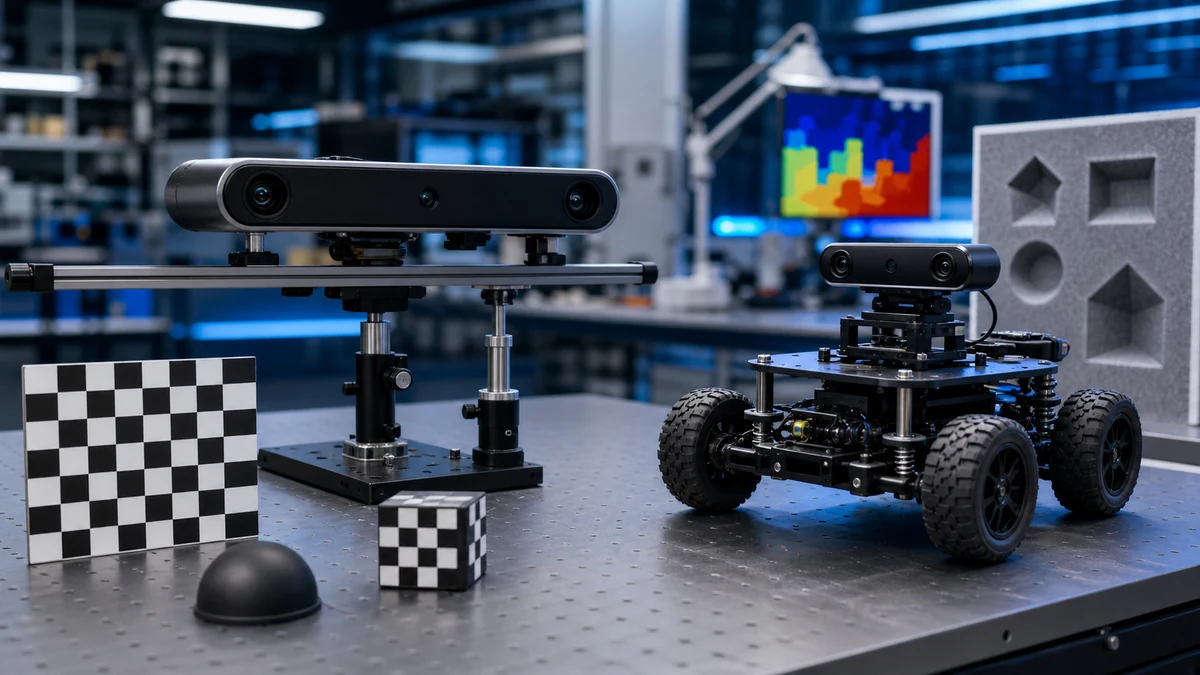
The RealSense D455 is the stronger default for robots that must measure beyond roughly 3 m or attach color reliably to depth while the camera or scene is moving. The D435i is easier to fit into a compact robot, starts its ideal working range closer to the camera and offers higher-resolution RGB. Both use global-shutter stereo depth imagers and both include an IMU; only their separate RGB cameras use different shutter types.
This comparison covers only the base D455 and base D435i; filter-equipped and rugged industrial variants have different specifications. Start with our guides to stereo, ToF and structured-light depth cameras, robot sensor fusion and event versus frame cameras when the decision also depends on environment, timing or a fundamentally different sensor architecture.
D455 favors range and color-depth correspondence; D435i favors proximity and size
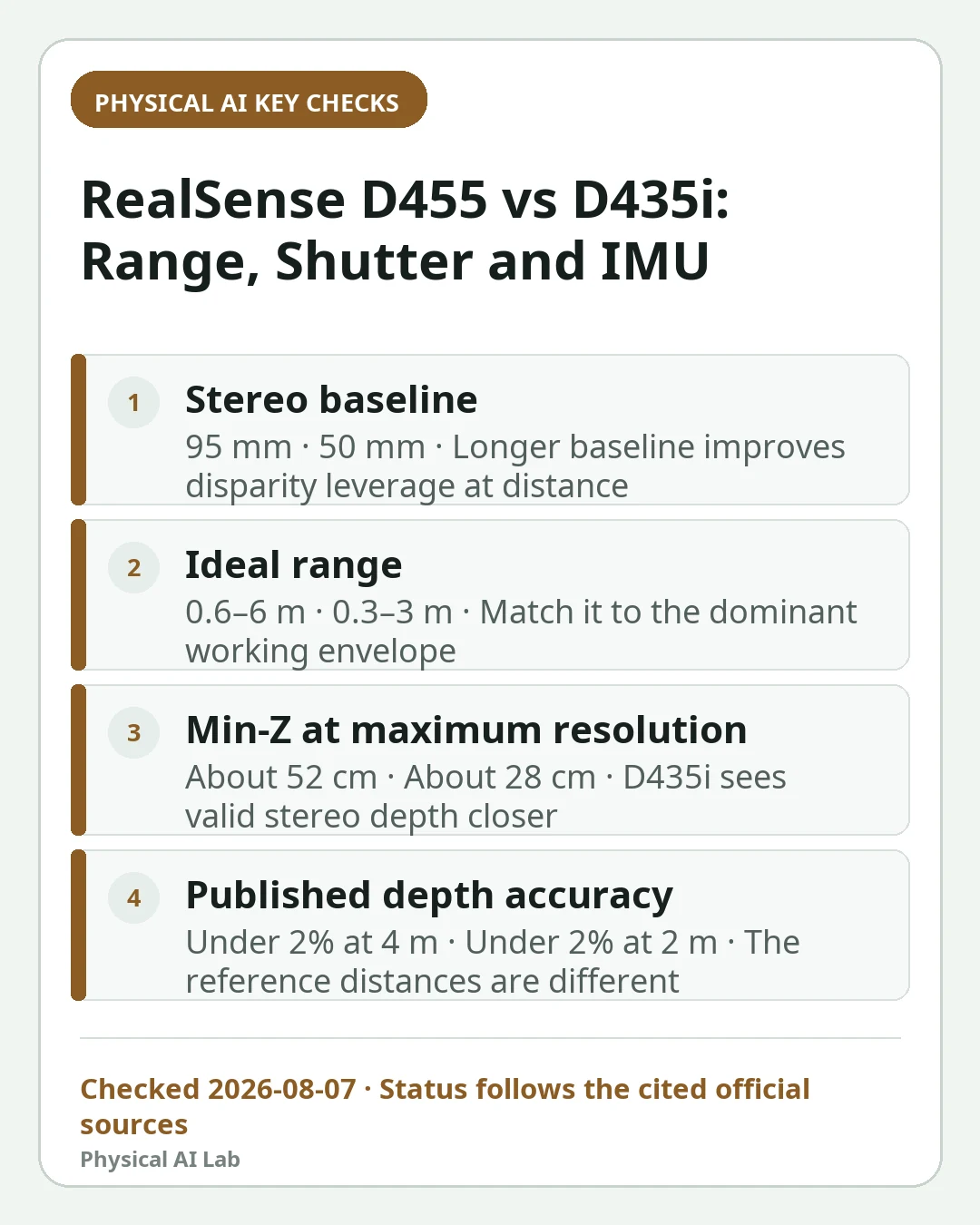
The official D455 product page lists an ideal range of 0.6 to 6 m and a minimum depth distance of about 52 cm at maximum resolution. The D435i page lists 0.3 to 3 m and about 28 cm. An ideal range is a design guide, not a guaranteed hard limit or an accuracy promise under every illumination, texture and exposure setting.
The D455 enclosure measures 124 × 26 × 29 mm, while the D435i is 90 × 25 × 25 mm. That 34 mm length difference can decide whether a camera fits behind a robot's protective window or at a manipulator wrist. Conversely, a warehouse vehicle watching several meters down an aisle can benefit more from the D455's longer stereo geometry than from the D435i's compact body.
| Specification | Base D455 | Base D435i | Why it matters |
|---|---|---|---|
| Stereo baseline | 95 mm | 50 mm | Longer baseline improves disparity leverage at distance |
| Ideal range | 0.6–6 m | 0.3–3 m | Match it to the dominant working envelope |
| Min-Z at maximum resolution | About 52 cm | About 28 cm | D435i sees valid stereo depth closer |
| Published depth accuracy | Under 2% at 4 m | Under 2% at 2 m | The reference distances are different |
| Dimensions | 124 × 26 × 29 mm | 90 × 25 × 25 mm | Mounting volume and occlusion differ |
A 95 mm baseline improves distant disparity but pushes the near boundary outward
The official D400-series datasheet identifies a 95 mm depth baseline for D455 and 50 mm for D435i. Stereo depth estimates distance from the disparity between the left and right infrared images. With other conditions equal, a wider baseline turns a given distant depth change into a more measurable disparity change, which is why D455 targets longer-range work.
The tradeoff appears near the camera. At short distances, an object may not fall inside both imagers' overlapping view or may produce disparity beyond the selected mode's usable search range. If a wrist camera must inspect a connector 35 cm away, validate D435i first. If an AMR must detect pallet edges at 4 m, evaluate D455 across distance, surface texture, sunlight and the actual protective cover rather than extrapolating from one accuracy number.
Both depth pairs use global shutters; the RGB cameras are different
D455 and D435i both use global-shutter left and right imagers for stereo depth, with up to 1280 × 720 depth output and up to 90 fps. The RGB sensor is the point of divergence: D455 has global-shutter RGB, while D435i has rolling-shutter RGB. Calling D435i a rolling-shutter depth camera is therefore incorrect and can send an engineering team toward the wrong mitigation.
On a rapidly rotating robot or a camera looking sideways at a conveyor, the D435i color image can skew because its rows are exposed at different times. A depth map captured by the global-shutter pair may then be geometrically sound while the moving color edge is temporally displaced. That matters when an application paints semantic labels onto the point cloud. Depth-only navigation and static color inspection experience a different risk profile.

D455 aligns the RGB field of view more closely; D435i keeps more color pixels
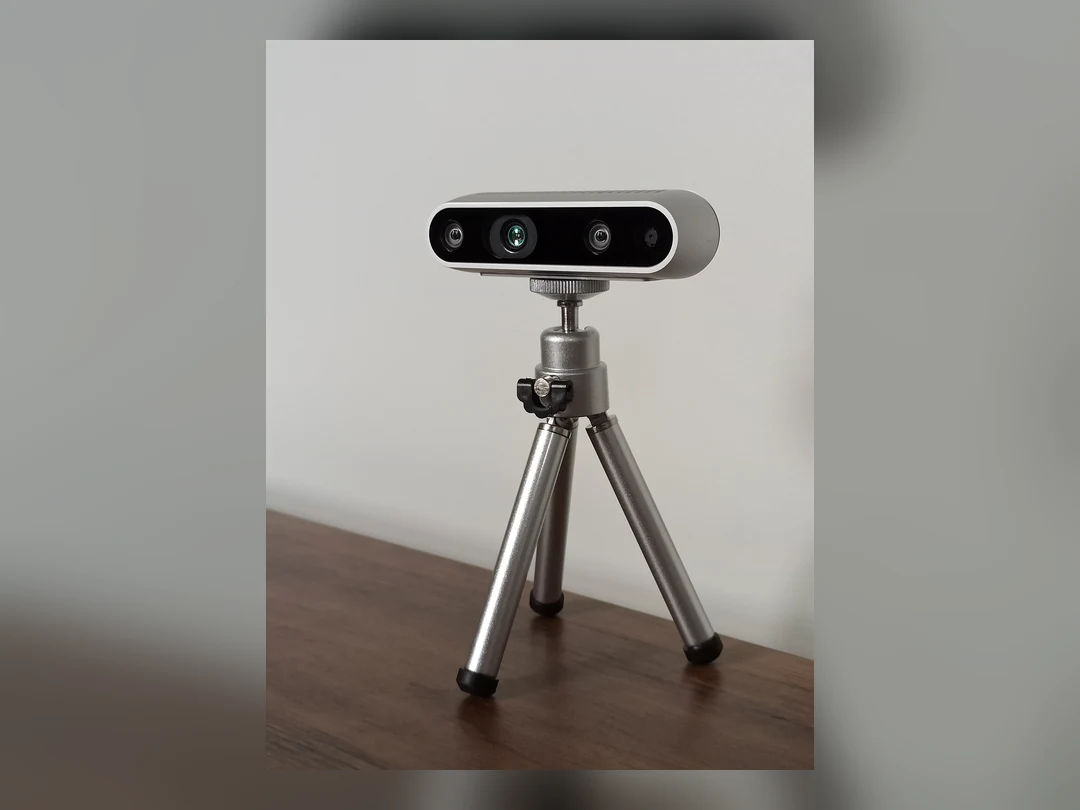
D455 combines an 87° × 58° depth field of view with 90° × 65° RGB and produces 1280 × 800 color at 30 fps. RealSense explicitly describes its global-shutter RGB and matched field of view as a way to improve correspondence between color and depth. D435i has the same 87° × 58° depth field but a narrower 69° × 42° RGB field, outputting 1920 × 1080 at 30 fps.
More RGB pixels do not restore color outside the RGB camera's view. A D435i point cloud can therefore contain depth points at the edge with no corresponding color, even after a correct calibration transform. D455 is attractive for moving colorized scans and semantic perception across most of the depth view. D435i remains attractive when fine color detail in the central view matters and the scene is slow enough for its rolling shutter.
| Design question | Prefer D455 when | Prefer D435i when |
|---|---|---|
| Primary distance | Most targets are 0.6–6 m | Most targets are 0.3–3 m |
| Color motion | Global-shutter RGB is valuable | Scene is slow or rolling shutter is manageable |
| Color detail | 1280 × 800 is sufficient | 1920 × 1080 central RGB detail is needed |
| Color-depth coverage | Matching fields of view reduce uncovered edges | A narrower RGB view is acceptable |
| Mechanical envelope | A 124 mm body fits | A 90 mm body materially eases integration |
Both include the BMI055 IMU, so calibration and timing decide its value
Both base cameras integrate a Bosch BMI055 six-degree-of-freedom IMU. The D435i page notes that SDK 2.0 exposes timestamped IMU data aligned with depth data, and the D455 specification lists the same IMU. A comparison claiming that only D435i contains inertial sensing is outdated or has confused the D455 with another family member.
An integrated IMU does not turn either device into a complete pose sensor. Visual-inertial estimation still depends on camera-to-IMU extrinsics, timestamp behavior, bias estimation, vibration, temperature and the downstream estimator. Mechanical details also differ: D455 provides a 1/4-20 point plus two M4 threads; D435i provides 1/4-20 plus two M3 threads. Reusing a bracket requires more than matching USB-C connectors.
August 7, 2026 price and stock snapshot
On August 7, 2026, the US official store listed the D455 at $419 and the D435i at $334. Both individual pages displayed Backorder and Out of Stock. The store also carried a tariff-surcharge notice, so these figures are not landed prices for every country and should not be reused without a fresh stock, tax and shipping check.
For software, use the current RealSense, Inc. identity and the realsenseai/librealsense repository. Before committing a camera to production, freeze an SDK and firmware combination, test all required simultaneous streams, measure USB bandwidth and dropped frames, validate depth scale and alignment, and repeat tests through the final enclosure. A cheaper camera is not cheaper if the chosen RGB-depth behavior forces a redesign.
Frequently asked questions
Is the D455 always better for a moving robot?
No. D455 is favored when longer range or moving RGB-depth correspondence matters. D435i may be the better integration choice for 0.3–3 m work, a 90 mm enclosure and higher-resolution central RGB.
Does the D435i use a rolling shutter for depth?
No. Its stereo depth imagers use global shutters. The separate D435i RGB camera uses a rolling shutter; D455 uses global shutters for both depth and RGB.
What were the official D455 and D435i prices and stock status?
The US store showed $419 for D455 and $334 for D435i on August 7, 2026, with both pages marked Backorder and Out of Stock. Recheck regional stock, surcharge, tax and shipping before purchase.
Official sources checked
- RealSense: D455 Product Page
- RealSense: D435i Product Page
- RealSense: D400 Series Datasheet
- RealSense SDK: realsenseai/librealsense
- RealSense Store: D455
- RealSense Store: D435i
2026-08-07