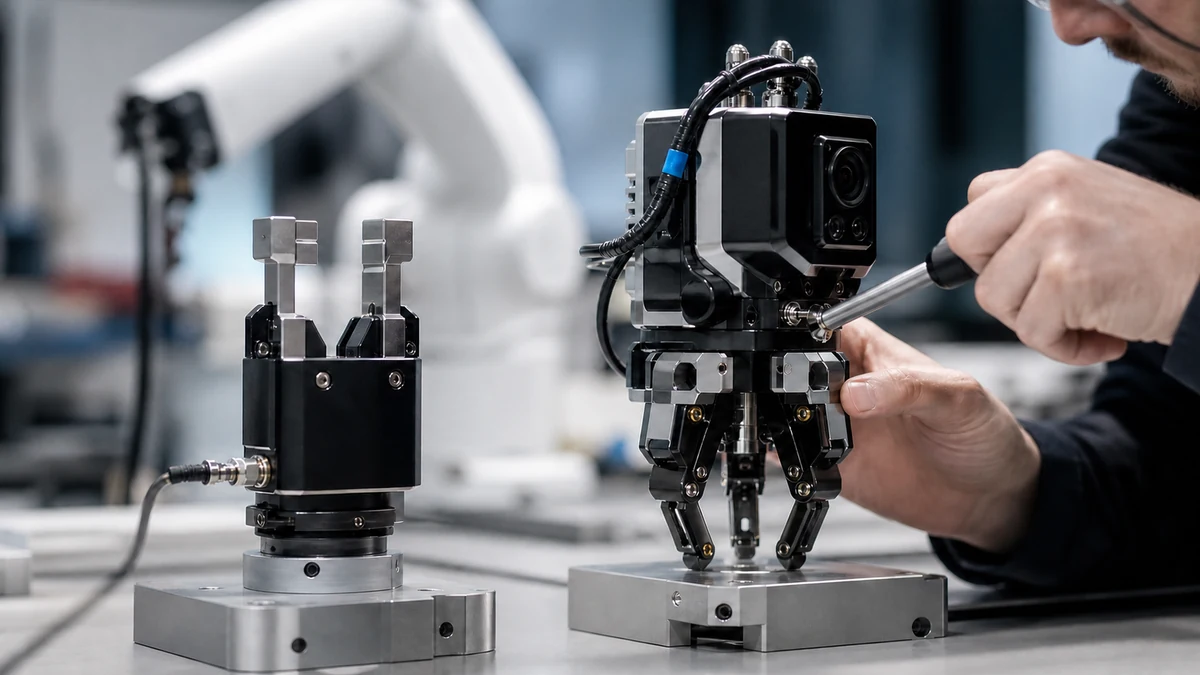
Start with Unitree Dex1-1 Advanced when the task needs a camera at the gripper for close-range alignment or observations after an external camera becomes occluded. Start with Standard when an existing wrist or scene camera is sufficient and the requirement is primarily position, speed, force or grasp control. The official Dex1-1 page labels Advanced as the version with a camera and lists 1080p at 30 or 60 frames per second with 118-degree horizontal, 87-degree vertical and 140-degree diagonal fields of view.
Do not infer a completely different mechanism from the edition names. Unitree publishes shared Dex1-1 parameters including 550-gram mass, 90-millimeter stroke, adjustable 5-to-120-newton gripping force, 0.1-millimeter fingertip position resolution and high-speed 485 communication. Current price, inventory, adapter, wiring and SDK inclusions still require a live official quote or store confirmation.
The documented Standard-versus-Advanced difference is the integrated camera
Unitree lists a Standard Version and an Advanced Version with Camera. An integrated view can support final approach, object pose correction and post-grasp observation where a head or wrist camera is blocked. The public summary does not fully define stream interface, encoding, latency, synchronization, calibration data or how the video is exposed in each supported robot.
Define the evidence need before choosing the edition. If external perception retains a calibrated view through closure, Standard can reduce sensor and data complexity. If the object becomes hidden or the policy needs a finger-level observation, ask for an Advanced sample stream, timestamps, intrinsic and extrinsic calibration, dropped-frame behavior and an SDK example before ordering.
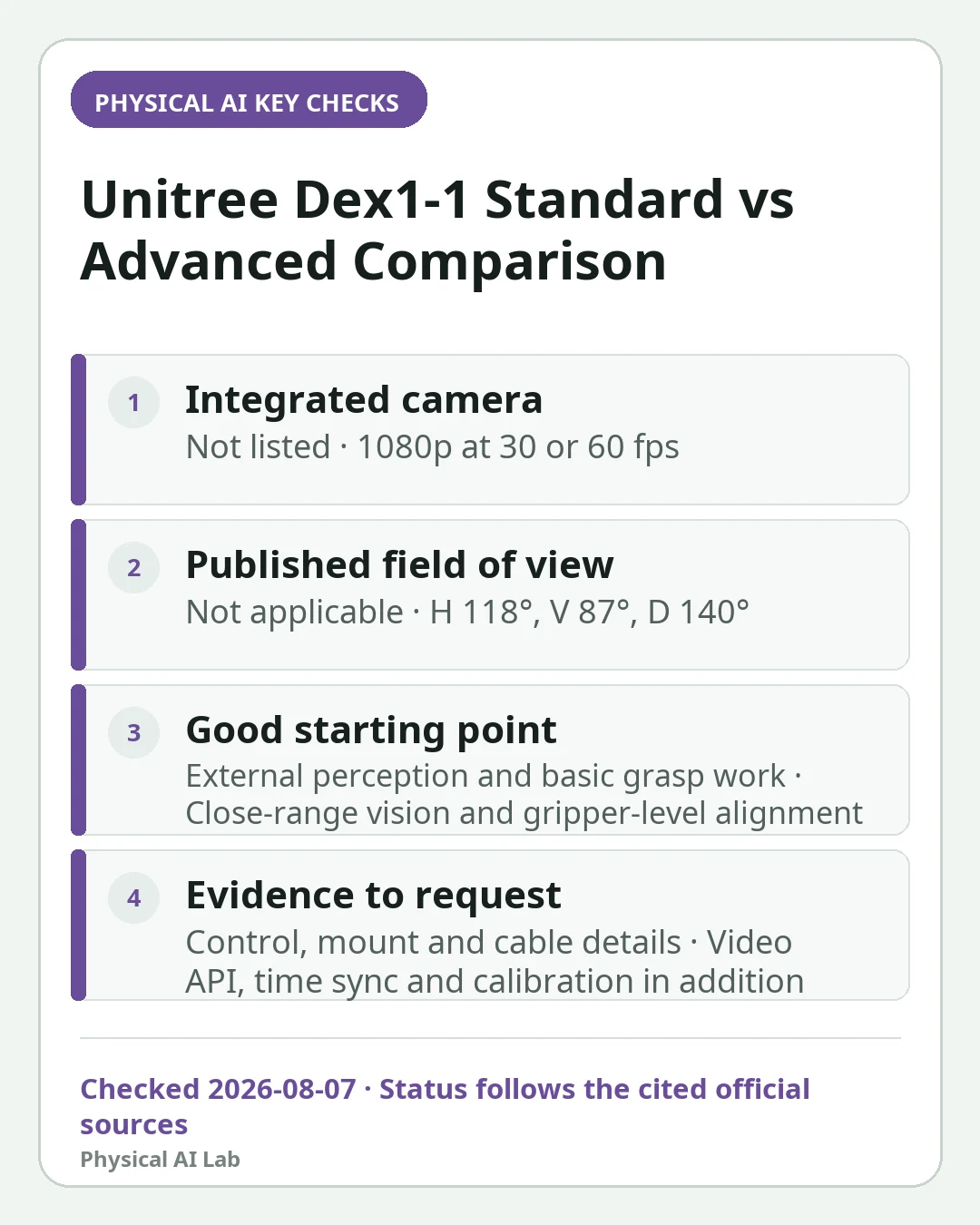
| Decision question | Standard | Advanced |
|---|---|---|
| Integrated camera | Not listed | 1080p at 30 or 60 fps |
| Published field of view | Not applicable | H 118°, V 87°, D 140° |
| Good starting point | External perception and basic grasp work | Close-range vision and gripper-level alignment |
| Evidence to request | Control, mount and cable details | Video API, time sync and calibration in addition |
The shared mechanism combines wide stroke with adjustable force and speed
Unitree lists dimensions of 143 by 78 by 67 millimeters, a 550-gram mass, 90-millimeter stroke and an 80-millimeter jaw length. Adjustable speed is shown as 50 to 375 millimeters per second, full-stroke shortest closing time as 0.24 seconds and fingertip position resolution as 0.1 millimeter.
The manufacturer notes that speed, force and closing time were measured under varying 24-to-60-volt conditions while changing motor stiffness, damping and torque, and that application results may differ. Do not assume all maxima occur together. Measure speed, force, current and temperature with the intended supply, robot trajectory and duty cycle.
| Shared parameter | Official figure | Deployment check |
|---|---|---|
| Mass | 550 g | Include adapter and cable in wrist load |
| Stroke | 90 mm | Check approach, object range and finger interference |
| Gripping force | Adjustable 5-120 N | Validate voltage, control settings and heat |
| Speed | Adjustable 50-375 mm/s | Validate impact, slip and cycle time |
A 20-kilogram form-fitting load is not the same as a 5-kilogram friction grasp
Unitree defines the 20-kilogram form-fitting figure as a maximum horizontal load held without losing the grip when geometry constrains the object. It separately defines the 5-kilogram friction figure as a vertical load held without slipping using a square steel block. These test directions and physical mechanisms are not interchangeable payload ratings.
Real capability depends on friction, contact area, center of mass, acceleration, jaw pads, contamination and safety factor. Build an object set that varies width, surface, mass distribution and grasp direction. Count slips, drops and recoveries under the full robot trajectory rather than repeating an ideal static hold.

High-speed 485 still requires a complete electrical and command contract
The official motor table lists high-speed 485 communication at 6 Mbps, a 1,000 Hz control frequency, a 24-to-64-volt operating range and 24 or 48 VDC recommendation. Feedback includes angle, angular velocity, torque and temperature; command fields include angle, angular velocity, torque, stiffness and damping.
The label 485 does not specify connector pinout, termination, framing, units, timeout behavior or clock relationship. Request the protocol and SDK version, firmware compatibility, command limits, watchdog, emergency-stop behavior, error codes, boot recovery and a reference cable. Verify command freshness and safe torque removal during a disconnected bus.
G1, H2 and R1 compatibility does not define the delivered integration kit
Unitree lists standalone use and compatibility with its G1, H2 and R1 humanoids. Compatibility should not be expanded into a claim that every robot generation includes the correct mechanical adapter, power harness, left and right pair, communication bridge and software package. The exact wrist and arm configuration matters.
Cross-check the target official R1 page and official H2 page, then put robot revision, handedness, bolt pattern, voltage, cable sweep, collision geometry and software version in the quote. After installation, re-evaluate arm inertia, available payload, self-collision and stopping motion with the gripper and object attached.
| Integration layer | Evidence required |
|---|---|
| Mechanical | Adapter, bolts, handedness and collision model |
| Electrical | Voltage, peak current, connector and moving cable |
| Communication | Protocol, firmware, SDK, timeouts and watchdog |
| Host robot | Exact G1, H2 or R1 revision and arm limits |
Accept the gripper on representative objects and failure recovery
Use the robot gripper selection guide for the broader end-effector choice, the tactile-sensor guide for contact feedback and the Unitree humanoid comparison for host-robot scope. This comparison stays focused on the Dex1-1 editions, shared specifications and integration questions.
An acceptance set should include the smallest, largest and heaviest target objects, low- and high-friction surfaces, offset centers of mass and camera occlusion. Measure grasp success, slip and drop rate, cycle time, temperature, communication loss, restart and safe recovery after delayed camera frames. A maximum data-sheet number is useful only after the complete robot repeats the intended task.
Frequently asked questions
What is the clearest difference between Dex1-1 Standard and Advanced?
The official page clearly identifies Advanced as the version with an integrated 1080p camera. Confirm any other package, cable, adapter or SDK differences in the current quote.
Can Dex1-1 lift 20 kilograms?
The 20-kilogram figure is a horizontal form-fitting grasp under a defined holding condition. Unitree separately lists 5 kilograms for a vertical friction grasp, so test the intended object, direction and motion.
Does Dex1-1 attach directly to G1, H2 and R1?
Those robots are on the official compatibility list, but that does not prove every revision includes adapters, wiring, a left-right pair and software. Match the exact host version and integration kit.
Official sources checked
- Unitree Dex1-1 official product page
- Unitree R1 official product page
- Unitree H2 official product page
2026-08-07