Robot grippers create contact between a robot and the task. Parallel-jaw, vacuum, soft and dexterous grippers use different contact physics, but their suitability depends on the object set, process variation, required cycle time, damage risk, sensing and recovery behavior.
Catalog payload or closing force is not enough. Finger geometry, friction, cup seal, object acceleration, center-of-mass offset, collision clearance and tool mass determine the real margin. A simple gripper matched to a stable process can outperform a more capable hand that is difficult to control and maintain.
Use this guide with the tactile sensor guide and bin-picking guide. Test the complete robot, tool, object and trajectory; gripping calculations do not replace application-specific risk assessment or retention measures.
Start with the object population and process variation
List every object family, size, mass, stiffness, surface, porosity, temperature, contamination and allowable contact area. Include tolerances, presentation uncertainty and damaged packaging. The gripper must handle the distribution, not one clean nominal sample.
Define pickup and placement orientation, available approach, acceleration, cycle time and changeover. A gripper that holds statically may fail during rapid wrist rotation. Determine whether dropped parts can create a hazard or only a recoverable process fault.
Parallel-jaw grippers provide simple constrained contact
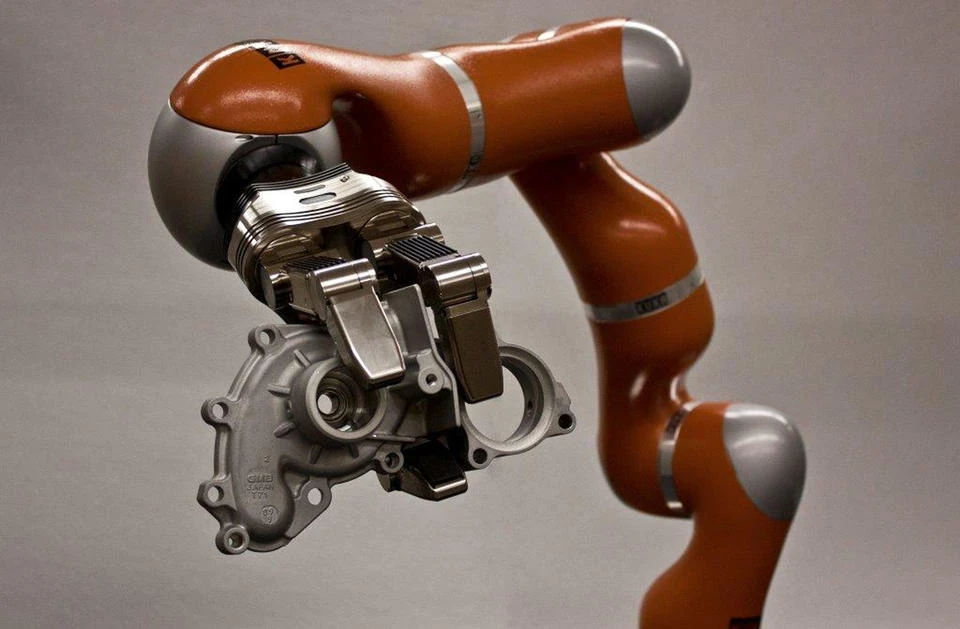
A linear parallel-jaw gripper moves two fingers along one axis and can grasp an object from the outside or expand inside a feature. It offers compact mechanics, clear position sensing and easily customized fingertips for repeated industrial tasks.
Its success depends heavily on finger shape, friction and alignment. Long fingers amplify bending and moment at the jaw guide. Calculate forces at the actual contact and include acceleration, uncertainty and wear rather than using rated force at an unspecified reference point.
For a linkage-driven jaw, pad parallelism is not the same as straight-line travel. The parallel-gripper pad-angle and closing-stroke comparison checks opposing face angles and edge gaps at sampled jaw positions, including what one fixed mounting correction can and cannot align. It is an authored ideal-geometry comparison, not a contact or gripping-force test.
| Gripper type | Contact principle | Primary strength | Common limitation |
|---|---|---|---|
| Parallel jaw | Friction or form closure | Simple and fast | Limited shape range |
| Angular jaw | Pivoting fingers | Wide opening in compact body | Changing contact direction |
| Vacuum | Pressure difference over sealed area | Fast planar handling | Porosity and seal loss |
| Soft gripper | Conformal deformation | Gentle irregular contact | Repeatability and durability |
| Dexterous hand | Multiple fingers and contacts | In-hand manipulation | Control, cost and complexity |
Vacuum grippers depend on seal and pressure difference
A suction cup produces holding force from pressure difference over effective sealed area. The useful force is lower after leakage, cup deformation, acceleration, peel moment and safety margin. Porous cardboard, textured surfaces and seams can prevent a stable vacuum.
Monitor vacuum level and evacuation time close to the cup or manifold. Segment circuits when one failed cup could vent the rest. Test filters, hose length, contamination and energy use. Stored vacuum or mechanical retention may be required during power loss.
Soft grippers trade exact geometry for conformal contact
Soft pneumatic or elastomeric fingers wrap around irregular or delicate objects and spread contact pressure. They can tolerate pose error that would defeat rigid fingers. The same compliance can reduce placement precision and make force prediction difficult.
Characterize material aging, puncture, temperature, pressure control and cleaning. Define what happens when a finger tears or a pneumatic line fails. A soft material is not automatically safe at high robot speed or around pinch points.
Dexterous hands add contact options and control burden
Multi-finger hands can form power and precision grasps and may reorient an object in hand. Additional joints and tactile surfaces expand capability, but also increase calibration, planning, sensing, collision and maintenance requirements.
Use dexterity only when the task benefits from it. Compare a hand against simpler alternatives such as a shaped two-jaw tool, fixture, regrasp station or automatic tool changer. Capability that is not used still consumes payload, space and reliability budget.
Gripping force at the object differs from actuator rating
Jaw-force ratings depend on supply pressure, stroke, finger length and mechanism geometry. At the object, friction and contact normal force must resist gravity, acceleration and moments from center-of-mass offset. Form closure can reduce reliance on uncertain friction.
Use the worst expected friction and loading direction. Check finger and object stress as well as retention. Excessive force can crush products or deform thin packaging, while insufficient force can allow micro-slip that becomes a drop.
| Benchmark | Metric | Test variation | Failure evidence |
|---|---|---|---|
| Grasp strength | Retained load or wrench | Direction and finger setup | Slip or release |
| Finger strength | Individual contact force | Stroke and lever arm | Deflection or limit |
| Cycle time | Close, verify and release time | Object and supply state | Throughput loss |
| Repeatability | Finger or grasp variation | Cycles and temperature | Position spread |
| Task success | Completed pick-place rate | Object set and pose | Drop, damage or timeout |
Finger and cup design often dominate performance
Custom fingers can locate features, support the center of mass and avoid sensitive surfaces. Their mass and length reduce payload and stiffness. Rounded edges, compliant pads and replaceable wear surfaces can improve robustness without changing the gripper body.
Vacuum cup diameter, lip material, bellows and mounting compliance affect sealing and peel resistance. Check collision envelopes, part release and cleaning. Version tooling geometry with the robot program because a small finger change can invalidate poses and force assumptions.
Sensors must distinguish command from successful grasp
A closed command proves only that the actuator was asked to close. Finger position can indicate object width, current can suggest contact, vacuum pressure can show seal quality, and tactile sensing can reveal local load or slip. Combine signals around the actual failure modes.
Set acceptance windows and timeouts. Detect no part, double pick, partial insertion, blocked jaw, weak vacuum and object loss. Define recovery that places the system in a known state instead of repeatedly applying more force.
Benchmark with representative objects and trajectories
NIST’s end-effector benchmarking protocols identify measurable characteristics including grasp strength, cycle time, finger strength and finger repeatability. These component metrics support comparison but should be connected to task success.
Build a test set across object variants, orientations, surface states and acceleration profiles. Record success, damage, cycle time, energy, maintenance and recovery. Separate detection failures from mechanical retention failures so improvements address the correct layer.
Choose lifecycle value and recoverable failure behavior
Compare purchase and integration cost with changeover time, compressed-air or vacuum energy, wear parts, cleaning, calibration and downtime. A gripper covering many objects may be valuable, but a tool changer with optimized tools may deliver better throughput and serviceability.
Select the simplest architecture that meets the validated object and process envelope with margin. Document known exclusions and a safe response to loss of grip. Re-test after finger, cup, firmware, supply or trajectory changes.
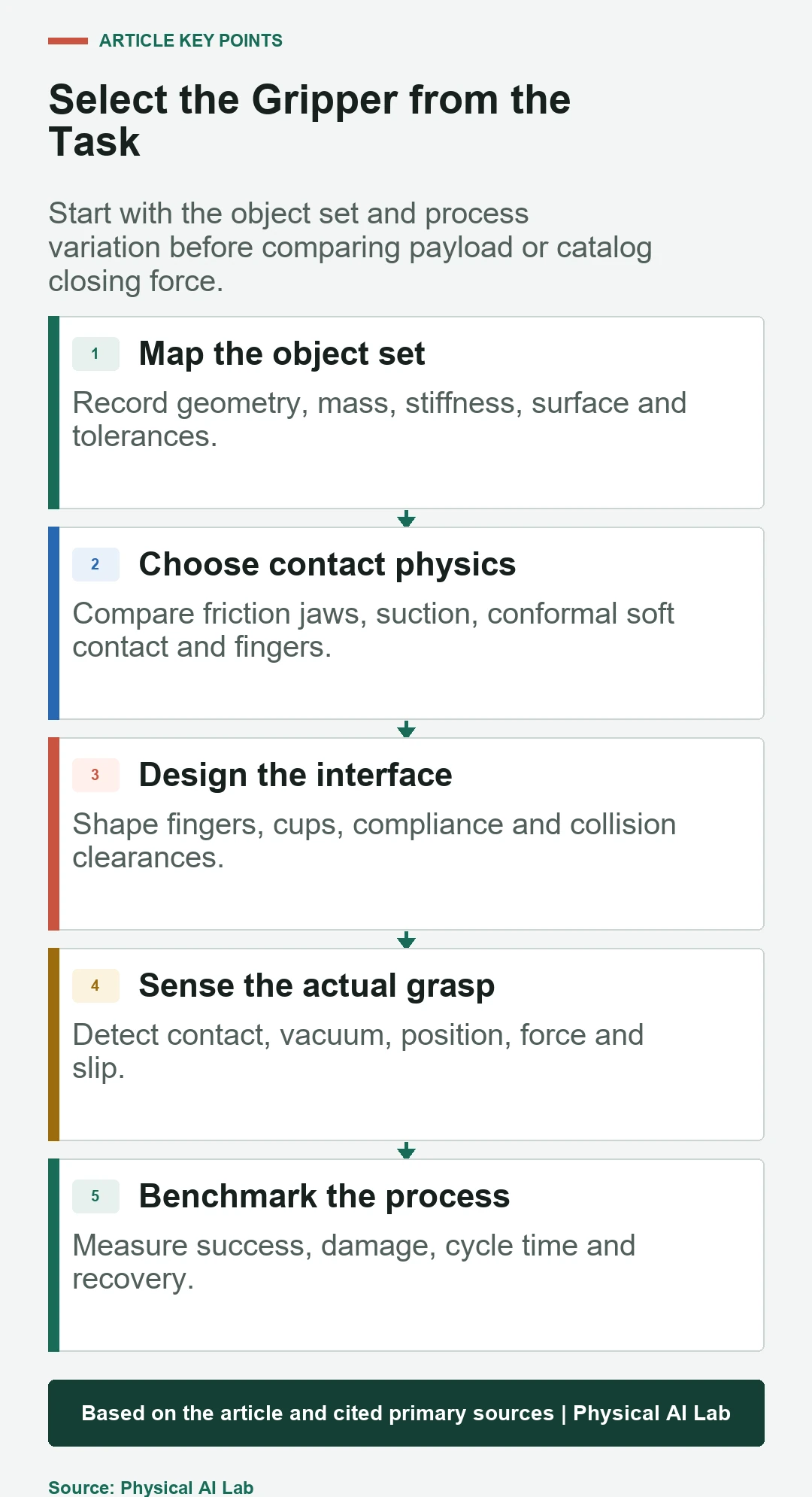
- Map object and process variation first.
- Choose contact physics before catalog payload.
- Design fingers or cups for the real load path.
- Sense actual grasp state and common failures.
- Benchmark task success, damage, cycle and recovery.
Frequently asked questions
Can vacuum grippers handle heavy objects?
Yes when effective sealed area, pressure difference, acceleration, moments, leakage and safety margin support the load; test the exact surface and orientation.
Is higher jaw force always better?
No. It can damage the object, deflect fingers and overload the tool while failing to solve poor contact geometry.
Will a soft gripper handle every irregular object?
No. Material, size range, surface, required precision, pressure and durability still limit performance.
Will dexterous hands replace parallel grippers?
Not for every task. Parallel grippers remain attractive where objects and motions are constrained and throughput and reliability dominate.
How should gripper success be measured?
Use representative objects and trajectories, then measure completed-task rate, drops, damage, double picks, cycle time and recovery.
End-Effector Selection Note
Gripper capacity depends on the complete contact geometry, object condition, acceleration, tool structure, sensing and failure response. Validate the installed end effector across the real object population and retain appropriate protection against dropped or damaged loads.