The announced multi-robot venue plan raised practical questions about networking, charging and fleet operations. Those questions transfer to mixed-vendor sites, but the plan does not show how many teams attended or that post-event interoperability was achieved.
What a multi-team event reveals about fleet operations
The pre-event official operations update anticipated many teams, events and robots. That does not mean every machine is connected through one fleet standard, so vendor-specific protocols and venue-level operations need to be distinguished.
We separate confirmed information from analysis. Event and company claims remain within the date and scope of the original source; undisclosed prices, lead times and success rates stay unverified.
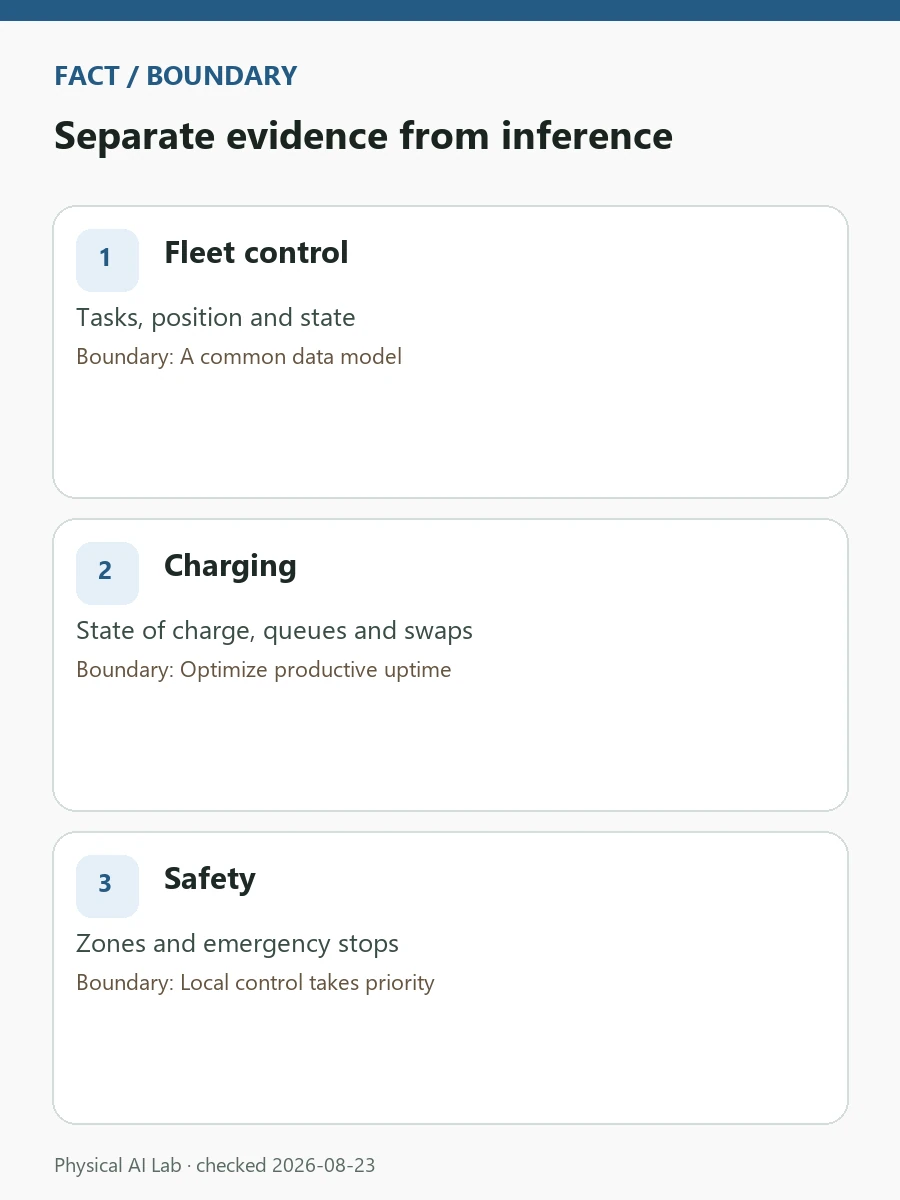
| Fleet layer | Information to manage | Design requirement |
|---|---|---|
| Fleet control | Tasks, position and state | A common data model |
| Charging | State of charge, queues and swaps | Optimize productive uptime |
| Safety | Zones and emergency stops | Local control takes priority |
A fleet manager needs software and fault state, not just location
The control system should collect software version, sensor faults, emergency-stop state and task logs alongside position and battery. When a connection is delayed or lost, the robot's local safety rules must take precedence.
The physical AI loop inside each robot still needs synchronized sensors, state estimation, planning, low-level control, safety limits and recovery for repeatable work.
Measure the worst network interval and the reconnection path
Do not evaluate fleet reliability from a successful command alone. Record the worst latency interval, time to reconnect and every command, model and error involved in recovery.
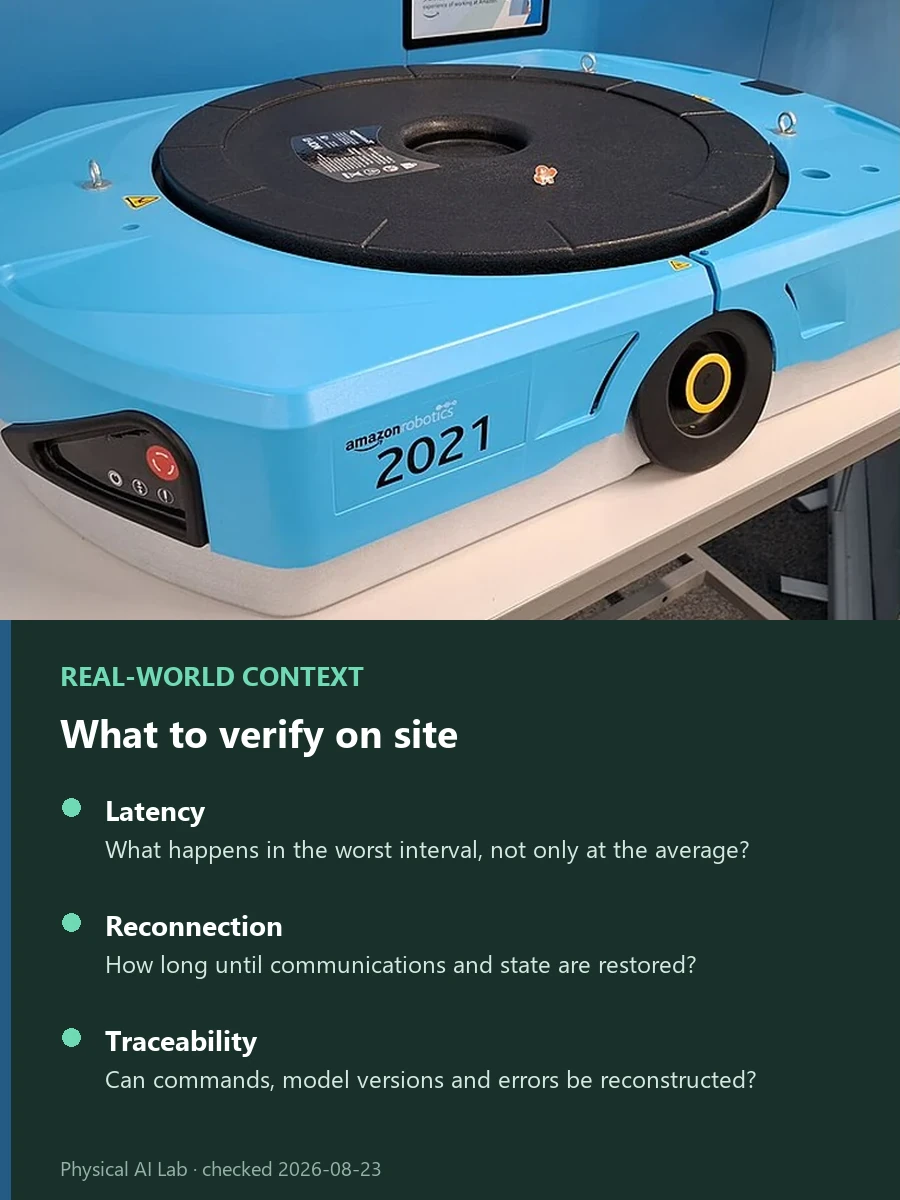
| Check | Question to ask |
|---|---|
| Latency | What happens in the worst interval, not only at the average? |
| Reconnection | How long until communications and state are restored? |
| Traceability | Can commands, model versions and errors be reconstructed? |

The network label does not answer the reliability question
A label such as 5G or Wi-Fi is not enough. Latency distribution, coverage gaps, reconnection time, security authentication and behavior during a network outage are more informative.
The cited sources describe the announced event operations, not a universal fleet standard. Customer deployments, independent tests and formal standards should update the assessment when available.
Standards and localization behind multi-robot sites
Our warehouse picking robot guide defines useful work, Open-RMF multi-robot integration addresses fleet coordination and VIO versus SLAM covers shared localization. Together they frame the fleet evidence reported in August 2026.
Fleet readiness begins where the individual demo ends
The announced plan for many teams and robots to share a venue made networking, charging and fleet control relevant alongside individual performance. A deployable site needs repeatable operations and disclosed failure behavior across the whole fleet.
Frequently asked questions
Does a fleet dashboard make mixed-vendor humanoids interoperable?
Not by itself. The site still needs common task, state and safety semantics, plus adapters for vendor-specific commands, charging and error handling.
Which humanoid fleet event should the log capture first?
Capture the original command, robot and model version, sensor and network state, safety transition, human intervention and recovery result on one synchronized timeline.
What should a humanoid do when fleet control disappears?
Its local controller should enter a predefined safe state, preserve the task and fault context, and reconnect without accepting stale commands. The safe behavior must not depend on the network returning quickly.
Official sources checked
- Beijing municipal government's official guide to the 2nd World Humanoid Robot Games
- Beijing municipal government's official WRC 2026 event guide
- Beijing municipal government's World Humanoid Robot Games operations update
Last checked: August 23, 2026