The LG–NVIDIA robotics partnership is not an announcement of a jointly launched humanoid. Under the strategic MOU signed on August 13, 2026, LG plans to connect robot data from homes, factories and logistics sites with NVIDIA Omniverse, Cosmos and Isaac in a repeatable training-and-deployment system. Full operation of the Yangjae Data Factory and 100,000 hours of data are both end-of-2026 targets, not completed milestones.
What is confirmed today: an MOU and a Data Factory under construction
According to LG's official announcement, LG Group and NVIDIA signed the MOU on August 13 in the United States. The companies met again four days later at LG's Yangjae R&D campus in Seoul to review the robotics program and Data Factory construction. The release signals an intent to move faster, but it does not disclose supply contracts, exclusivity, or the price and launch date of a joint finished product.
The disclosed facility combines 1 basement level and 3 above-ground floors for a total of 10,000 m². LG says it plans to bring the space fully online by the end of 2026 and place hundreds of robots there. “Under construction,” “year-end target” and “in operation” are different states. Robot counts and utilization should remain targets until a later official update documents them.
| Category | Confirmed in the official announcement | Not yet confirmed |
|---|---|---|
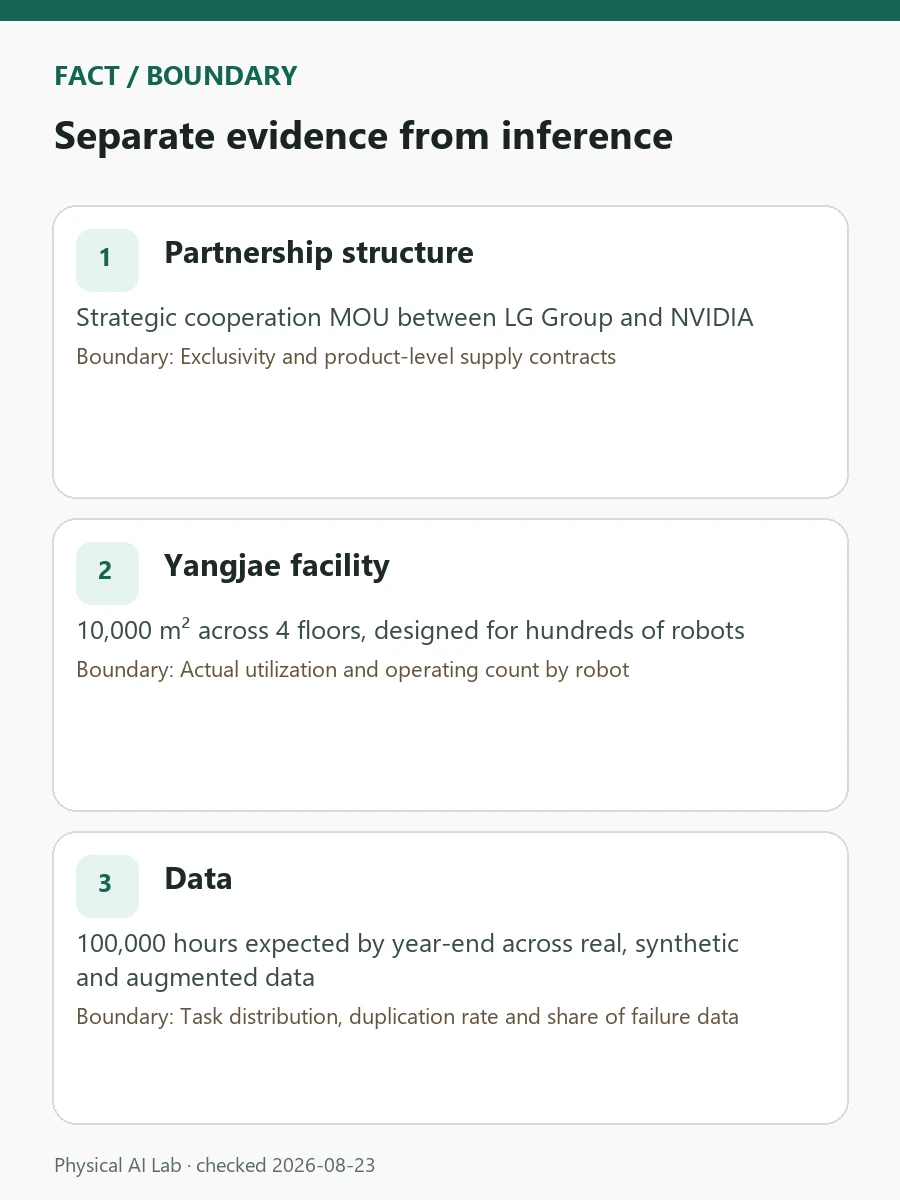
| Partnership structure | Strategic cooperation MOU between LG Group and NVIDIA | Exclusivity and product-level supply contracts |
| Yangjae facility | 10,000 m² across 4 floors, designed for hundreds of robots | Actual utilization and operating count by robot |
| Data | 100,000 hours expected by year-end across real, synthetic and augmented data | Task distribution, duplication rate and share of failure data |
| Productization | Connecting LG RFM development with the NVIDIA robotics stack | Target robots, model versions and customer deployment schedule |
A useful Data Factory needs failure scenes, not only successful runs
The Yangjae site will include replicas of homes and manufacturing environments. LG CLOiD robots are expected to repeat cleaning tasks in the home setting, while a space modeled on LG's Tennessee washing-machine plant will support moving, stacking and assembling parts. Data from LG CNS logistics automation and LG Innotek robot-hand training is also expected to feed the system.
The value is not simply the number of recorded hours. Scenes outside the nominal workflow—misaligned parts, crushed boxes, a person entering the aisle or a lost grasp—carry more information. One 1-hour session of uninterrupted success and one 1-hour session densely labeled with failures, interventions and recovery do not teach a model the same thing.
Data quality should be separated by task, environment, robot form factor, success or failure, human intervention and missing sensor data. Buyers also need to know whether time from multiple cameras was simply added together and how synthetic data is mixed with real data. A total of 100,000 hours cannot by itself guarantee robot generalization.
Omniverse, Cosmos and Isaac cover different parts of the pipeline
LG names the NVIDIA Omniverse libraries, Cosmos open world models and Isaac open robotics development platform. Treating all three as one AI model obscures their roles.
- Omniverse provides a foundation for building and simulating digital versions of factories, homes and logistics spaces.
- Cosmos sits at the world-model layer used to synthesize or augment conditions that are hard to collect frequently in the real world.
- Isaac connects development tools for robot training, validation and deployment.
The official NVIDIA robotics platform likewise describes training, physics-based simulation and edge inference as a “three-computer” architecture. Using a named tool, however, does not prove that a particular robot passed a target task. Policy version, sensor configuration, test repetitions and teleoperation must accompany any performance claim.

LG RFM is where data is supposed to become robot behavior
LG plans to use Data Factory output to improve its Robot Foundation Model, or RFM. The company presents RFM as a foundation for humanoid performance, but the public announcement does not specify input formats, supported robots, model size, deployment method or external-developer access.
NVIDIA GR00T should not be inserted into the story by assumption. LG's announcement explicitly names Omniverse, Cosmos and Isaac. Until another source says otherwise, the defensible description is that LG plans to connect its RFM with the NVIDIA robotics stack.
The real connection will appear in the deployment process rather than the model name. Teams should ask who approves a new policy for CLOiD or an industrial robot, how quickly a site can roll back after abnormal behavior, and whether the safety controller remains independent of the learned model. Without those controls, a data flywheel is a training pipeline—not an operating system.
The 100,000-hour target needs a clearly defined denominator
LG expects to combine directly collected data with Cosmos-generated synthetic and augmented data for 100,000 hours—roughly 12 years—by the end of 2026. This is a production target, not an independent validation of data usefulness or product performance.
If the simulated washing-machine plant is training a robot to load parts, total time becomes comparable only when the following conditions are disclosed.
| Validation area | Records to request | Failure condition |
|---|---|---|
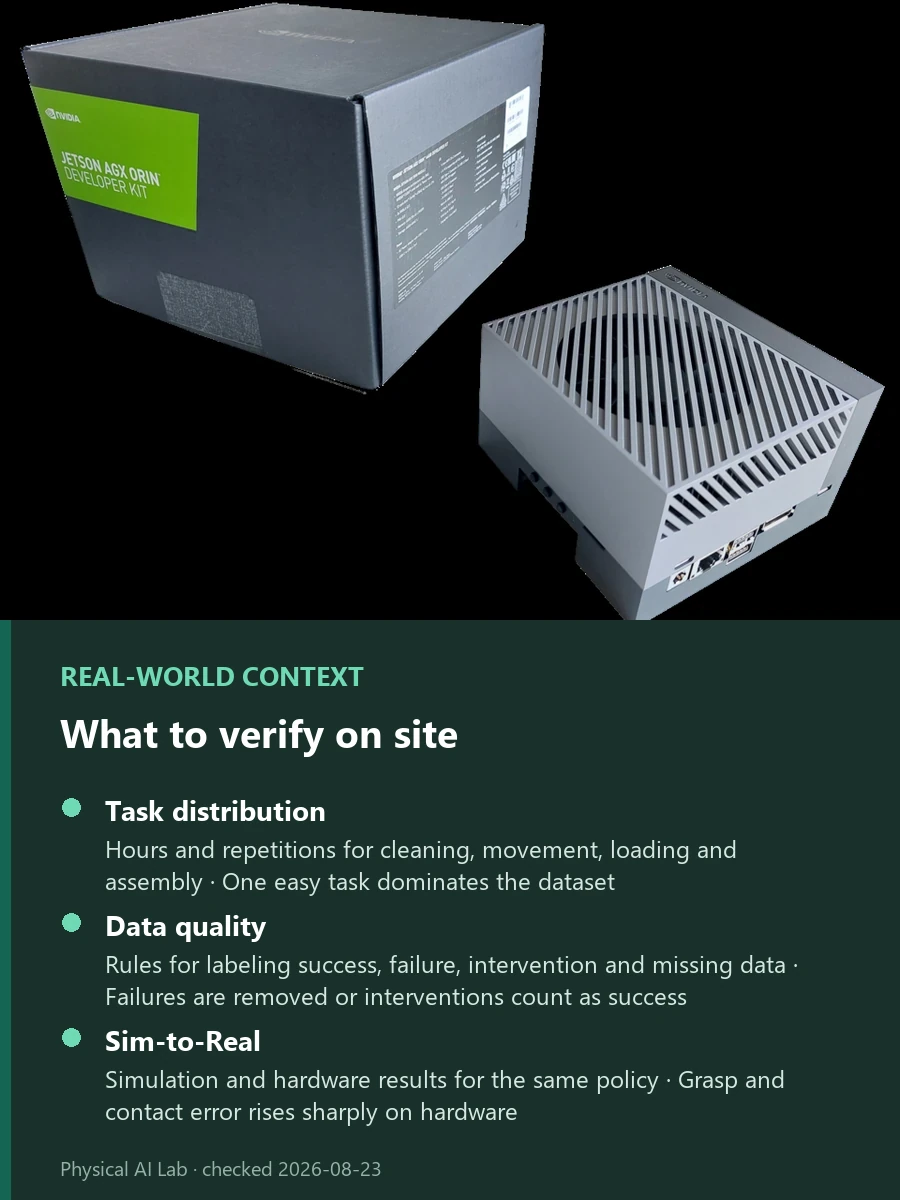
| Task distribution | Hours and repetitions for cleaning, movement, loading and assembly | One easy task dominates the dataset |
| Data quality | Rules for labeling success, failure, intervention and missing data | Failures are removed or interventions count as success |
| Sim-to-Real | Simulation and hardware results for the same policy | Grasp and contact error rises sharply on hardware |
| Operational deployment | Version, approval, rollback and stop-reason logs | A bad update spreads across the entire fleet |
Rare compound failures need their own tests. Sensor occlusion, network delay, low power and a person's sudden approach may reveal problems hidden by average success rates. That is why procurement teams should request unedited full sessions and recovery time, not only a public demo.
Commercial maturity has to be measured product by product
The official LG Robotics Business Center announcement says the CEO-level organization began on July 1, 2026 and combines business development, sales and operations. The direction—bringing industrial, commercial and home robots, actuators and Data Factory into one business system—is clear. A new organization and an MOU are prerequisites for commercialization, not evidence of revenue or long-duration operation.
The next disclosures should identify paying customers, delivery terms and field support for CLOiD, industrial robots and robot hands. Intervention rate, cycle time, uptime and recovery time should be measured against each site's baseline. Those are the numbers that show whether data production has reduced customer cost or improved productivity.
Four questions buyers should settle before signing
Developers should verify data formats, sensor synchronization, the boundary between RFM and NVIDIA tools, and policy versioning. Operators should test whether one stopped robot blocks the rest of the fleet, whether staff can bypass it safely, and how many minutes rollback takes. Procurement should put data ownership, export rights, support exclusions and recovery responsibility into the contract.
For background, continue with what physical AI means, robot foundation models and the core ideas behind Sim-to-Real. Separating those concepts prevents a large-data announcement from being mistaken for proof that a robot works reliably in the field.
The central idea in the LG–NVIDIA partnership is not one robot but a production system connecting collection, synthesis, training and deployment. The year-end assessment should put the 100,000-hour target beside the number of operating robots, task-level failure distribution, products using RFM and repeat performance at paying sites.
Frequently asked questions
Are LG and NVIDIA launching a joint humanoid now?
No. What is confirmed is a strategic cooperation MOU and a plan to connect data and robotics platforms. No model name, price or launch date for a joint humanoid has been announced.
Does collecting 100,000 hours of robot data guarantee performance?
No. The 100,000-hour figure is a year-end data-volume target. Task diversity, failure share, duplication and results on real hardware still have to be evaluated.
What would show that the LG Data Factory has moved beyond construction?
LG set full operation by the end of 2026 as its target. It was still under construction in the August 2026 announcement, so the operating state and robot count need a later official update.
Official sources checked
- LG's official announcement on robotics cooperation with NVIDIA
- LG's official Robotics Business Center announcement
- Official NVIDIA robotics platform
Last checked: August 23, 2026