SEER Robotics' “1 million robots” is not a current installation count. It is a long-range goal to deploy 1 million embodied-intelligence robots with Ladder Program partners by 2030. The strategy is broader than one giant model: a model layer handles decisions, a cerebellum layer handles motion, a nervous-system layer connects sensors and actuators, and a field-data network feeds failures back into training.
1 million robots is a 2030 target, not today's installed base
SEER Robotics' WRC 2026 announcement says the Ladder Program aims to deploy 1 million embodied-intelligence robots with partners by 2030. It also identifies the first 20 partners. The goal and partner structure are confirmed; neither means that 1 million robots have been ordered or are already working.
The same announcement cites about 3,000 customers, more than 20 industries and adaptation for over 400 core components. Those are company-defined ecosystem figures. One customer may run several robots or only one project, so customer count cannot be converted into robot count or recurring revenue. Because the official SEER website and releases from different dates may use different customer counts, every figure needs its date and definition.
| Number | Meaning in the official material | Incorrect interpretation |
|---|---|---|
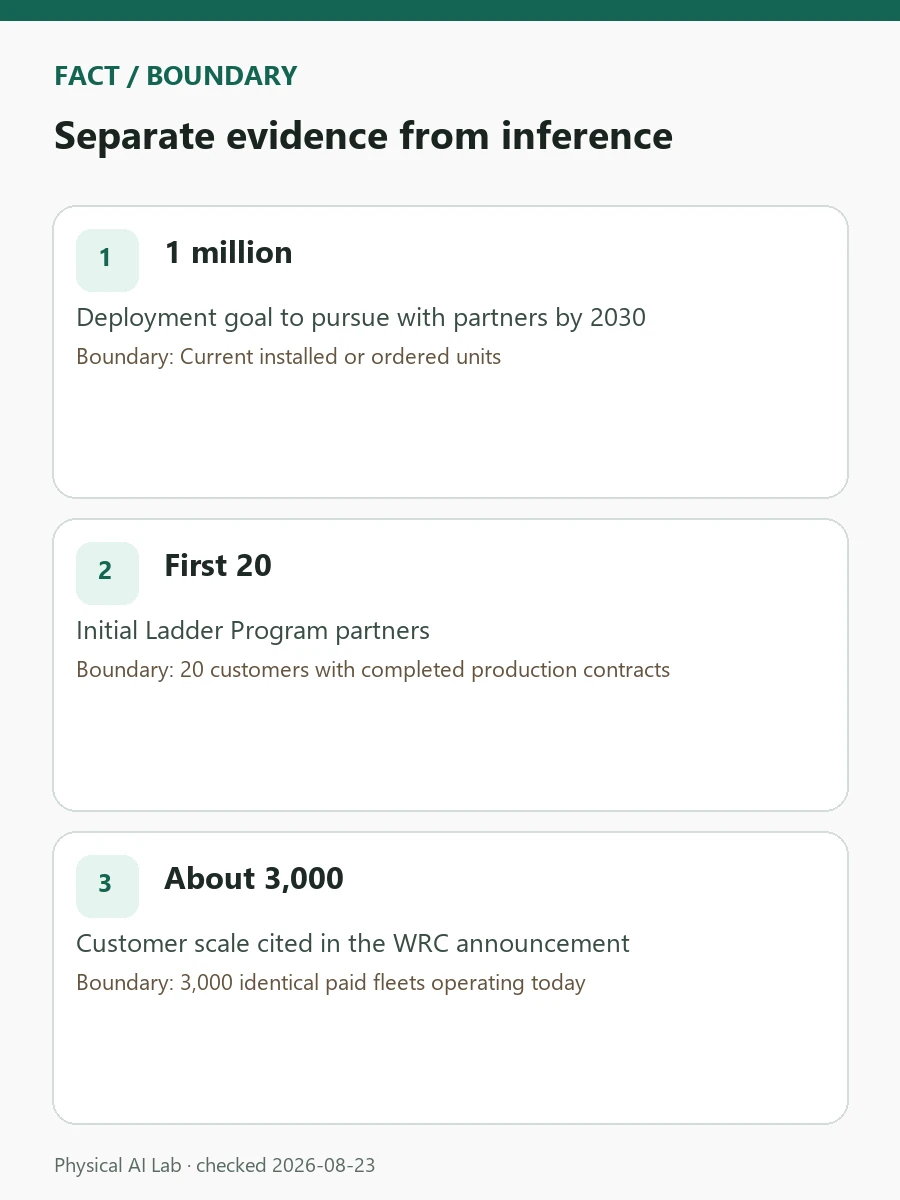
| 1 million | Deployment goal to pursue with partners by 2030 | Current installed or ordered units |
| First 20 | Initial Ladder Program partners | 20 customers with completed production contracts |
| About 3,000 | Customer scale cited in the WRC announcement | 3,000 identical paid fleets operating today |
| More than 20 | Industries the company says it serves | One model has been validated in every industry |
| Over 400 | Core-component adaptation system | Compatibility and safety certification for every version and combination |
A universal robot brain requires model, cerebellum and nervous system
SEER divides the robot brain into three layers. The model layer interprets the environment, plans tasks and makes decisions. The cerebellum turns plans into motion trajectories and stabilizes real-time execution. The nervous system provides interfaces and protocols for sensors, joints and actuators.
The split reflects different time scales. A plan such as “pick up the pallet and move it to the destination” can be formed relatively slowly, while avoiding a person and correcting wheel speed must run much faster. Lower-level control and safety should reject an unstable command even when higher-level inference is late or wrong.
Calling a universal brain “one large AI model” therefore misses the product review. Task understanding, real-time control period, supported hardware, communication latency, safe stops and version compatibility all have to work together for a field task to finish.
The 400-component claim needs a versioned compatibility matrix
Forklifts, AMRs, quadrupeds and humanoids use different sensors and drives. A wheeled robot and a humanoid may receive the same task command, but their speed and balance control have different reuse boundaries. Supporting more than 400 core components could widen the range of bodies a common platform can address.
A component name on a list is not the end of field compatibility. Firmware, drivers, communication period, safety state, calibration and long-term supply must line up. A replacement sensor that adds latency or an actuator whose torque limit is misread can defeat a correct high-level plan.
Buyers should request a matrix of robot model × component × firmware × brain version rather than a yes-or-no compatibility answer. Total cost also includes who revalidates a new release and what replacement is available when a component leaves support.

A field-data subsidiary can turn robot failures into training assets
SEER's proposed data system runs from collection through multi-source integration, governance, training, evaluation and field feedback. Stops and teleoperator takeovers become examples for improving the next model—a closed loop between deployment and development.
Consider a forklift separating black and blue pallets. A color-classification demo is not enough. Teams need to know how bird's-eye-view, or BEV, perception changes when a pallet is skewed or a person enters the aisle; how pre- and post-intervention data are labeled; and whether the new policy damages a task the robot already performed well.
Training again on biased data produced by a bad policy can amplify the error. Field data should not trigger automatic training and fleetwide deployment without quality review, safety evaluation, approval, staged release and rollback gates.
| Data stage | Document the operator should receive | Failure risk |
|---|---|---|
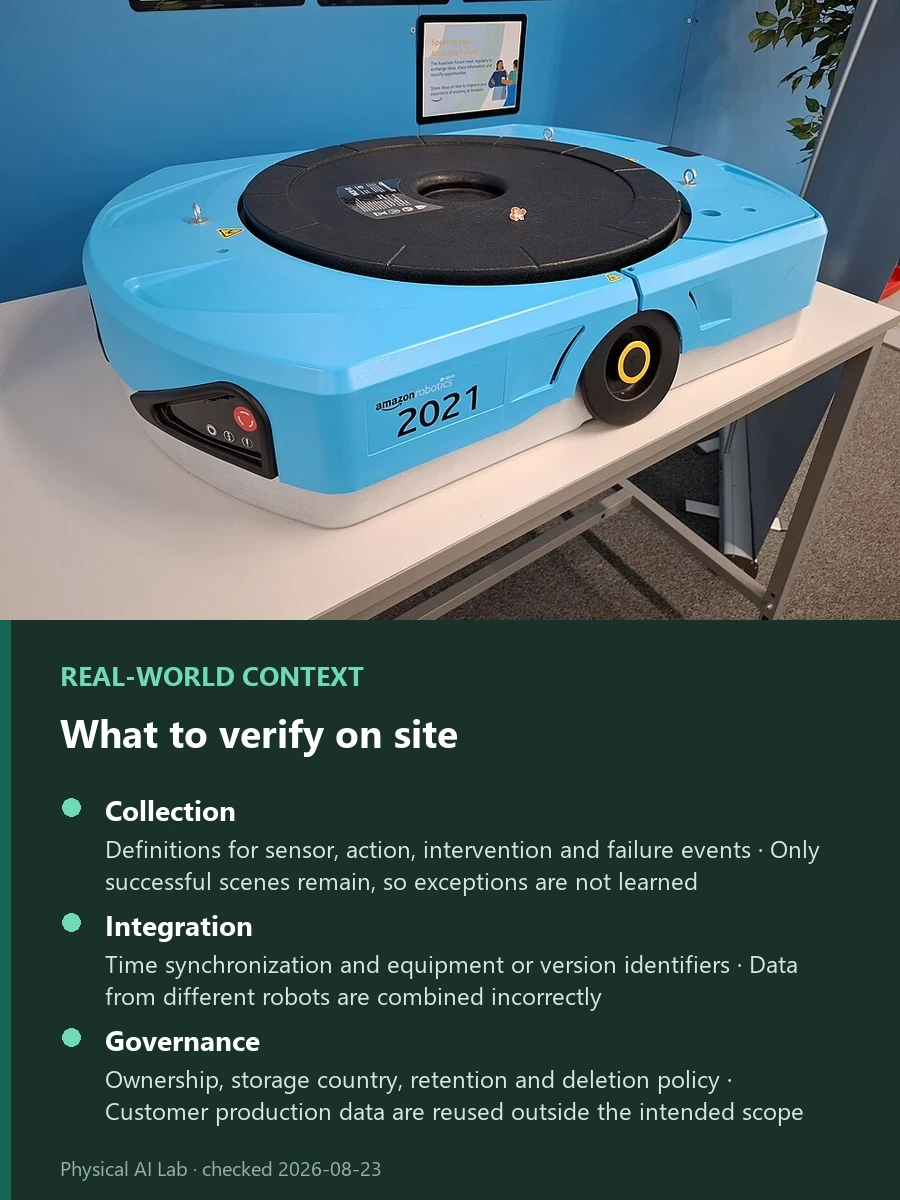
| Collection | Definitions for sensor, action, intervention and failure events | Only successful scenes remain, so exceptions are not learned |
| Integration | Time synchronization and equipment or version identifiers | Data from different robots are combined incorrectly |
| Governance | Ownership, storage country, retention and deletion policy | Customer production data are reused outside the intended scope |
| Training and evaluation | Baseline model, test set and regression evaluation | A new feature reduces performance on existing tasks |
| Deployment and feedback | Approval scope, staged release and rollback record | An error spreads rapidly across the fleet |
Ladder Program value depends on who gets data and improvements back
The initial 20 partners are a starting point connecting robot makers, components and operating sites. More bodies could improve shared representations. But if rights to production data, security, ownership of performance gains and update responsibility remain unresolved, a larger network also creates larger disputes.
A prospective partner should identify the country, legal entity and cloud holding the data. The contract should say whether raw video and equipment information may be used for training, whether a customer can demand deletion, and whether it can decline an update or return to an earlier version. Joining a data network should not require surrendering customer control.
A single security weakness has greater impact in a large fleet. The operating design should block unsigned models, track vulnerabilities and patches by component version, and isolate only the affected robot group after an incident. Those controls determine whether the 1 million robot strategy has an operating foundation.
Coffee and Tower of Hanoi demos should be interrupted on purpose
Multi-step tasks are useful for showing planning. Move an intermediate object while a robot makes coffee or solves the Tower of Hanoi, and a prerecorded motion sequence separates from a system that understands the new state and replans.
A reviewer should omit one step or move the cup rather than watch only the successful video. Record when the robot notices the error, how it returns to an earlier step, human interventions and total completion time. If the same “brain” runs on a humanoid and an AMR, separate genuinely shared modules from body-specific retraining.
That turns “general purpose” into a measurable reuse rate. Even if a common model handles 70% of task planning, integration may remain costly when all low-level control and data are body-specific. The exact percentage belongs in vendor version documentation and repeat testing.
The 3,000-customer claim and open-source plan need separate audits
The company's figures of about 3,000 customers across more than 20 industries show market contact. Active and paying customers, project duration and robots per customer are still needed to assess depth. Track the official SEER news center for changes in those definitions across quarterly and business updates.
SEER also says it plans to release datasets and evaluation criteria in Q4 2026. That remains a future commitment. After release, review the license, composition, removal of personal and customer information, share of failure cases and benchmark reproducibility. Uploading files alone does not validate an open ecosystem.
Use the physical AI company ecosystem, robot simulator comparison and edge AI for robots for context. The goal becomes credible not because it says 1 million, but because safe improvement repeats across different robots and the benefit returns to partners.
Frequently asked questions
Has SEER Robotics already deployed 1 million robots?
No. 1 million robots is a target for the Ladder Program and its partners to pursue by 2030, not the current installed base or confirmed orders.
Is SEER's universal robot brain one giant model?
SEER describes a combination of model, cerebellum and nervous-system layers for task understanding and decisions, motion execution, and sensor or actuator interfaces.
Are SEER's datasets and evaluation criteria already public?
The company announced a Q4 2026 release plan. Scope, license and quality can be assessed only after the materials are actually published.
Official sources checked
- SEER Robotics' official WRC 2026 strategy announcement
- Official SEER Robotics website
- Official SEER Robotics Ladder Program announcement
Last checked: August 23, 2026