Wheeled delivery robots are usually the efficient choice on paved sidewalks and campuses. A quadruped becomes worth testing when stairs, high curbs or thresholds repeatedly force a person to complete the final segment. Legs alone do not finish doorstep delivery, however. Doors, elevators, recipient authentication and remote recovery all belong in the order-completion rate.
Choose the robot body from the route where deliveries actually fail
The last 100m is less a literal distance than the final segment where an existing transport mode stops working. A flat run from a restaurant to a campus dorm entrance prioritizes rolling efficiency; moving from a lobby up stairs to an individual door prioritizes step traversal and building integration.
Robot.com announced R-dog on August 11, 2026, presenting stairs, curbs, thresholds and irregular terrain as last-100m obstacles. The official Robot.com R-dog release is a company-issued announcement. R-dog was described as a concept, with commercial deployment planned for 2027; a plan or demonstration is not evidence of recurring paid operation.
| Route condition | Where wheels tend to win | When to test a quadruped |
|---|---|---|
| Surface | Paved sidewalks, corridors and gentle grades | Stairs, high curbs and irregular floors |
| Payload and range | Heavier loads, longer routes and simple paths | Route continuity matters more than maximum payload |
| Operations | Standardized recovery and maintenance are priorities | The team can support complex joints and foot-contact issues |
| Completion point | A building entrance or pickup zone is sufficient | Reaching an individual floor or door creates the service value |
Wheels use less energy when the route stays smooth
A wheel does not repeatedly lift the body during forward travel. With comparable battery and payload, it is likely to lose less energy and require less control complexity than a quadruped on a flat surface. A large enclosed cargo bay is easier to package, and maintenance can center on tires, motors and bearings.
Starship Technologies' official website says its wheeled robots have completed more than 10 million deliveries and operate with 99% autonomy at Level 4. That company evidence demonstrates a long-running wheeled operation; it is not independent proof of identical performance in every region. Sidewalk width, grade, snow, rain, crossing rules and remote operations all matter.
A wheeled robot's weakness is that one impassable step can break the entire route. A short detour or entrance pickup may make that acceptable. If an employee must walk downstairs for every order, the promised labor savings can disappear in the final few meters.
Weather can reverse the flat-route advantage. Braking distance increases on wet ramps, and snow deeper than a small wheel can turn a familiar route into an obstacle. Test loaded entry, stopping and restart on grades, and include drainage grates, paving gaps and uncleared hours that do not appear as lines on a map.
Quadruped legs matter on steps, but traversal is not delivery
A quadruped can place each foot independently across uneven heights and adjust body posture. The R-dog announcement describes climbing stairs, crossing curbs and thresholds, carrying separate items and supporting unattended drop-off. It also names the REMI fleet platform and FieldAI models as part of the planned production direction.
Mobility and service completion are different. One stair-climbing video does not prove repeatability on wet steps, in a tight glass-door turn, around people or with a low battery. More leg joints can also mean more noise, energy, heat, impacts and maintenance points.
A quadruped pilot should measure foot slip, stair-edge miscontact, cargo motion, turning within stair width and recovery after a fall—not just falls avoided. Foot placement near people and pets is a safety case of its own.
Cargo position changes gait stability. A heavy item shifting to one side, or one compartment emptying before another, moves the center of mass. Do not extrapolate an empty-bin stair result to maximum payload. Liquids, oversized packages and temperature-controlled containers each need restraint, and damage after an emergency stop belongs in service quality.

Compare energy and human intervention per completed order, not top speed
Empty-vehicle top speed does not reveal delivery economics. Carry the same payload from the same origin to the same recipient and include charging loss, waiting, remote assistance and field recovery. If the wheeled unit takes a flat detour and the quadruped takes stairs directly, retain that route difference in the comparison.
Noise matters indoors and at night. A wheel motor's continuous sound differs from joint and foot-contact noise, so measure peak values in corridors, stairs and at the door rather than only at departure. Cargo rattle can also affect beverages or medical samples.
| Measure | Value under matched conditions | Decision question |
|---|---|---|
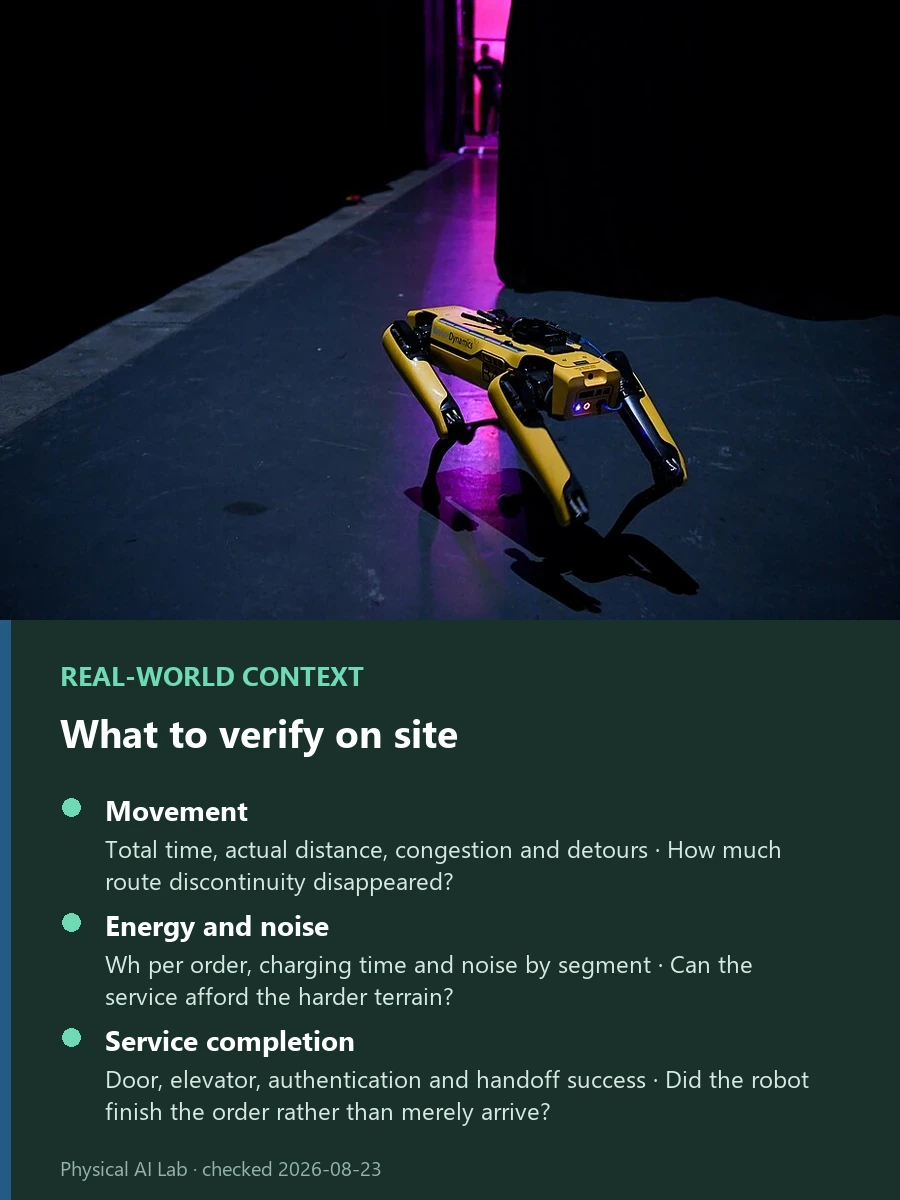
| Movement | Total time, actual distance, congestion and detours | How much route discontinuity disappeared? |
| Energy and noise | Wh per order, charging time and noise by segment | Can the service afford the harder terrain? |
| Service completion | Door, elevator, authentication and handoff success | Did the robot finish the order rather than merely arrive? |
| Operating burden | Remote-intervention time, field recovery and maintenance | Did hidden human work decline? |
Doors and elevators are integration problems that legs do not solve
After reaching a building, the robot needs access permission, a door-opening path and an elevator call. If a secure door requires phone authentication or the elevator has no API, both body types stop. Following a resident through a locked entrance is not an acceptable service design.
Handoff is a separate system too: notify the right person, unlock only the correct compartment, and handle waiting, redelivery or return when nobody arrives. Alcohol or medicine can add identity rules. Cameras may capture residents and home interiors, requiring retention and access policies.
Air delivery sits under a different regulatory structure. The FAA UAS portal links to U.S. drone registration, remote-pilot qualifications, airspace authorization and package-delivery requirements. Do not merge ground robots and flying drones into one approval checklist simply because both are called unmanned delivery.
Ground robots also need local sidewalk rules, property permission and pedestrian-priority policy. A numeric speed cap alone is inadequate. Test wheelchair and stroller clearance, accessibility for people with low vision, and whether a stopped robot blocks an emergency route. Complaints and changed pedestrian paths are failures that may never appear in technical logs.
Remote assistance and physical recovery can dominate cost per order
Remote rerouting when a robot is blocked can be an intentional operating feature rather than a failure. But automation claims cannot be compared without intervention frequency and duration. Record how many robots one person supervises and what authority the operator has when video latency appears at a stair.
Field recovery costs more. A quadruped stopped mid-stair or a wheeled robot dropped below a curb requires a person to retrieve equipment and cargo. One rare recovery can erase profit from many fast deliveries. Include travel, labor, customer compensation and discarded food in per-order cost.
Segment intervention by time and condition. Rain, crowds after class or unstable night sensing may reveal that changing hours or routes is cheaper than changing the robot body.
Customer communication belongs in recovery. An app that keeps saying “arriving soon” during a fault destroys trust even if engineering later restores the robot. Show delay, alternate pickup and refund or redelivery choices immediately, and give customers a contact path so they do not push or lift the machine. Log technical work and customer handling separately.
A mixed fleet can reserve quadrupeds for the hard segment
One body does not have to serve every route. A wheeled robot can cover a long, flat segment, with a quadruped or person taking over inside a building with stairs. The transfer creates new requirements for lockers, custody confirmation, delay and theft responsibility.
The benefit is avoiding quadruped cost across the full route while reducing discontinuity. If transfers fail often or cargo does not fit the smaller robot, complexity rises without service gain. Dispatch should consider route geometry, package size, battery and availability from the start.
The rule needs more detail than “use legs for stairs.” A wheeled detour of 2 minutes may beat a transfer, and a pickup at the entrance may be preferable while a quadruped is in maintenance. Estimate completion time, intervention probability and available charge per order, then update estimates from outcomes. Different parts, chargers and technician training are fixed costs of the mixed fleet.
Physical AI drone architecture, outdoor physical AI testing and edge AI for robots add context on air-versus-ground design, weather validation and local compute.
Spend one week counting current route failures before choosing a platform
Before assigning live orders, have existing operators log the route for one week. Map stops caused by stairs, curbs and thresholds, door and elevator waits, failed handoffs, cargo weight and weather. If steps explain only a small share of failure, a quadruped may not be the answer.
Then repeat matched runs with both forms at the same times and payloads. Compare completion, Wh per order, peak noise, intervention, recovery and package condition. For future items such as a 2027 commercial-deployment plan, contractually separate available functions from delivery dates and planned support.
The decision is not whether one robot crossed harder terrain. It is whether the service removed the person's final task while keeping total cost, customer friction and safety events within bounds.
Decide route by route. If wheeled completion is already high on flat segments, keep it and shortlist only buildings where steps concentrate intervention. Compare a quadruped with cheaper facility changes such as an elevator API or pickup locker.
Set stop criteria in advance. Do not expand when rare recoveries consume long periods, noise complaints recur or a remote operator touches every order, even if stair traversal looks strong. Expand only when completion and handoff remain stable in rain and crowds and maintenance-inclusive unit cost meets the target.
Frequently asked questions
Will quadrupeds replace wheeled delivery robots?
Not on most flat routes. Wheels retain strong energy, payload and maintenance advantages. Quadrupeds or mixed fleets become useful where steps and high discontinuities repeatedly cause real order failures.
Does climbing the stairs complete doorstep delivery?
No. Building access, elevator permission, recipient authentication, privacy and unsuccessful-handoff recovery remain. Stair traversal is only one step in the service.
Which metric should a delivery pilot collect first?
Measure why today's deliveries fail. Separating intervention caused by terrain from doors, elevators and handoff shows whether a different robot body addresses the actual bottleneck.
Official sources checked
Last checked: August 23, 2026