Actuate 26 asks whether robotics teams can turn research code into production-level reliability, not simply whether a model works once. Its official agenda emphasizes robot data, simulation, debugging, evaluation, fleet operations and the feedback loop between field and development teams.
What the official Actuate agenda establishes
NVIDIA and Actuate's official pages confirm the August 18–19, 2026 event, its technical themes and participating companies. They do not justify inferring performance figures or product announcements that individual sessions have not disclosed.
This article keeps confirmed facts separate from interpretation. Event and company claims stay within their stated date and scope; unpublished prices, lead times and success rates remain unverified.
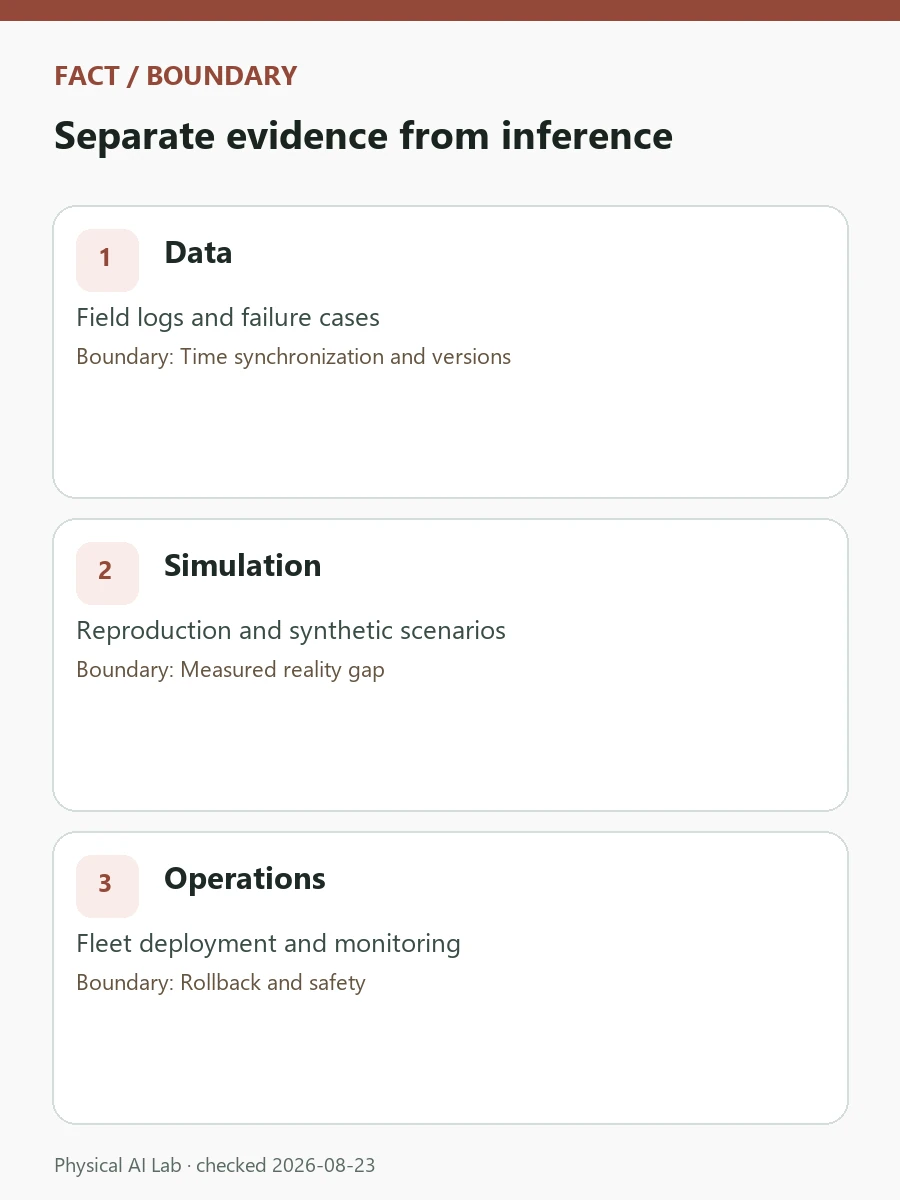
| Production layer | Agenda focus | Evidence to preserve |
|---|---|---|
| Data | Field logs and failure cases | Time synchronization and versions |
| Simulation | Reproduction and synthetic scenarios | Measured reality gap |
| Operations | Fleet deployment and monitoring | Rollback and safety |
The bottleneck is the time from field failure to verified fix
Production engineering has to find a failure, reproduce it, fix it and redeploy with confidence. Logs need synchronized sensor data, commands, model versions and environment state so the same fault can be replayed in simulation.
The robot itself still depends on state estimation, planning, low-level control, safety limits and recovery operating as one physical AI loop.
Track reproduction, regression and rollback as operating metrics
Ask how often failures can be reproduced, which critical tasks run before and after an update, and how quickly a bad release can be withdrawn. These are deployment capabilities, not housekeeping details.
| Check | Question to ask |
|---|---|
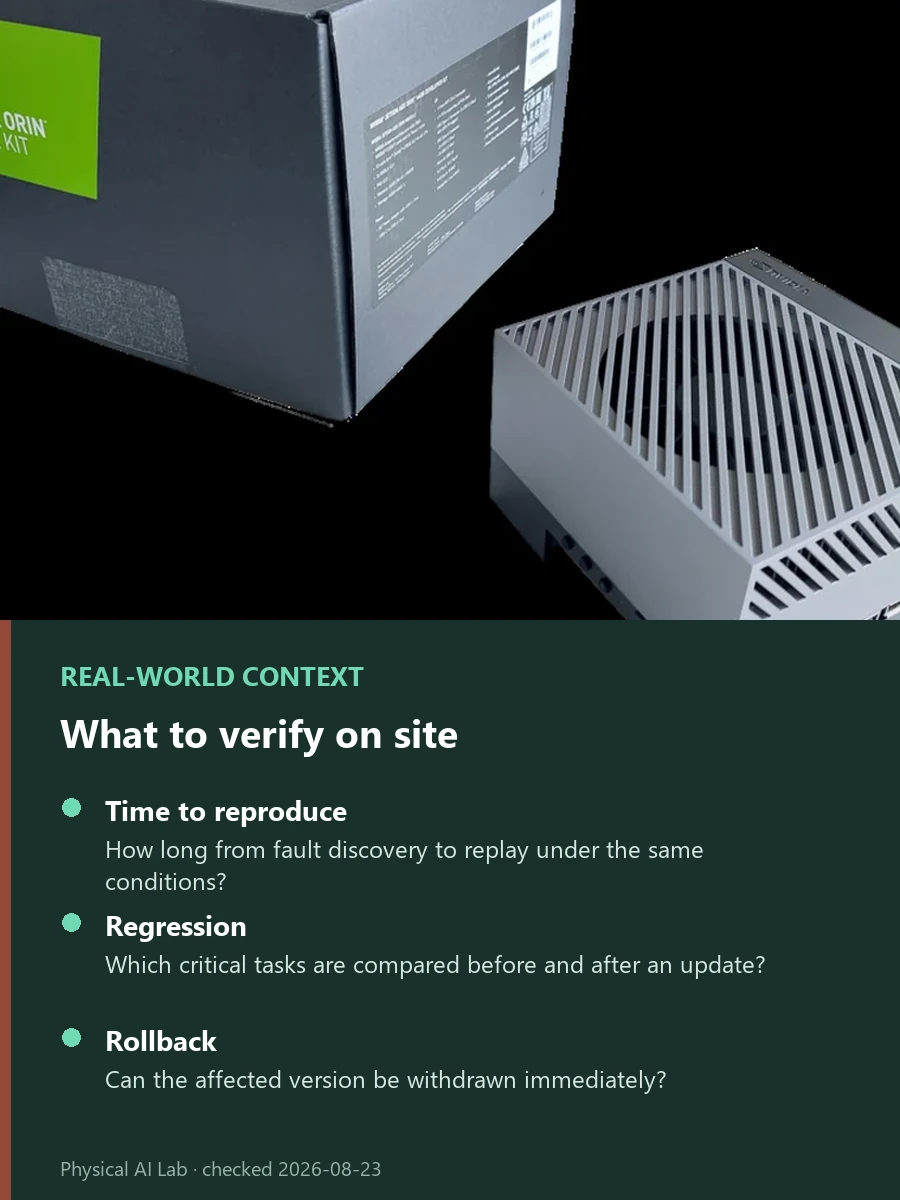
| Time to reproduce | How long from fault discovery to replay under the same conditions? |
| Regression | Which critical tasks are compared before and after an update? |
| Rollback | Can the affected version be withdrawn immediately? |

A new model cannot repair a missing production process
Replacing the model is risky when data quality, labels, scenario coverage, regression tests and staged deployment are weak. Performance can quietly decline even as one headline benchmark improves.
The current sources describe an event agenda. Customer fleet data, independent tests and safety documentation should update the assessment when published.
Connect production engineering to the robot stack
The physical AI company ecosystem identifies ownership across the stack, the robot simulator comparison supports regression design and edge AI for robots exposes deployment limits. Those guides provide the operating context for Actuate in August 2026.
The question Actuate puts in front of robotics teams
Actuate 26 shifts attention from whether a model works once to whether a team can operate, diagnose and improve it at production reliability. Repeatable results and a controlled field-to-development loop matter more than the scale of the announcement.
Frequently asked questions
What evidence would move an Actuate technique from presentation to production?
Look for synchronized failure logs, a reproducible test, regression results, staged release records and a demonstrated rollback. Production evidence shows that a team can correct a fault without losing control of the deployed fleet.
Which log fields make a robot failure reproducible?
Synchronize sensor streams, commands, robot and model versions, configuration, environment state, safety events and human interventions on one timeline.
How should a physical AI team stage a risky update?
Run regression scenarios, deploy to a limited cohort, monitor predefined failure and safety metrics, and keep an immediate rollback path before expanding the release.
Official sources checked
Last checked: August 23, 2026