UBTECH Walker C1 is a full-body humanoid aimed at urban services—guidance, shopping assistance, patrol and education—not repetitive material movement on a production line. UBTECH emphasizes an onboard world model, motion library, omnidirectional perception, standard interfaces and an SDK. That starting point differs from Walker S2, which foregrounds payload, autonomous battery swaps and continuous factory operation.
Walker C1 is designed to deliver services in front of people
The official UBTECH Walker C1 product page groups applications into four areas. Commercial service includes multilingual reception, AI guidance and shopping support; culture and entertainment covers events and visitors; urban safety includes patrol and traffic assistance; education and research includes classroom support and development. All are spaces where questions and human motion keep changing.
C1 therefore cannot be judged only by how many kilograms it lifts. Service quality depends on whether it stops when a stranger blocks the route, chooses a speaker when several people talk, understands a question in noise, and hands the case to staff when it does not know the task. Interaction failures are immediately visible to visitors.
| Comparison | Walker C1 | Walker S2 |
|---|---|---|
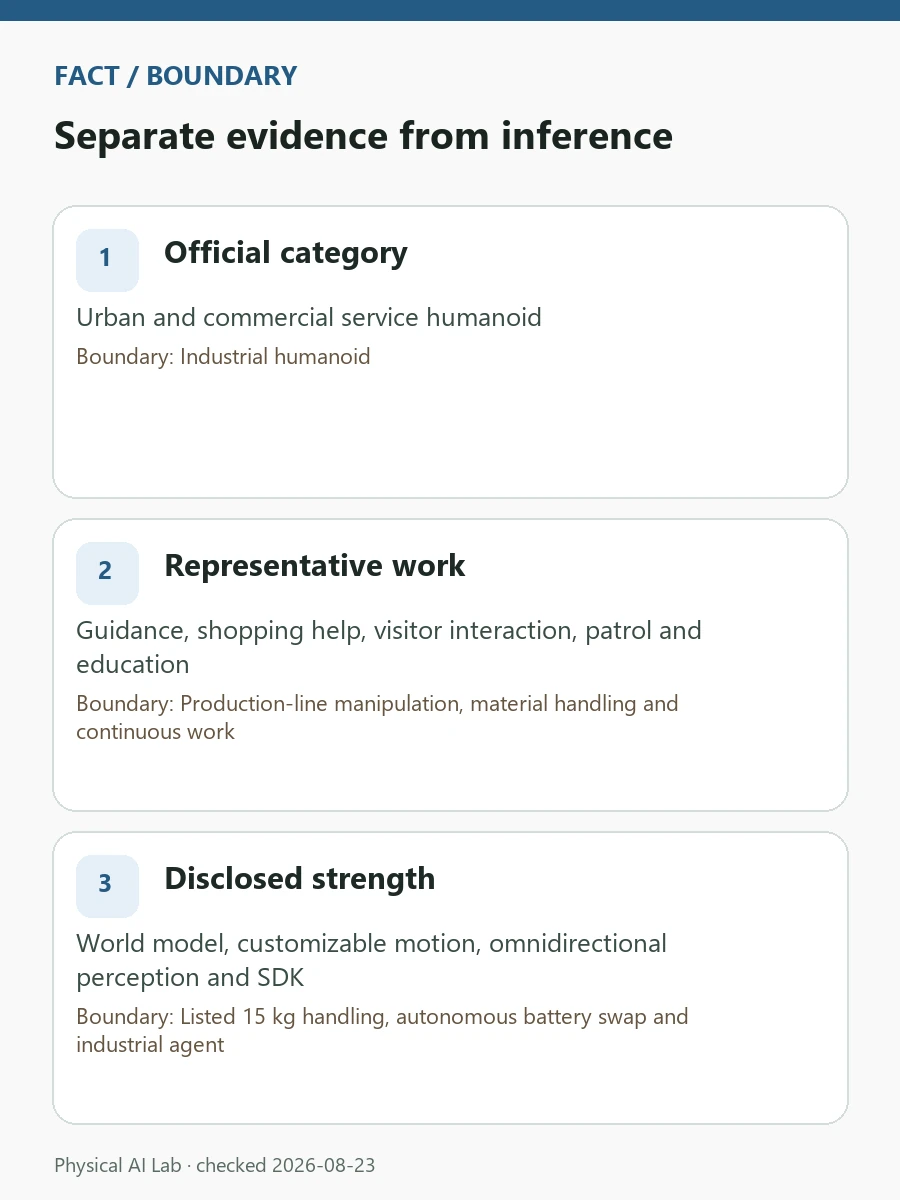
| Official category | Urban and commercial service humanoid | Industrial humanoid |
| Representative work | Guidance, shopping help, visitor interaction, patrol and education | Production-line manipulation, material handling and continuous work |
| Disclosed strength | World model, customizable motion, omnidirectional perception and SDK | Listed 15 kg handling, autonomous battery swap and industrial agent |
| Power operation | C1 page does not detail a shift-operating method | Company describes dual batteries and an autonomous swap in under 3 minutes |
| Deployment KPI | Request completion, safe stops, staff handoff and visitor wait | Cycle time, uptime, intervention and throughput |
The 3 m/s-plus figure is not a service-speed promise
The official specification graphic lists motion above 3 m/s. That is an upper capability indicator, not a promise that the robot will move continuously at that speed among shoppers or event visitors. Operating speed may be far lower once pedestrian density, floor friction, stopping distance, local safety rules and operator limits are applied.
Test speed in crowds rather than on an empty stage. Include a child entering the route, a stroller or suitcase blocking the view, and places where people pause such as an escalator entrance. High top speed has limited service value if braking starts late or the body oscillates after a stop. Fast motion and safe service throughput are different metrics.
A world model is an architecture claim, not proof of field completeness
UBTECH says C1 includes a world model and high-performance computing, but the product page does not disclose a model name, training-data scope, failure rate or update policy. “World model” does not mean prior understanding of every building and human behavior. Temporary walls, reflective glass, unfamiliar signs and crowded queues are more informative tests.
Split field evidence into perception, decision and action. Log whether the robot distinguished a visitor from an obstacle, converted a request into the right destination, and resumed guidance after a blocked route. Include self-correction after a wrong direction and escalation to staff. The physical AI company and technology ecosystem explains how models, sensors and robot bodies connect.

A motion library and SDK begin customization; they do not finish integration
UBTECH says C1 includes a motion library, customizable actions, standard interfaces and a comprehensive SDK. It also presents modularity, cross-model compatibility and one-person deployment as advantages. The public page does not enumerate every customer API, version matrix, data location or recovery owner.
A guidance service needs far more than motion: building maps, event schedules, inventory, appointments, multilingual content, staff handoff and privacy consent. An SDK does not make those links work immediately. Before contracting, request sandbox access, authentication, rate limits, offline cache, update and rollback procedures. The robot simulator comparison explains how to choose a test environment.
Walker S2 solves a different bottleneck from the service model
The official UBTECH Walker S2 product page foregrounds autonomous battery swaps and 24-hour continuous operation. UBTECH describes dual batteries, a swap in under 3 minutes, up to 15 kg handling and a production-line Co-Agent. That message differs sharply from C1 guidance in a lobby.
C1 is not simply a cheaper or reduced S2. C1 broadens interaction across conversation, cultural events, patrol and education; S2 targets clear workpieces, shifts and production output. Procurement evidence should differ too: request-completion and safe handoff for C1, cycle time and uninterrupted operation for S2.
Service performance is whether the visitor's request is completed
A humanoid waving and greeting in several languages makes an attractive exhibit, but service begins with the follow-up. If a visitor asks for the nearest restroom while that destination is closed and the area is noisy, the robot still needs to provide an alternative. A long conversation has not completed the task if the robot cannot admit uncertainty and hand off to staff.
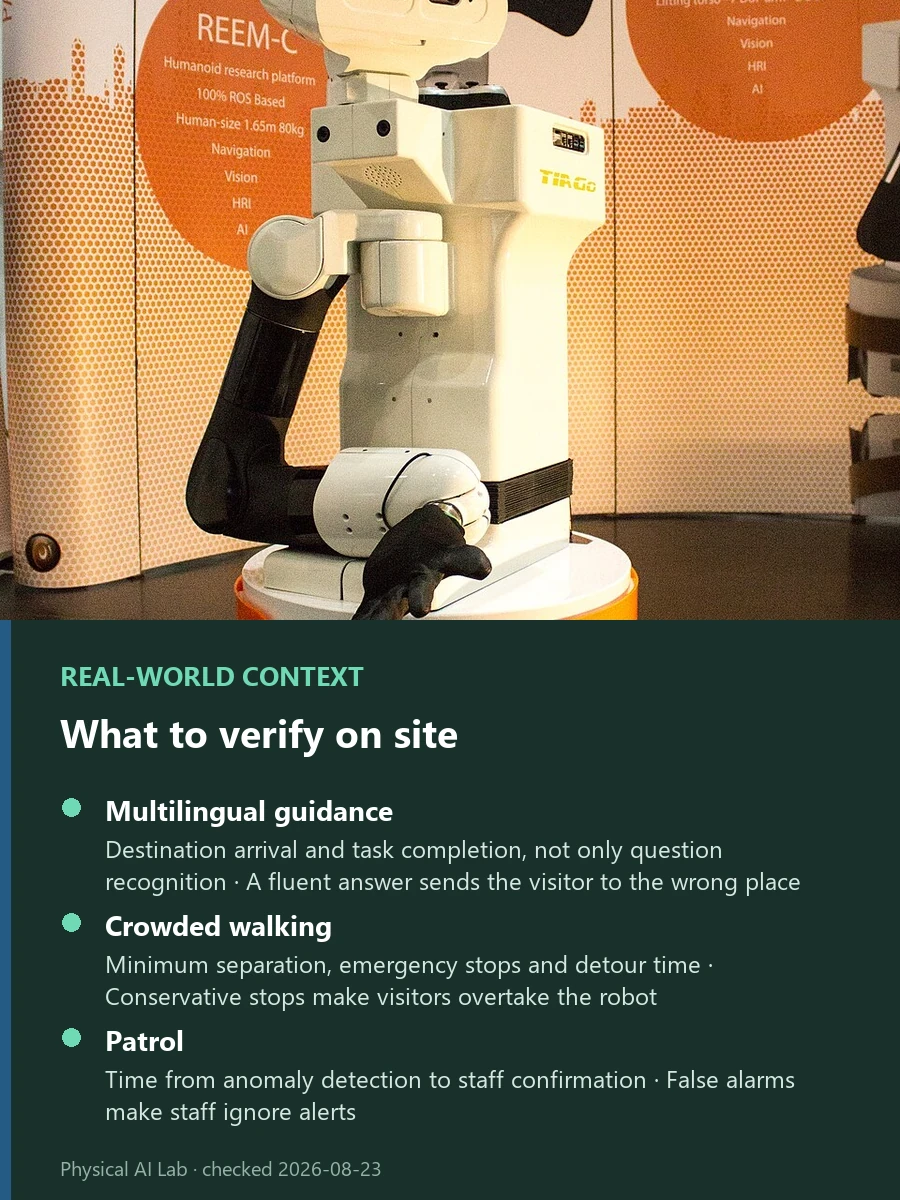
| Scenario | Metric | Easy-to-miss failure |
|---|---|---|
| Multilingual guidance | Destination arrival and task completion, not only question recognition | A fluent answer sends the visitor to the wrong place |
| Crowded walking | Minimum separation, emergency stops and detour time | Conservative stops make visitors overtake the robot |
| Patrol | Time from anomaly detection to staff confirmation | False alarms make staff ignore alerts |
| Shopping support | Freshness of inventory and location data, plus staff handoff | Stale information lengthens the customer route |
| Failure | Safe state and recovery after network loss | The screen remains on but does not reveal that service stopped |
Pilot logs should include time people spent clearing the robot's path, remote interventions and when visitors abandoned the answer. Responding to 90 of 100 guidance requests matters less than how many ended at the destination or with a completed reservation. Edge AI for robots helps separate information that stays onboard from information sent to a server.
Production status, price and regional support require a written inquiry
The product page says modular design and mass-production capability support rapid supply and deployment. That is a company claim about supply capability. Public list price, regional inventory, actual lead time, language-pack scope and integration cost are not specified. “Ready to use” should not be assumed to include a customer's data and building systems.
Use the official UBTECH company profile and sales channel to quote the body, charging equipment, developer license, content creation, remote operations, training, spares and warranty response separately. In guidance, medical or education settings, put voice and video storage, deletion, administrator access and security-support period in the contract.
C1 is a candidate for teams that need a robot to converse and move in public space. Teams moving heavy parts around the clock should compare an industrial product such as S2 first. Defining what completes the job is more useful than comparing their silhouettes.
Knowledge freshness and privacy operations determine service quality
An urban service robot is not finished after one model installation. Store locations, event times, access restrictions, inventory and transit information change. A confident stale answer can confuse a visitor more than no answer. Operating KPI should include content-update latency, expiration behavior and rollback time after a wrong update.
Cameras and microphones require explicit data boundaries. Video used only for obstacle avoidance has a different retention purpose from visitor analytics. Determine whether face or voice originals are stored, whether speech recognition leaves the site, and how children and employee data are handled. A consent notice alone is insufficient: administrators need search, export and deletion rights with access logs. Human handoff should also specify whether the full transcript or only the necessary request is transferred. Without that operating design, a strong world model and motion library still support only a narrow service scope.
Frequently asked questions
Are Walker C1 and Walker S2 the same robot?
No. C1 is presented for commercial and urban service interaction; S2 for production-line work and continuous operation. Their priority KPI sets differ.
Can customers buy Walker C1?
The official product page provides an inquiry channel, but no public list price or regional lead time. Request a written quote covering configuration, support region and integration.
Will this UBTECH humanoid continuously walk among people at 3 m/s?
No. Above 3 m/s is an upper performance specification. Service speed must be limited for crowding, stopping distance, floor conditions and operating policy.
Official sources checked
- Official UBTECH Walker C1 product page
- Official UBTECH company profile
- Official UBTECH Walker S2 product page
Last checked: August 23, 2026