Humanoid foot slip occurs when tangential demand exceeds the available ground-contact margin and the support foot moves relative to the surface. It can begin as small local shear or rotation, then corrupt base-state estimation and remove the support assumption used by the balance controller.
Detection and recovery are different problems. A system may predict low friction margin without proving motion, or confirm motion only after the remaining balance region has disappeared. Useful protection combines early risk evidence, measured slip, bounded latency and a recovery action matched to the current support phase.
Use this guide with the foot force and CoP guide and humanoid state-estimation guide. Validate estimator, controller and physical outcome on one synchronized timeline.
Separate friction risk from confirmed motion
A ratio of tangential to normal force can indicate proximity to a friction limit under a simplified contact model. It is a risk measure, not proof that the sole moved. Unknown friction, changing pressure distribution and foot rotation complicate the boundary.
Confirmed slip requires relative motion evidence from kinematics, inertial sensing, tactile or pressure migration, vision or another ground reference. Keep risk and motion states separate so recovery can escalate proportionally.

Model direction, rotation and partial contact
Slip can be translational, rotational or localized at one part of the sole. A foot may pivot about an edge while its center moves little. The direction of shear determines which momentum change or step can restore a viable support condition.
Represent the active contact region and its uncertainty. A nominal whole-sole friction cone is unsafe when load has concentrated at the toe, heel or one corner.
| Evidence | Indicates | Strength | Primary ambiguity |
|---|---|---|---|
| Shear-to-normal ratio | Friction risk | Early warning | Unknown coefficient |
| Pressure migration | Local motion or load shift | Foot-local | Rocking versus slip |
| Kinematic residual | Foot not fixed | Uses robot model | Base-state error |
| Vision or lidar | World-relative motion | Independent reference | Latency or occlusion |
| IMU response | Body disturbance | High rate | Cause not unique |
Estimate friction margin with conservative assumptions
Available friction varies with surface material, dust, moisture, sole wear, temperature and normal load. A single laboratory coefficient should not be treated as a permanent site constant. Use bounds and update them only from validated evidence.
The friction estimation study provides one research approach for legged systems. Preserve the platform and experimental conditions when deciding whether its estimator or thresholds transfer to a humanoid application.
Detect slip with independent signals
A robust detector combines signals whose failure modes differ. Force can warn about margin, foot kinematics can reveal a violated stationary constraint, and external perception can confirm world-relative motion. A planned gait transition prevents normal liftoff from being mislabeled.
Normalize sensor timing and frames before fusion. Two signals computed from the same biased state estimate are not independent evidence, even if they have different names.
Measure onset-to-command latency
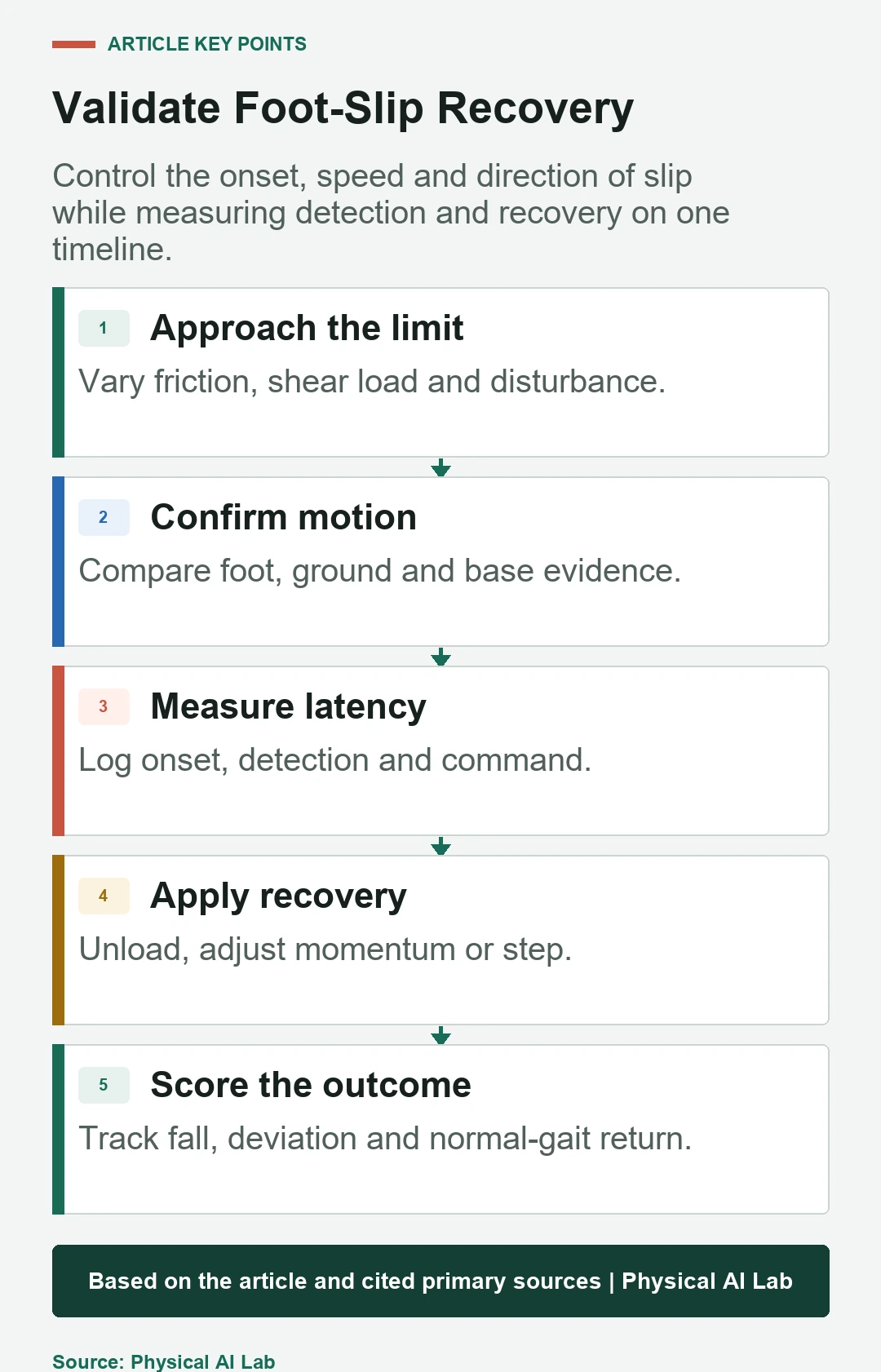
Define physical onset, first detectable evidence, declared detection, controller command and measurable recovery effect. A frame-level accuracy score hides whether the decision arrives early enough to change the outcome.
Report the latency distribution, not only its mean, and include sensor buffering, filtering, inference, messaging and controller cycle. Use time-to-fall or remaining capture margin to interpret whether the delay is acceptable.
Remove the false fixed-contact constraint
When a supporting foot slips, an estimator that treats it as a stationary landmark can infer that the torso moved oppositely. The controller then acts on a corrupted base velocity while the physical support is already degrading.
Inflate or remove the contact update as soon as evidence crosses the qualified boundary. Preserve uncertainty and use other contacts or external measurements where available; do not simply freeze the last confident state.
Choose unloading, momentum shaping or a step
If balance remains recoverable, reducing tangential demand or normal load on the slipping foot can arrest motion. Torso and arm momentum can reshape the ground-reaction demand, while a capture step creates a new support point.
The correct response depends on slip direction, support phase, available footholds and actuator margin. Precompute or optimize alternatives, then choose only actions that the current estimator confidence and timing can support.
Use a controlled stop when recovery margin is gone
Continuing nominal walking after an unbounded slip can create a larger fall. A controlled squat, protected contact or emergency stop may reduce injury and hardware damage when no reachable step or force redistribution can restore balance.
Define the transition before deployment, including arm posture, power and brake behavior, nearby people and floor clearance. Safe stopping must be tested without exposing personnel to an uncontrolled fall.
Avoid false positives during normal contact change
Heel-to-toe roll, compliant sole deformation, planned pivoting and touchdown impact can resemble slip in one sensor. Excessively sensitive detection can trigger repeated stops or destabilizing corrections during normal gait.
Cross gait speed, turning, slopes and sole wear in negative tests. Use phase-aware thresholds or learned classification only when their coverage and uncertainty are documented.
Scope learned detectors to their actual evidence
Learning can combine high-dimensional proprioceptive or tactile signals, but training labels for slip onset are difficult and platform-specific. Synthetic events or another robot’s feet may not reproduce the timing, compliance and contact geometry of a humanoid.
The 2026 SlipSense preprint concerns quadruped slip perception, not proof of humanoid performance. Use it as a method reference and run humanoid-specific held-out surfaces, gaits and sensor-fault tests.
Evaluate detection and recovery as one system
Vary friction, shear direction, support phase, disturbance, speed, sole condition and sensor quality. Report detection delay, false positives, missed events, slip distance and rotation, estimator error, recovery step, falls and return-to-normal time.
Use the footstep-planning guide to verify recovery footholds and the whole-body control guide for shared force and momentum limits. Preserve near-falls and aborted tests in the denominator.
| Test factor | Variation | Detection metric | Recovery metric |
|---|---|---|---|
| Surface | Dry, dusty, wet, low friction | Delay and miss rate | Slip distance |
| Direction | Forward, lateral, rotation | Direction error | Balance restoration |
| Phase | Single, double, transition | False or late state | Step success |
| Sensor | Delay, dropout, bias | Confidence behavior | Safe-mode entry |
| Strategy | Unload, momentum, step, stop | Command latency | Fall and return time |
Release with a slip-recovery contract
Document friction assumptions, signals, onset labels, time alignment, decision thresholds, estimator gating, recovery choices and controlled-stop boundary. Store raw synchronized traces, surface condition and sole state for every trial.
Close validation with the following checklist.
- Separate predicted friction risk from confirmed motion.
- Detect translation, rotation and partial-contact slip.
- Measure physical onset through recovery effect.
- Remove invalid fixed-contact estimator constraints.
- Test false positives, faults, recovery and controlled stopping.
Frequently asked questions
Does a high tangential-force ratio prove the foot is slipping?
No. It indicates friction risk; confirmed slip requires evidence of relative motion or a changing contact state.
Why can slip corrupt humanoid state estimation?
A fixed-contact update interprets support-foot motion as opposite base motion, biasing velocity and pose used by control.
What is the fastest recovery action?
There is no universal action; unloading, momentum shaping, stepping or stopping depends on direction, phase, margin and available footholds.
Can a quadruped slip detector be used directly on a humanoid?
Not without new validation, because gait, foot geometry, compliance, sensors and recovery dynamics differ.
Which metric matters most?
Measure detection delay together with slip distance, estimator error, fall rate and safe return, because classification accuracy alone does not show control value.
Confirmed-Slip and Recoverable-Balance Boundary
Slip protection must change the estimator assumption and the physical recovery command before balance margin disappears. A late correct label is not a successful recovery system.