ISO 18646-5:2026 addresses methods for specifying and evaluating locomotion performance of legged service robots. The official ISO record shows Edition 1, published in July 2026, and identifies complete-machine, sample, qualification and check-and-accept testing as possible uses.
The public ISO abstract also states that the document is not intended to verify or validate safety requirements. A locomotion result therefore cannot be presented as proof that the robot is safe, functionally safe or acceptable for human access.
This article is a purchasing and test-report reading guide, not a reproduction of the copyrighted procedure. Use the purchased standard for normative details, then pair it with the robot evaluation guide and functional-safety guide where relevant.
Confirm the published edition and status
The official ISO 18646-5:2026 record lists Edition 1, publication date 2026-07 and stage 60.60, International Standard published. Record that exact reference rather than an earlier draft or committee-stage title.
Standards can be amended, corrected or reviewed. Archive the purchase record, language, issue date and any amendments used by the laboratory so later tests can be compared against the correct document.

Read the public scope before designing the test
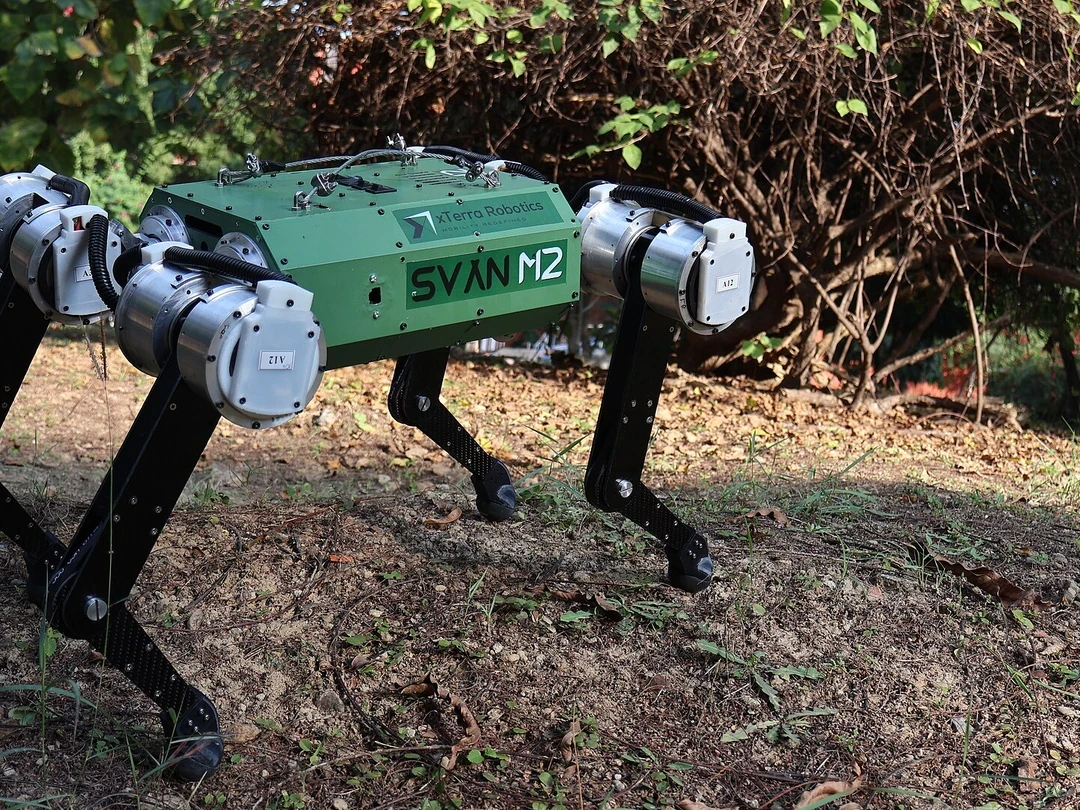
The public abstract describes locomotion performance specification and evaluation for legged robots. It says tests are mainly for the complete machine and may support sample, qualification or check-and-accept use. That scope does not disclose every normative test detail.
Acquire the standard through an authorized source before claiming conformity. A summary, search result or this article cannot establish required apparatus, sequence, calculations or reporting clauses.
| Report item | Question to ask | Why it matters | Evidence |
|---|---|---|---|
| Edition | Was 2026 Edition 1 used? | Drafts may differ | Standard reference |
| Test object | Which complete configuration? | Hardware changes results | Serial and build |
| Conditions | Which surface and environment? | Locomotion is condition dependent | Fixture record |
| Metric | How were start, end and failure defined? | Names can hide different calculations | Procedure and raw data |
| Deviation | What differed from the standard? | Affects comparability | Signed deviation list |
Identify the complete machine under test
Record robot model, serial or asset ID, leg and foot configuration, payload, battery state, software, controller parameters, perception mode, autonomy and communication setup. A photograph alone cannot establish the tested state.
If a sample or subsystem is used, state that explicitly and avoid presenting it as a complete-machine result. Changes to feet, payload, firmware or control policy can alter the valid comparison.
Fix environmental and operating conditions
Locomotion depends on surface material, friction, slope, obstacles, available space, temperature, battery, network and startup state. Capture measurement methods and tolerances, not only nominal labels such as indoor floor.
Repeat environmental checks before and after the run where drift is plausible. Log charging, warm-up and maintenance events that can divide a test series into different conditions.
Define every measurement and failure boundary
A metric name is insufficient without unit, sensor, sampling, filtering, start event, end event and failure definition. Human intervention, protective stop, stumble, timeout and course departure must be classified consistently.
Use the normative text for required definitions, then add application-specific metrics without implying they are ISO requirements. Keep derived calculations traceable to raw measurements.
Report repeats, variation and worst cases
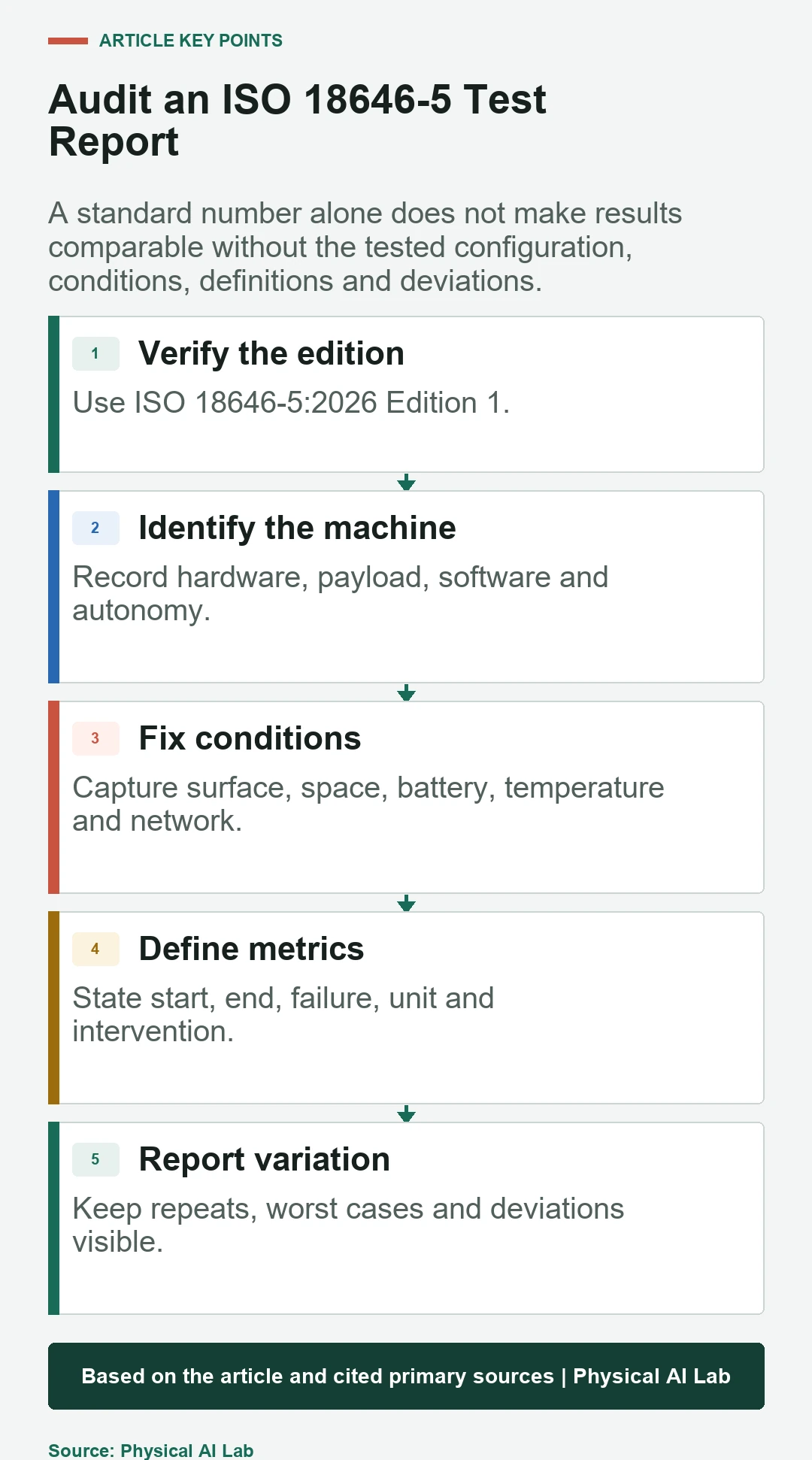
A single best trial is not a repeatability result. Preserve every valid trial, excluded trial and reason for exclusion. Report distribution, spread and condition-specific failures alongside averages.
Predefine how many repeats and which statistics answer the purchasing or qualification question. Do not choose a favorable subset after seeing results.
Set acceptance criteria before the test
The standard provides test methods and performance criteria within its scope, while a buyer or integrator may still need application thresholds. Define acceptance, conditional acceptance and failure before execution, with stakeholders agreeing on retest rules.
Separate development exploration from formal acceptance. Tuning the robot between trials may be useful engineering but creates a different configuration and should reset or segment the acceptance record.
Compare robots only under matched definitions
Two reports citing ISO 18646-5 can still differ in robot configuration, environment, metric choice, deviations and acceptance purpose. Normalize only genuinely comparable quantities and keep embodiment-specific limits visible.
Use a common test fixture where possible and publish uncertainty. A quadruped and humanoid may both be legged robots while having different support, recovery and payload constraints.
Keep locomotion performance separate from safety
The official public scope explicitly excludes verification or validation of safety requirements. Strong locomotion performance does not demonstrate hazard identification, safety functions, safe distances, impact limits or human-access control.
Build a separate safety case using applicable standards and risk assessment. The Physical AI safety-layer guide explains why policy, control, hardware and operational protection require distinct evidence.
Preserve configuration and software traceability
Record source revision, model checkpoint, parameters, dependencies, firmware and calibration. A software update can change gait, perception or recovery enough that previous performance no longer represents the deployed system.
Define which changes require regression, partial retest or full retest. Link each result to an immutable configuration bundle and the exact raw-data archive.
Build an auditable test report
Include purpose, standard reference, test object, apparatus, conditions, sequence, interventions, raw and derived results, uncertainty, deviations, exclusions and signatures. Photos and videos support traceability but do not replace measurements.
Use the following matrix to keep procurement, development and acceptance questions distinct.
| Use | Primary question | Decision evidence | Change trigger |
|---|---|---|---|
| Development | Where is performance limited? | Conditioned metrics and logs | Design iteration |
| Sample test | Does this sample behave as expected? | Identified unit results | Sample change |
| Qualification | Does the design meet a declared envelope? | Repeated representative tests | Design or software change |
| Check and accept | Does delivered equipment meet criteria? | Witnessed acceptance record | Delivery deviation |
| Regression | Did an update preserve performance? | Matched before-and-after run | Release change |
Release with a standards-use checklist
Document access to the normative edition, laboratory competence, complete configuration, conditions, measurement traceability, statistics, deviations, acceptance rules and safety boundary. Avoid claiming certification or conformity beyond the evidence obtained.
Close review with the following checklist.
- Use ISO 18646-5:2026 Edition 1 normative text.
- Identify the complete machine and software configuration.
- Preserve conditions, raw measurements and variation.
- Predefine failures, interventions and acceptance rules.
- Never convert locomotion performance into an unsupported safety claim.
Frequently asked questions
Does passing an ISO 18646-5 test prove the robot is safe?
No. The official scope explicitly says the document is not intended to verify or validate safety requirements.
Can two results be compared because both cite the standard?
Only after confirming matched configurations, conditions, metrics, deviations and statistical treatment.
Can a single best run be used as the result?
It can be reported as a trial only if allowed and clearly labeled, but it does not establish repeatability or representative performance.
Can the public ISO summary replace the purchased standard?
No. Use an authorized normative copy for procedure, apparatus, calculations and report requirements.
Does a software update preserve the old result?
Not automatically. Assess its effect and perform the defined regression or retest for the changed configuration.
Performance-Test Scope and Safety-Claim Boundary
ISO 18646-5:2026 is a locomotion-performance document, not a safety validation. Use its normative text and report the exact machine, conditions, metrics, variation and deviations.