Stair and slope walking changes more than foot height. Stair treads create finite support regions and vertical risers that threaten toe, heel, knee and torso clearance. Ramps rotate the surface normal and may include cross-slope, changing ankle posture and allowable ground-reaction force.
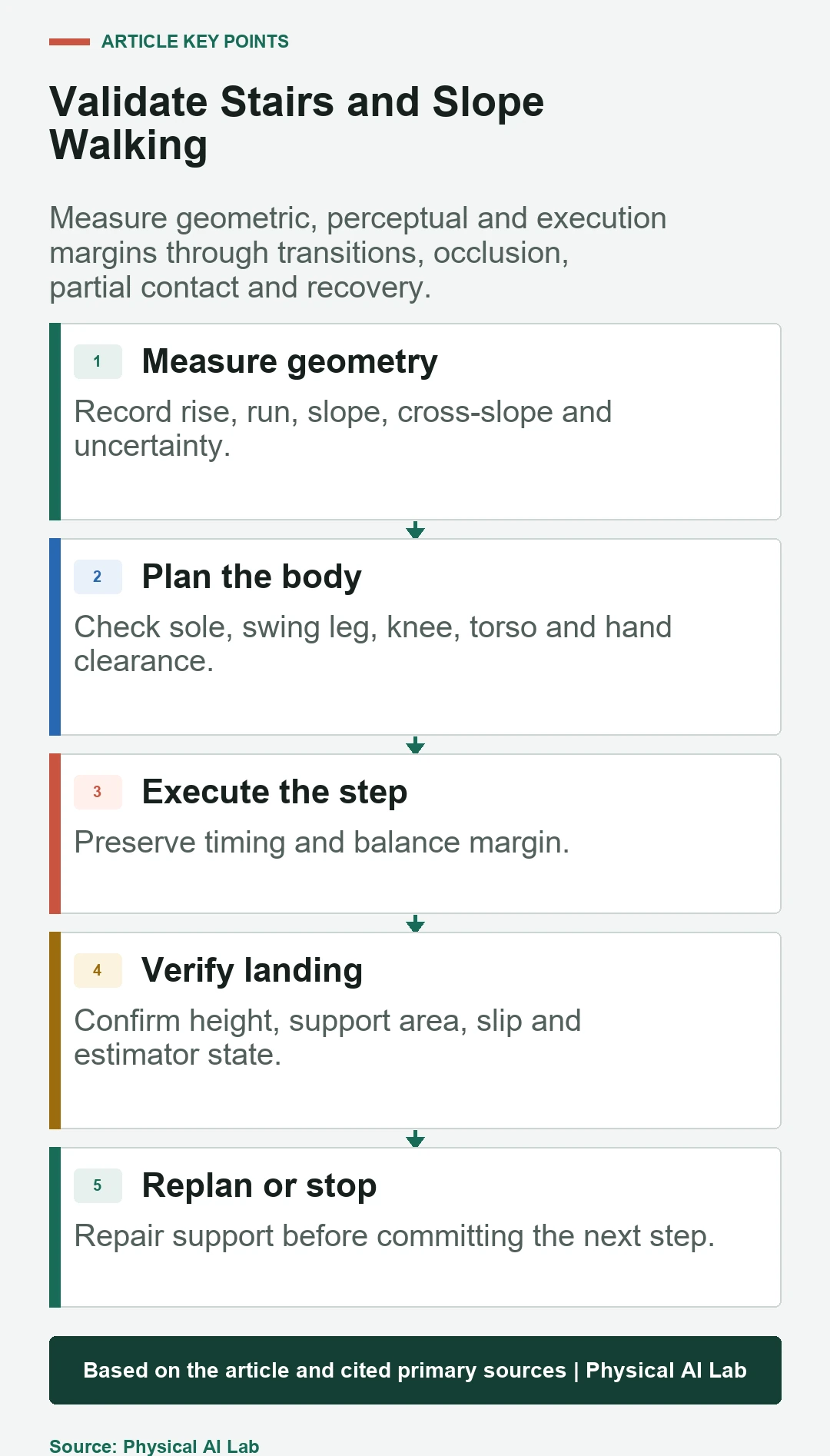
A practical system estimates terrain geometry with uncertainty, plans full-sole footholds and whole-body motion, verifies the measured landing, then repairs support or replans before committing the next step. The transition from level ground to terrain deserves its own validation.
Use this guide with the humanoid footstep-planning guide and foot force and contact guide. Compare perceived, planned and executed geometry.
Describe stairs and ramps with task geometry
For stairs, record rise, run, nosing, width, heading and variation between steps. For ramps, record longitudinal slope, cross-slope, width, surface condition and transition radius. A nominal building dimension cannot replace a robot-centered measurement.
Attach uncertainty and acquisition time to the model. A depth camera may miss dark edges, reflective surfaces or regions occluded by the robot itself, and a stale map can place a foot against the wrong riser.

Separate height maps from support surfaces
A height map is useful for collision and elevation, while planar or support-region extraction asks whether enough sole area fits with acceptable slope and roughness. Each representation loses information the other may retain.
Preserve raw or confidence data so a flat fitted plane does not hide a protruding edge. Unknown cells should reduce support margin rather than becoming free space.
| Terrain feature | Required estimate | Planning use | Common hidden error |
|---|---|---|---|
| Stair tread | Rise, run, edge, heading | Sole placement | Nosing overhang |
| Ramp | Slope and cross-slope | Ankle and body reference | Local bump |
| Transition | Break line and radius | First or last step | Frame discontinuity |
| Surface | Friction and roughness | Force margin | Wet or loose patch |
| Unknown region | Coverage and confidence | Conservative rejection | Occlusion |
Plan for the entire sole and active support
Place the foot polygon inside the supportable region with edge margin. A sole center on a tread is insufficient if the heel overhangs, the toe meets a riser or the foot is yawed relative to the stair.
If partial contact is allowed, define the active support polygon and controller limits. Otherwise reject the foothold and replan rather than assuming the nominal sole area.
Check knee, torso, arm and sensor clearance
Ascending stairs brings knees and shins toward risers. Descending changes toe and heel clearance and can occlude the next tread. Torso, elbows, carried objects and safety tethers also need swept-volume checks.
Run whole-body collision validation, not a foot-only trajectory. The motion-planning comparison explains how discrete footholds and continuous body trajectories solve different parts of the problem.
Adapt step length, height and orientation before swing
Terrain geometry should condition the next foot target and body plan before toe-off. On stairs, step height and tread depth constrain the reachable sequence. On ramps, foot orientation and pelvis reference should change gradually to avoid abrupt ankle or torso demands.
A 2026 stair-geometry-conditioned locomotion preprint explores explicit conditioning for humanoid stairs. It remains a research result under its reported simulation and hardware conditions, not a universal field guarantee.
Set swing clearance from uncertainty and dynamics
Too little clearance causes toe strikes. Excessive lift increases energy, knee demand, swing time and balance disturbance. Choose a clearance profile from estimated edge height, uncertainty, tracking error and foot geometry.
Measure actual toe and heel trajectories with synchronized terrain and robot frames. Include early contact logic so a strike does not automatically become a full forward command into the obstacle.
Verify touchdown before trusting the next step
After landing, compare measured foot height and orientation with the plan and check normal load, pressure distribution, slip and estimator innovation. A delayed or partial contact changes the support available for the next swing.
Use a gate before committing the opposite foot. If support is uncertain, hold double support, adjust the foot, unload or stop instead of rushing to preserve nominal cadence.
Adapt ankle and torso reference on slopes
The sole may align with the surface normal while the torso remains closer to gravity, depending on stability, comfort and joint range. Cross-slope creates asymmetric ankle and hip demands that are not captured by one pitch angle.
Check force feasibility and joint margin throughout the ramp. Conservative speed and step width may be needed when friction is uncertain or lateral slope reduces the recovery region.
Test entry and exit transitions explicitly
The first stair or ramp step changes the terrain reference while one foot may remain on level ground. The final step reverses that geometry. Mixed-height double support can create posture and force distributions absent from steady terrain walking.
Create dedicated scenarios for approach distance, heading error, stopping on the transition and resuming. Do not infer transition reliability from success in the middle of a uniform staircase.
Recover from toe strikes and partial landings
A toe strike, heel overhang or unexpected early contact should trigger a phase-aware response. Options include retracting, lowering, shifting weight, returning to the previous support or stopping. Continuing the planned transfer can turn a minor error into a fall.
Coordinate with the foot-slip recovery guide. Record which evidence distinguished obstacle contact, low friction, compliance and a perception error.
Evaluate geometric margin and recovery cost
Report completion rate, minimum sole edge and swing clearance, foot-pose error, contact timing, joint and force margin, slip, replans, interventions and falls. Break results out by ascent, descent, ramp direction and transition.
The humanoid stair-climbing study offers research context, but comparison requires matched stair geometry, robot and evaluation conditions. Publish the actual test fixture and uncertainty.
| Test factor | Variation | Geometry metric | Execution metric |
|---|---|---|---|
| Stairs | Rise, run, yaw, irregularity | Sole and riser margin | Completion and strike |
| Ramp | Slope and cross-slope | Normal estimate error | Slip and joint margin |
| Perception | Noise, holes, occlusion | Surface confidence | Replan rate |
| Transition | Entry, exit, stop | Mixed-support geometry | Balance transient |
| Fault | Partial landing, toe strike | Contact residual | Recovery success |
Release with a terrain-walking contract
Document supported stair and ramp envelope, sensor placement, map representation, uncertainty, sole margins, swing profile, whole-body checks, landing gate and recovery states. Store terrain scans, robot logs and fixture dimensions together.
Close validation with the following checklist.
- Measure stair and ramp geometry in the robot frame.
- Check full-sole support and whole-body clearance.
- Condition swing and posture on uncertainty.
- Verify measured landing before the next step.
- Test transitions, partial contact, strikes and stopping.
Frequently asked questions
Is stair height enough to plan humanoid walking?
No. Tread depth, edge, heading, sole size, swing clearance and whole-body feasibility are also required.
Should the system use a height map or planes?
Often both; height maps preserve elevation detail while support regions answer whether the sole can land with margin.
Can ascent and descent use the same policy?
They may share components, but visibility, swing clearance, momentum and failure behavior differ and need separate validation.
Should the robot step quickly after a partial landing?
No. It should verify and repair support or return to a safe state before committing the opposite foot.
Can stair performance be summarized by success rate?
Not alone. Report geometry, clearance, contact error, recovery cost, interventions and falls by condition.
Verified-Landing and Terrain-Transition Boundary
Terrain walking remains valid only while perceived geometry, planned footholds and measured contact agree. Repair a questionable landing before committing the next swing.