Robot observability is the ability to reconstruct internal software execution and external physical behavior from emitted evidence. A screen showing that a node is alive cannot explain why a mobile manipulator selected the wrong object, used a stale transform and entered recovery.
Logs record events, metrics summarize measurements and traces connect work across components. Robots also need sensor and actuator evidence, clock quality, mission identity and configuration lineage because physical incidents cross edge devices, fleet services and human operations.
Use this guide with the robot latency-budget guide and dataset lineage guide. Collection must obey cybersecurity, privacy, retention and safety constraints.
Design observability around questions and incidents
Start with decisions: which task failed, what command reached the actuator, how old was the perception input, which configuration ran and where the delay or state divergence began. Each question defines evidence, correlation and retention needs.
Instrument the critical path from mission assignment through planning, inference, control, device response and task result. Avoid collecting every possible field without an investigation use case and resource budget.

Give logs, metrics and traces distinct jobs
A structured log captures a discrete event and its context. A metric aggregates values over time for alerting and trend detection. A trace represents an operation as related spans across components; none of these alone replaces raw physical evidence.
The official OpenTelemetry signals documentation lists traces, metrics, logs and baggage as supported categories. Map robot concepts carefully rather than assuming cloud-service semantic conventions automatically fit motion and hardware.
| Signal | Best question | Robot example | Failure if misused |
|---|---|---|---|
| Log | What event occurred | Safety stop reason | Free text cannot correlate |
| Metric | How much or how often | P95 command age | Raw IDs explode cardinality |
| Trace | Where operation time went | Mission-to-actuation spans | Missing context breaks chain |
| Recording | What physically happened | Images, joints and commands | Storage and privacy overload |
| Config snapshot | What exactly ran | Model, map and calibration | Incident cannot reproduce |
Propagate one operation identity across boundaries
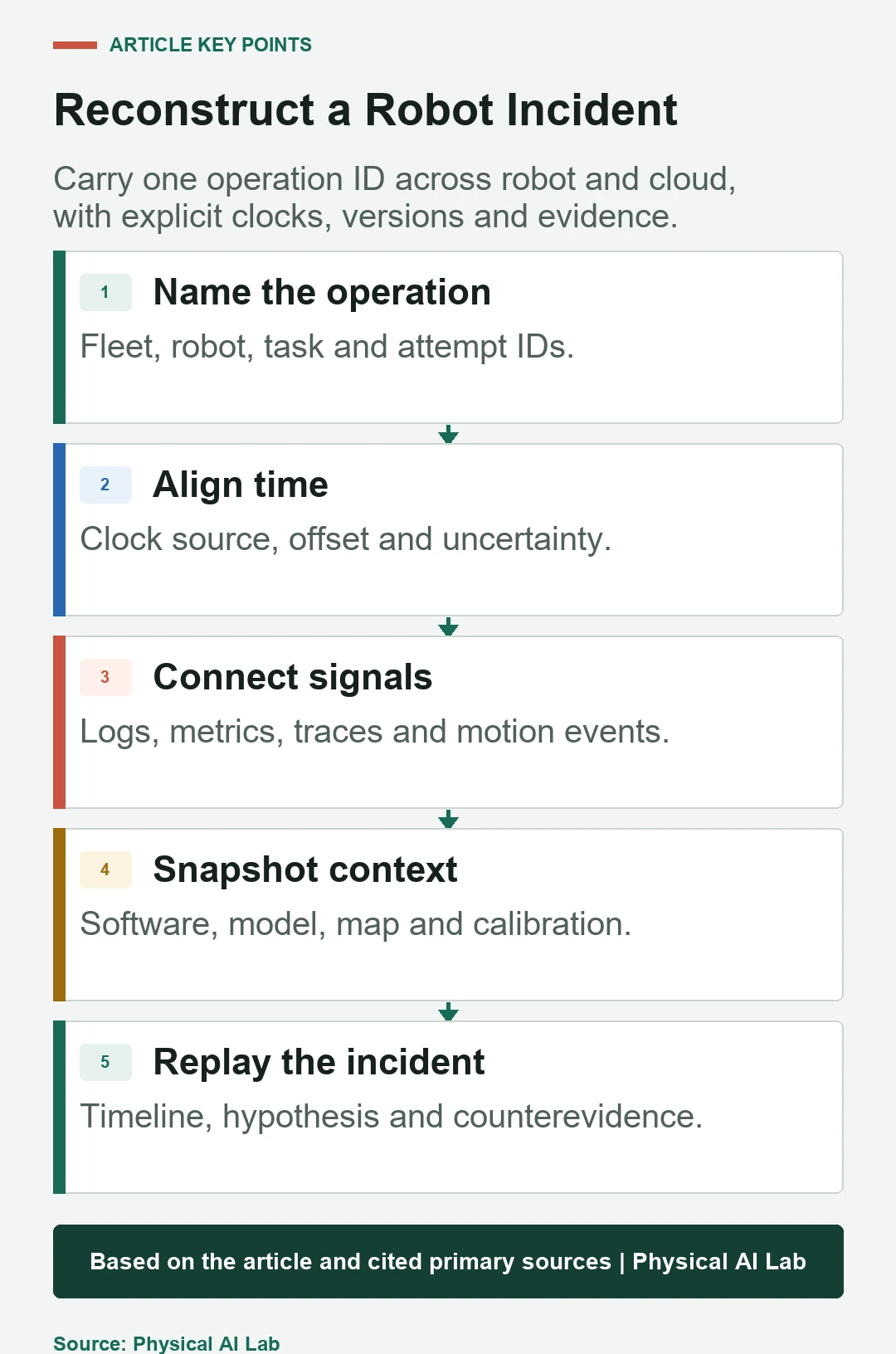
Create fleet, robot, mission, task, attempt and recovery identifiers with clear lifetimes. Carry a trace and span context across service calls, queues and device commands while keeping physical episode identity visible when work is retried.
The W3C Trace Context recommendation standardizes traceparent and tracestate for distributed context. Use its rules at compatible interfaces and define explicit mappings for field buses, ROS messages and offline recordings.
Make clock quality part of every latency claim
Timestamps from different clocks cannot be subtracted safely unless offset, drift and uncertainty are known. Record clock source and synchronization status, and use monotonic time for local durations when wall-clock corrections could jump.
When synchronization degrades, retain event order and uncertainty rather than publishing a false precise latency. Correlate sensor exposure, message arrival, callback start, inference completion, command application and measured motion.
Use structured logs with stable schemas
Include event name, severity, timestamp and clock, operation IDs, component and version, robot state, reason code and bounded diagnostic fields. Keep human-readable text as an explanation, not the only machine-queryable value.
OpenTelemetry’s logging specification supports correlation through TraceId and SpanId. Preserve original device error codes and mapping versions so normalization does not erase evidence.
Control metric labels and cardinality
Use counters, gauges and histograms according to the measured behavior. Metrics can summarize fault rate, queue depth, command age, inference latency, control deadline misses, battery state and intervention duration.
The current OpenTelemetry metrics guidance warns that unique attribute combinations drive memory cost and describes SDK cardinality limits. Do not place raw mission, user or object identifiers on every metric series; connect exemplars or bounded labels to detailed traces and logs.
Trace asynchronous robot work and retries
A mission may fan out into perception, planning, map, policy and device calls, then continue through queues or an offline edge link. Use parent-child spans for nested work and span links when causal work is not a single synchronous call tree.
Record enqueue and dequeue times, retry number, timeout owner and result. OpenTelemetry’s trace documentation explains spans, context propagation, events and links; apply sampling rules that retain failures and representative successful operations.
Preserve physical evidence beside telemetry
For selected incidents, capture sensor frames, joint states, commands, transforms, safety events and operator actions with consent and storage controls. Preserve units, coordinate frames, serialization and QoS or drop information.
The ROS 2 rosbag2 documentation is versioned for the Rolling distribution; pin the deployed distribution and storage plugins. A bag file without clock, configuration and event IDs remains difficult to interpret.
Snapshot software, model, map and calibration lineage
Attach build ID, container or package digest, model and dataset lineage, map, tool, calibration, controller parameters and feature flags to the robot resource or incident bundle. Do not rely on the mutable label latest.
Use the robot dataset lineage workflow to connect learned artifacts to their inputs. Preserve update and rollback events so a mixed fleet is not analyzed as one configuration.
Build an incident bundle that supports counterevidence
An incident record should contain the timeline, affected configuration, logs, metric windows, traces, selected physical recordings, operator statements, candidate causes and evidence that contradicts each hypothesis. Root cause should not be selected from the first alarming graph.
Connect confirmed recurring cases to the failure-mining guide while keeping training selection separate from operational adjudication and safety reporting.
Budget telemetry, security, privacy and degraded operation
Set collection rates, local buffering, upload priority, retention and redaction by signal class. Camera, audio, precise location and worker identifiers can create privacy and security exposure; protect access and prove deletion behavior.
Observability must not starve control or safety tasks. Test disconnected operation, storage exhaustion, collector failure and log storms. The robot should preserve a bounded critical ring buffer and continue or stop according to its operational safety design.
Release an observability acceptance specification
Preserve incident questions, signal schemas, identifier lifetimes, context propagation, clock quality, sampling, cardinality budgets, buffer and retention rules, access controls, configuration lineage and replay tests.
Close review with the following checks.
| Acceptance test | Injected condition | Required evidence | Failure |
|---|---|---|---|
| Correlation | Cross-service retry | One task and attempt chain | Duplicate or broken IDs |
| Timing | Clock offset and drift | Qualified duration or uncertainty | False latency |
| Sampling | Rare critical failure | Trace and physical bundle retained | Head sampling drops case |
| Resource | Network and disk pressure | Bounded control impact | Telemetry disrupts robot |
| Replay | Known incident | Timeline and configuration reproduce | Dashboard-only diagnosis |
- Trace one mission from dispatch to physical result.
- Record clock source, offset and uncertainty.
- Keep metrics bounded and detailed IDs out of labels.
- Link telemetry to exact software and calibration versions.
- Prove incident capture under network loss and storage pressure.
Frequently asked questions
Are logs enough for robot observability?
No. Logs need metrics, traces, physical evidence, clock quality and configuration context to reconstruct many incidents.
Should robot ID be a metric label?
A bounded fleet label may be justified, but high-cardinality identifiers require explicit cost analysis and often belong in traces or logs.
Can trace timestamps prove end-to-end latency?
Only when the clocks and propagation boundaries are qualified; otherwise report local durations and synchronization uncertainty.
Should every successful task be fully recorded?
Usually not. Use risk-based sampling, summaries and bounded buffers while retaining critical failures and representative successes.
Does observability replace safety monitoring?
No. It supports diagnosis and evidence; validated safety functions must remain independent of ordinary telemetry availability.
Incident-Reconstruction Evidence Boundary
Robot observability succeeds when a team can reconstruct a physical incident, identify the exact configuration and test competing explanations without disrupting control, safety, privacy or fleet operation.