AgiBot Expedition A3 is a 173 cm, roughly 55 kg bipedal humanoid. Official A3 developer documentation lists a 1,152 Wh battery, charging in 2 hours or less, 10 hours of operation and a 5 kg rated load per arm. The specification does not disclose detailed conditions for the 10-hour result or a sale price. A service or research deployment still needs real-configuration tests of the hands, aisles, floors and mission energy.
The 173 cm, 55 kg body sets the safety envelope
A3 measures 173 × 52 × 30 cm. Human-like height helps it reach existing handles and worktops, but the hazard zone of a falling 55 kg machine must be wider than one person's walking width. The official manual separates a 600 mm minimum for side-stepping from 900 mm for forward travel. Those are close to geometric clearances for the robot alone, not safe margins for people and carts crossing.
A site drawing should mark the narrowest door, elevator, charging point and evacuation route. Include turning with the arms extended and additional steps after a stop command. Lobby guidance and warehouse picking can require different safety envelopes from the same body.
| Item | Official A3 specification | What to verify before deployment |
|---|---|---|
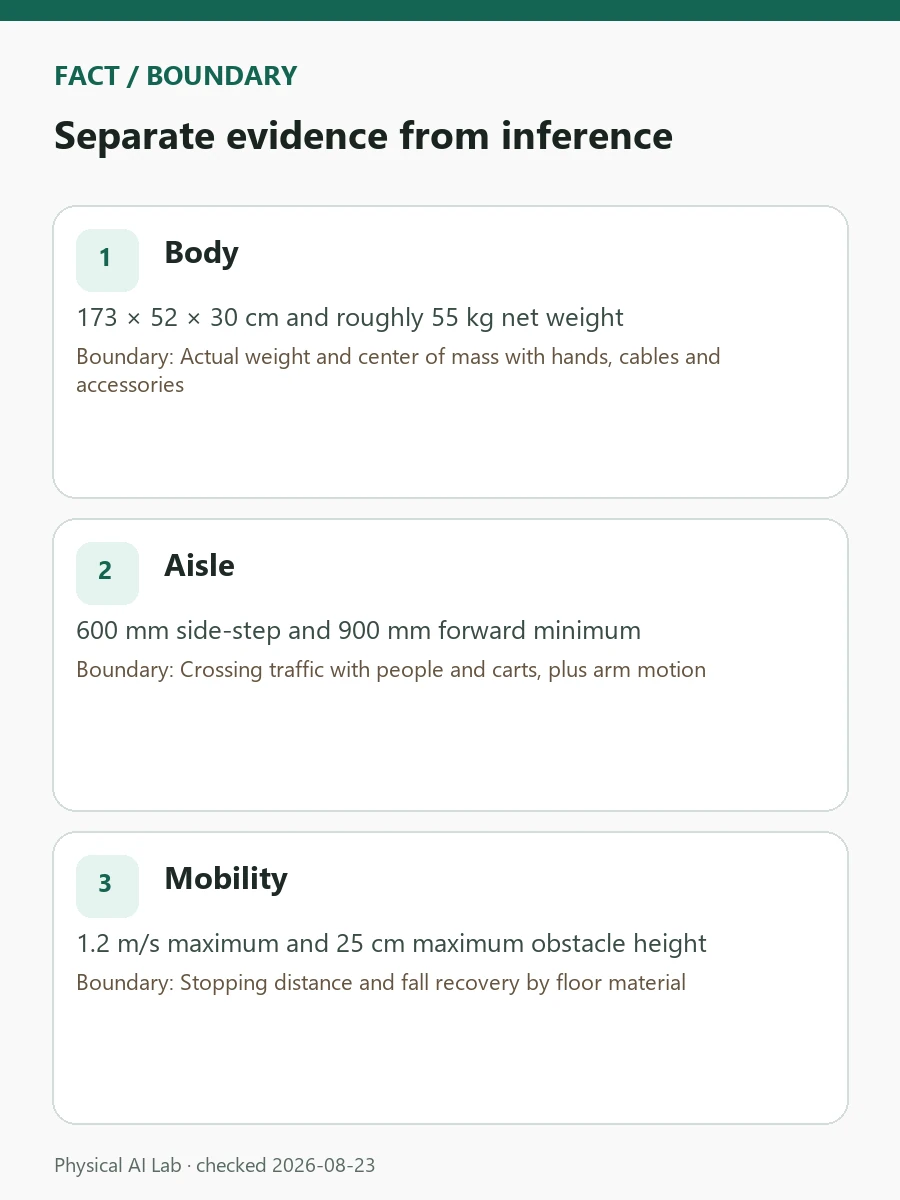
| Body | 173 × 52 × 30 cm and roughly 55 kg net weight | Actual weight and center of mass with hands, cables and accessories |
| Aisle | 600 mm side-step and 900 mm forward minimum | Crossing traffic with people and carts, plus arm motion |
| Mobility | 1.2 m/s maximum and 25 cm maximum obstacle height | Stopping distance and fall recovery by floor material |
| Slope | Listed for omnidirectional movement and parking on a 15° slope | Retest with wetness, lower friction and battery state |
| Arms | 7 axes × 2 and 5 kg rated load per arm | Actual payload by hand mass and pose |
The listed 10-hour runtime is not guaranteed shift uptime
The official AgiBot A3 developer guide lists a 1,152 Wh battery, charging in 2 hours or less and 10 hours of operation. The same table does not disclose walking speed, arm duty cycle, compute load, room temperature or usable battery range for that 10-hour result. It is therefore insufficient to treat the maximum figure as a work shift.
Standing for 10 hours while running a display and voice interface is not the same mission as walking and carrying a 5 kg object for 10 hours. Locomotion, arm torque, camera processing and communications raise both energy use and heat. A pilot should record Wh per cycle, behavior below 20% battery, return-to-charge success and time spent under thermal limits.
Choose the hand for the workpiece and maintenance burden—not DOF alone
A3 documentation lists dexterous hands as options. Agile 2026 and Professional 2026 configurations use different finger degrees of freedom. More axes create more poses, but do not guarantee stable handling of thin film, slippery bottles or fragile containers. Grip force, tactile coverage, repeat durability, finger replacement and recalibration after contact determine task performance.
Do not curate only attractive demo objects. Group candidates by friction, deformation, reflectivity and damage cost as well as size and weight. Testing paper cartons, plastic film, cylindrical bottles and thin parts yields more information than picking the same box 100 times. For the model layer, see manipulation learning in robot foundation models and the role of real contact data.

Cameras, controllers and links reveal the development boundary
A binocular head camera handles environmental perception. The manual says both the main data unit, MDU, and the human–machine interaction unit, HDU, use RK3588-family platforms. Connectivity includes Wi-Fi, Bluetooth and 4G/5G, with autonomous navigation and obstacle avoidance listed. Position accuracy is ±10 cm and orientation accuracy ±10°.
Those figures are not end-effector accuracy for a particular task. Teams must check whether a wrist camera or joint controller refines the ±10 cm location, whether external markers are required and how low light changes error. Behavior after a mobile-network loss and log location also belong in operating design. See the core ideas behind Sim-to-Real for the simulation-to-field gap.
The documented operating environment is not an outdoor rating
The A3 v3.0 table specifies -10–45°C, 10–90% relative humidity and non-condensing operation. Joint modules are listed as IP5X. IP5X describes dust-ingress protection; it does not authorize rain, washdown or condensation. Storage is separately listed at -20–70°C under non-condensing conditions, so storage and operating limits should not be mixed.
An outdoor event or semi-outdoor lobby needs additional tests for splashing water, direct sun, rapid temperature change, sand and ramp surfaces. Indoors, wet polished tile or a raised carpet edge also changes gait. A 25 cm obstacle and 15° slope in the table do not guarantee every 25 cm edge or every 15° surface: shape, approach angle, friction and payload all matter.
| Test scene | Record | Example failure criterion |
|---|---|---|
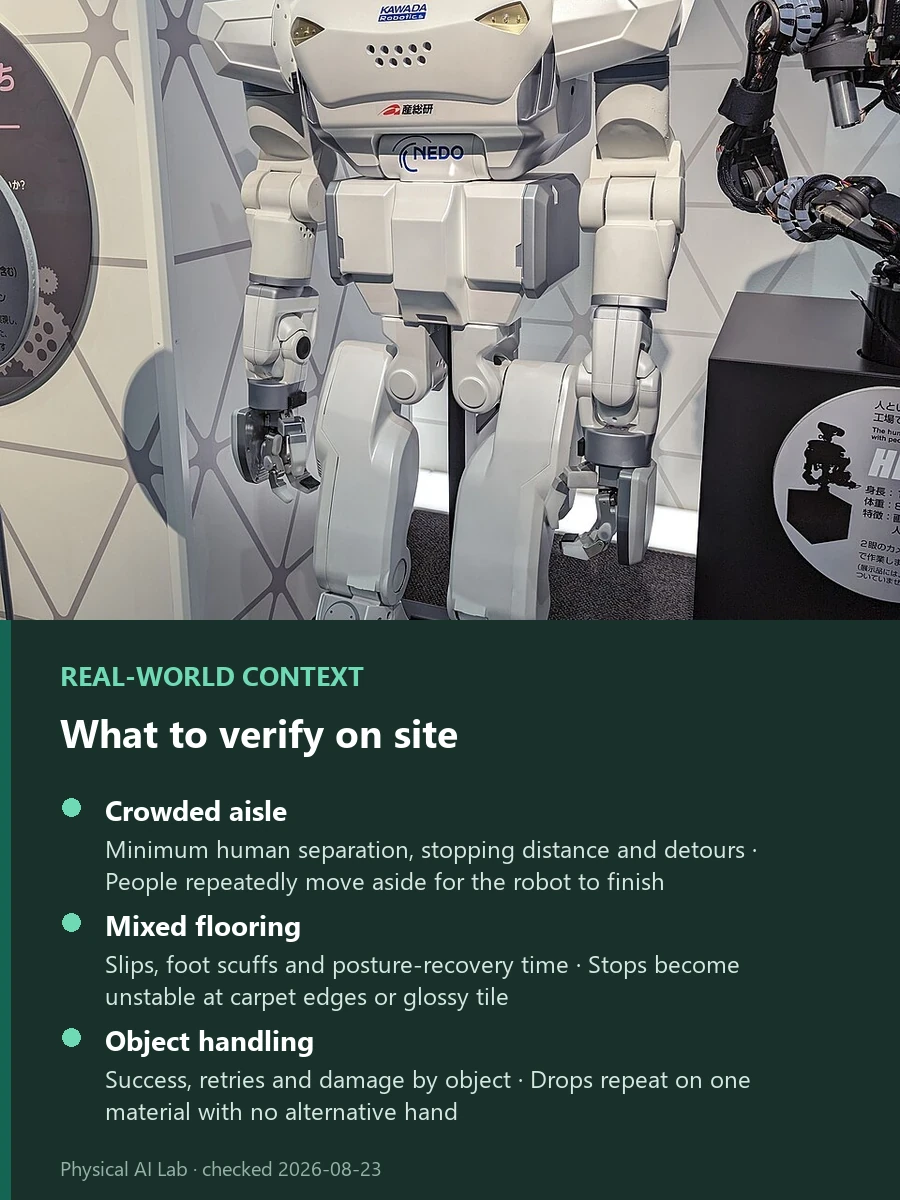
| Crowded aisle | Minimum human separation, stopping distance and detours | People repeatedly move aside for the robot to finish |
| Mixed flooring | Slips, foot scuffs and posture-recovery time | Stops become unstable at carpet edges or glossy tile |
| Object handling | Success, retries and damage by object | Drops repeat on one material with no alternative hand |
| Long mission | Energy per cycle, thermal limits and charging queue | Planned work is unfinished before the listed runtime |
| Communication loss | Stop behavior, local-control continuity and log retention | The safe state cannot be verified after disconnection |
A development kit does not equal a complete field service
A3 documentation exposes secondary development for motion control, voice playback, microphone management, fault diagnosis and simulation. That gives a research team a development path. It does not prove that customer apps, multilingual guidance, elevators, remote supervision and incident response arrive as one finished service. Hardware and AIMDK document versions must match first.
The inquiry path on the official AgiBot website serves a different purpose from technical documentation. Get price, supply country, lead time, warranty, spares and field service in writing. For model development, compare the licenses and A3 hardware compatibility of data and models on the official AgiBot World open-source page. A public repository does not automatically grant commercial deployment rights or support.
If the stack is unfamiliar, start with what physical AI means. A3 deployment does not end with “human-sized, so it fits.” The right hand, a safe floor, enough energy for the target shift and a recovery organization all have to be in place.
Build the first pilot around the combined worst case
A slow walk through an average lobby will not reveal the boundary. Combine the narrowest aisle, lowest-friction floor, hardest object and low-battery period. Run the actual shift rather than a 30-minute demo, and subtract human restaging and remote intervention from autonomous work time.
Set continuation criteria before testing: success by object, continuous time without intervention, charge-return rate, recovery time, daily throughput and maintenance cost. Those values are more comparable with the current process than top speed or longest listed runtime. Do not estimate undisclosed values; define their measurement in the pilot protocol and contract appendix.
A 25 cm obstacle and 15° slope are starting points for testing
The table lists a 25 cm maximum obstacle and omnidirectional movement or parking on a 15° slope. Results still depend on whether an edge is rounded or sharp, whether the foot approaches straight or diagonally, and whether a ramp is dry and high-friction or wet metal. Request the vendor's test fixture and approach direction, then reproduce the site geometry.
Do not record every walking failure simply as “fell.” Toe strikes, slips, state-estimation errors, planning stops and safety-control stops have different fixes. Safe stopping without hitting people or equipment comes before self-righting. A fall can shift joint zero or camera pose even when the shell looks intact, so recalibration and restart approval are needed. For sites with frequent stairs, accumulated impacts across hundreds of repetitions and low-battery stability matter more than one pass at the maximum edge.
Frequently asked questions
Does AgiBot A3 really work for 10 hours continuously?
The official document lists 10 hours but does not disclose the detailed test conditions in the specification table. Re-measure with the intended walking, arm duty cycle, compute load and temperature.
Does A3 have only one hand option?
No. Official documentation lists hand configurations with different degrees of freedom. Choose for workpiece weight and surface, tactile needs and maintenance cost.
Can this AgiBot humanoid work outdoors in the rain?
IP5X is a dust-protection designation for the joint modules, not a waterproof rating for rain or washdown. Outdoor use requires vendor confirmation and separate environmental testing.
Official sources checked
Last checked: August 23, 2026