The announced WRC 2026 exhibition scope listed sensors, reducers, ball screws, motors, batteries, robotic hands and integrated joints. Those categories help map upstream bottlenecks, but the list does not verify attendance or production capacity.
Which parts of the robot stack were listed in the announced scope
The component categories named in official material span perception, force transmission, linear actuation, energy and manipulation. Exhibiting at the event does not verify service life or production yield, so every comparison still needs a data sheet and clearly matched test conditions.
This guide separates published facts from analysis. Event and company figures stay within the date and scope of their original sources; undisclosed prices, lead times and success rates remain unverified.
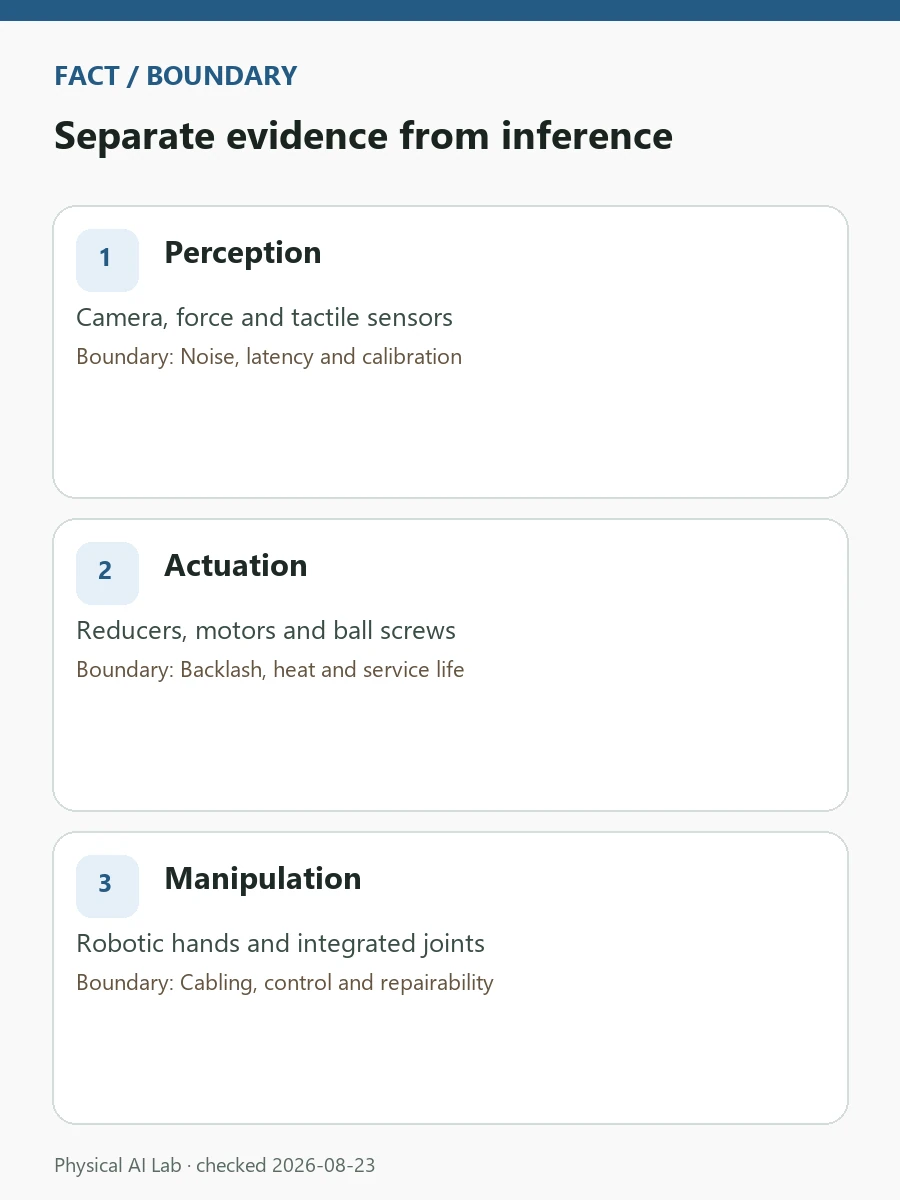
| System layer | Components named | Comparison risks |
|---|---|---|
| Perception | Camera, force and tactile sensors | Noise, latency and calibration |
| Actuation | Reducers, motors and ball screws | Backlash, heat and service life |
| Manipulation | Robotic hands and integrated joints | Cabling, control and repairability |
The best component specification may not make the best system
Components have to be evaluated as a combination. Higher torque density can increase thermal and power demands, while a more dexterous hand can add sensors, cables and control complexity.
Repeatable physical AI also requires sensor time synchronization, state estimation, planning, low-level control, safety limits and post-failure recovery to remain connected. Perception is only one layer.
Ask for production evidence, not only peak specifications
Request the conditions under which a part fails, not just the best test result. Repeat counts, intervention points and recovery time after a system stop help reveal how a component behaves once integrated.
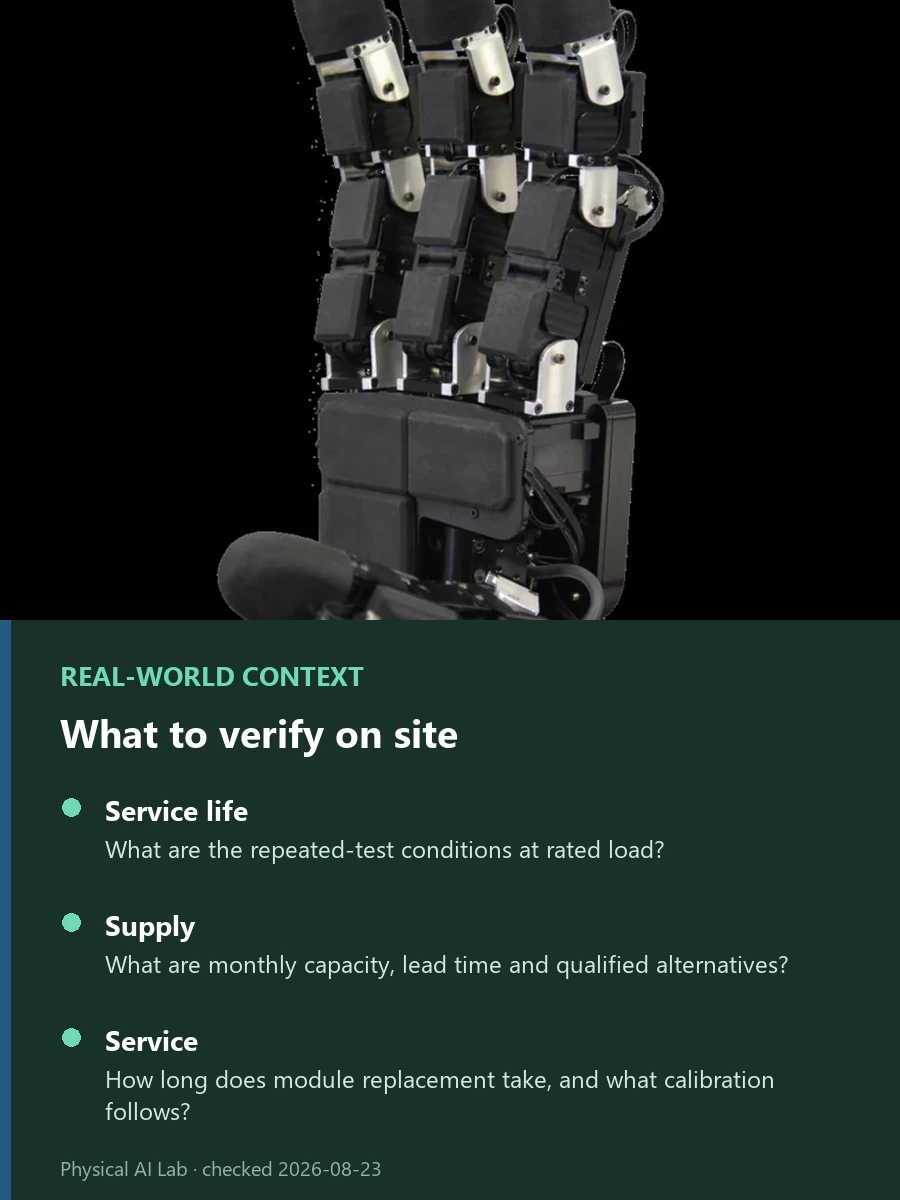
| Check | Question to ask |
|---|---|
| Service life | What are the repeated-test conditions at rated load? |
| Supply | What are monthly capacity, lead time and qualified alternatives? |
| Service | How long does module replacement take, and what calibration follows? |

Compare samples and production parts under the same conditions
Do not mix prototype specifications with production specifications. Temperature, shock, duty cycle and ingress-protection conditions must be aligned before the numbers are compared.
Current evidence comes from event and company material. Customer data, independent tests and regulatory documentation should be added when available.
Place each component inside the broader physical AI stack
Place each supplier in the physical AI company ecosystem, compare its validation tools with the robot simulator comparison and test its compute assumptions against edge AI for robots. That context turns the August 2026 component list into a system-level review.
The supply-chain lesson
The finished humanoid brand is only the visible end of a much larger component system. Judge suppliers by repeatable results under matched conditions and by transparent production, integration and service requirements—not by the largest isolated specification.
Frequently asked questions
How can a component exhibitor demonstrate volume-production readiness?
Provide production-part test data, lot-to-lot variation, yield, lead time, service-life conditions and a replacement process. A peak prototype specification does not show that customers can receive consistent parts.
Which component metrics should a robot builder request first?
Alongside task success, request the human-intervention rate, mean recovery time, continuous operating time and failure conditions for the integrated system. Those four measures reveal interactions that a peak component specification can hide.
How should teams compare two robot components fairly?
Use the same load, duty cycle, temperature, shock, ingress, control and calibration conditions. Compare service life and repair time as well as peak performance.
Official sources checked
- Beijing municipal government's official WRC 2026 event guide
- Invest Beijing's WRC 2026 industry overview
- World Robot Conference official service platform
Last checked: August 23, 2026