The most useful way to classify humanoid robots is by the environment and job they are designed to handle. A robot built for a home faces clutter, close contact and many object types. A factory robot can work inside a narrower operating envelope with known routes, containers and safety procedures. A research platform is designed to be changed by developers rather than used as a finished service.
Body shape alone is a poor classifier. Two robots may both have a head, torso, arms and legs while differing completely in payload, speed, hands, autonomy and support model. Some systems walk on two legs, others combine a humanoid upper body with wheels, and some omit the lower body because the task is tool use at a fixed workstation.
A practical comparison therefore asks four questions: where will the robot work, what task will it repeat, how much human intervention is expected, and what deployment evidence exists? Those questions separate a promising demonstration from a machine that can be operated and maintained in a real facility.
A practical classification starts with the job
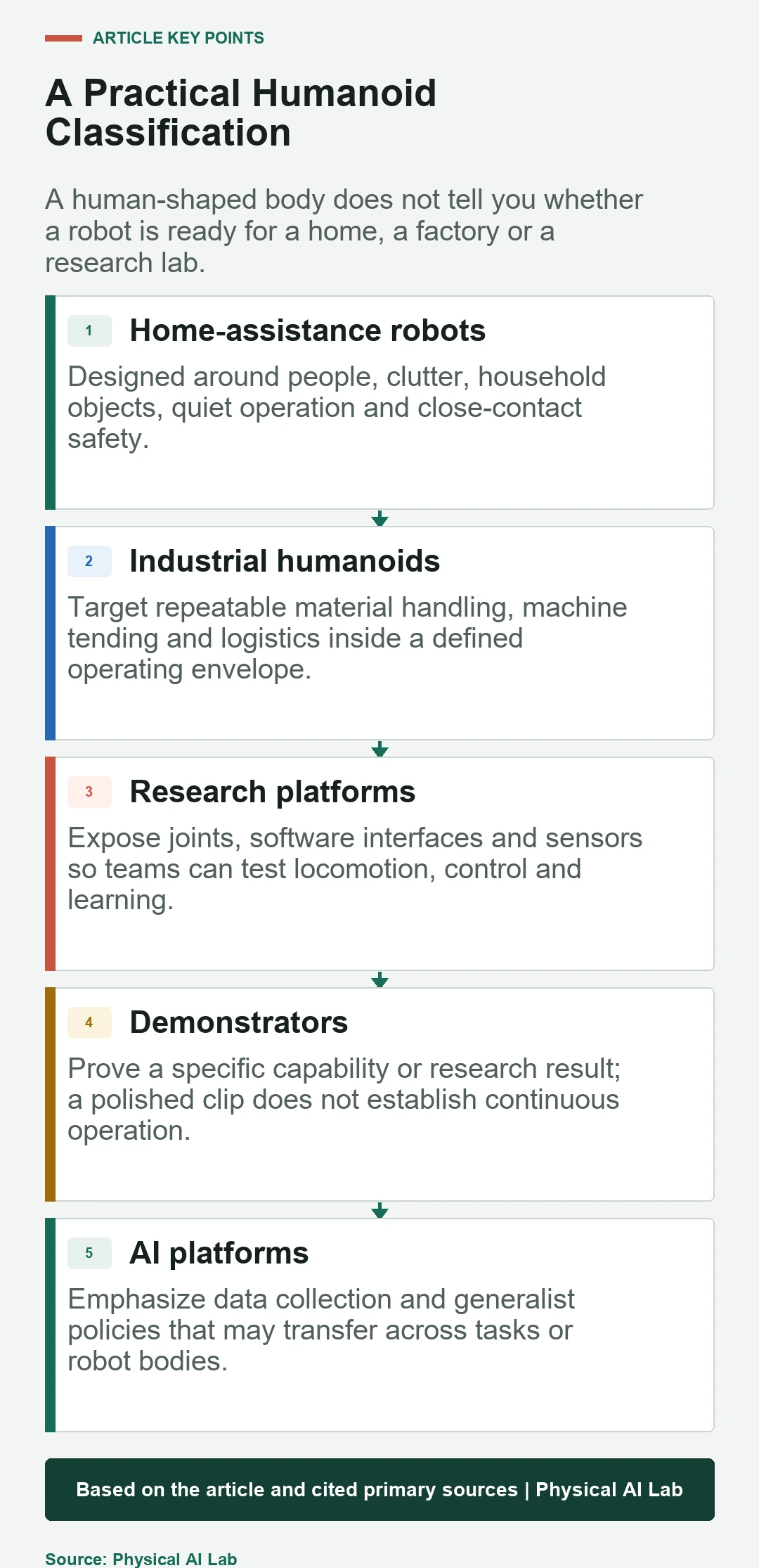
Home-assistance, industrial, research, demonstration and AI-platform robots are useful working categories. They are not formal standards, and one product may span more than one group. The categories help readers interpret product pages without assuming that every human-shaped machine has the same readiness or purpose.
The classification should be paired with body architecture. A biped may cross thresholds and use human-scale spaces, while a wheeled base can be more efficient on flat floors. Dexterous hands can expand task range but add sensing, control and maintenance problems. The card below summarizes the five use-oriented categories.
Home robots must handle people and long-tail variation
A home robot must operate around people, pets, fragile objects and layouts that were not prepared for automation. The official 1X NEO page describes household chores, autonomous behavior and an Expert Mode in which a person can remotely guide unfamiliar tasks. That combination is evidence that early home operation may mix autonomy and human support.
Figure also positions Figure 03 for home and commercial settings, with redesigned hands, tactile sensing, soft materials and charging features. These are relevant design choices, but a home claim still needs task-level evidence: which chores, how many trials, what objects, how often intervention occurred and what the robot does when it is uncertain.
Industrial humanoids trade breadth for an operating envelope
Factories and warehouses are more structured than homes. Containers, aisle widths, workstations and handoff rules can be specified, so an industrial humanoid can begin with a narrow material-handling or machine-tending task. The objective is not to imitate every human movement; it is to complete a valuable workflow safely and repeatedly.
Agility Robotics presents Digit around material movement and facility operation, while Boston Dynamics Atlas is framed for industrial work. Evaluate these systems by sustained task cycles, integration with facility software, recovery procedures, charging, maintenance and the boundary of the approved workspace.
Research platforms are products for developers
A research humanoid is valuable because teams can access software interfaces, sensors, logs and control modes. It may be used for locomotion, manipulation, reinforcement learning or teleoperation experiments. That openness does not make it a household appliance; it often assumes trained operators, controlled test space and active engineering support.
The Unitree R1 illustrates the way a platform can be marketed to developers and education alongside broader humanoid ambitions. Before buying, check the available SDK, actuator and sensor documentation, emergency-stop behavior, replacement parts, warranty limits and whether the advertised hands or computing options are included in the quoted configuration.
A demonstration is evidence of one capability
Demonstration robots are optimized to prove that a motion, model or mechanical design is possible. A successful clip may show an important advance, but it does not reveal the failed attempts, resets, remote assistance, environmental preparation or time required between takes. The correct conclusion is limited to what the demonstration actually measured.
A deployment claim needs a different evidence set. The humanoid robot cost guide explains why hardware price is only one part of adoption. Operations also include integration, safety validation, tooling, charging, support, spares and downtime. A robot type becomes commercially meaningful when those elements are defined for a task.
Bipeds, wheels and upper-body systems solve different constraints
Two legs can help a robot use stairs, thresholds and workspaces designed around human reach. They also introduce balance control, fall risk and energy cost. Wheels reduce those problems on smooth floors, and an upper-body system can focus its mass and complexity on arms and hands when locomotion is unnecessary.
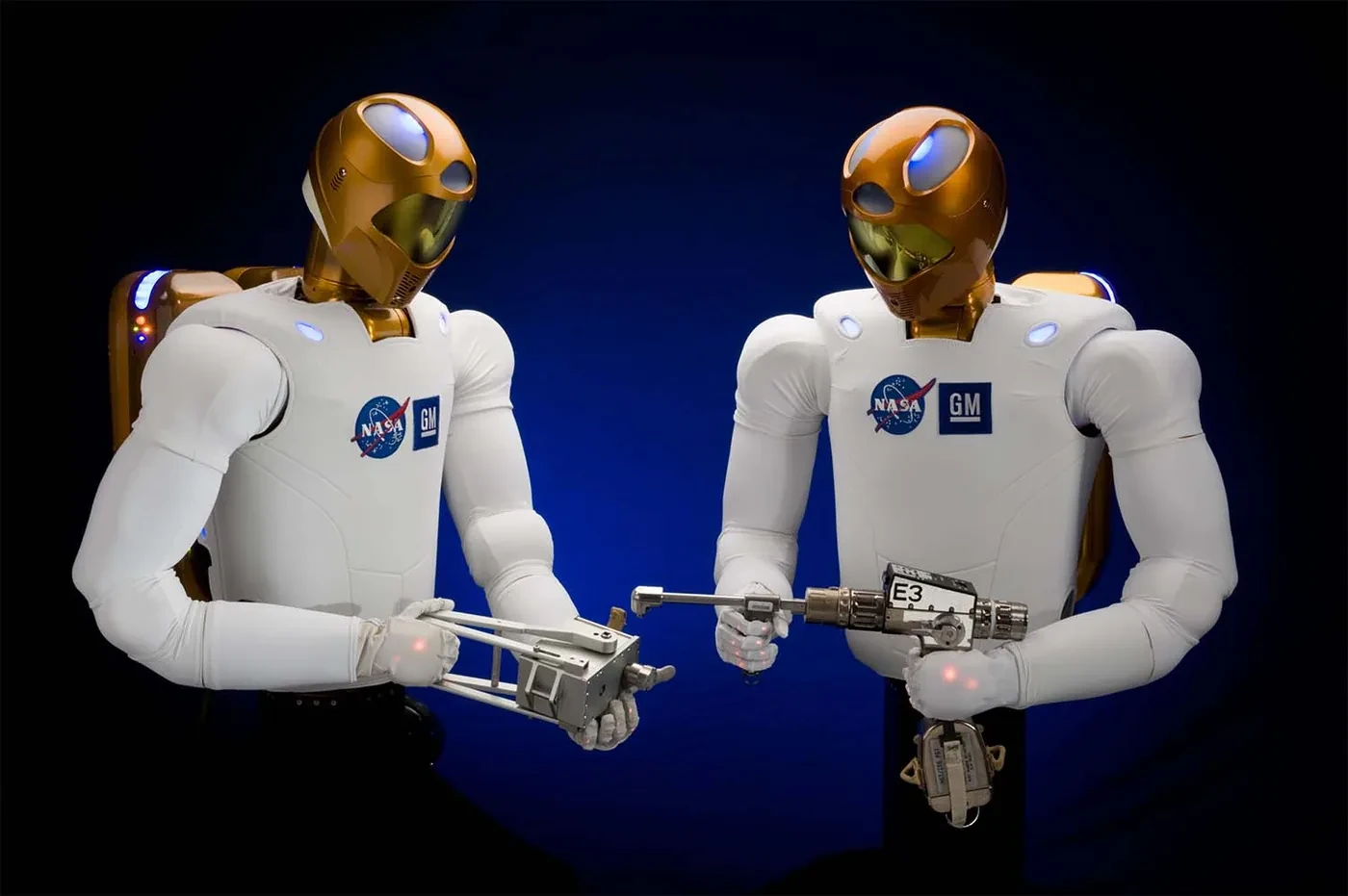
NASA’s Robonaut 2 is a useful reminder that humanoid design can center on a torso, arms, hands and human tools. Classification should describe what the body enables and what it gives up, instead of treating full bipedal form as the only measure of sophistication.
Autonomy and operating model form another axis
One robot may use scripted control for a known process, another may combine teleoperation with learning, and another may use a vision-language-action model for more flexible instructions. These approaches are not simple maturity levels. A scripted system can be the better product when the task is stable and safety requirements are strict.
Ask who acts when the robot encounters an unfamiliar object, blocked path or weak grasp. The answer may be an onboard recovery policy, a remote operator, a local worker or a complete stop. Intervention rate, response time and data handling are part of the product type because they determine staffing, privacy and economics.
Use environment and task to narrow the comparison
Start with the operating environment before comparing specifications. Payload and walking speed matter only after the task, floor, human proximity and object set are defined. The table separates the dominant design pressure for three common categories and shows why a single ranking is misleading.
Products within a category still vary. A home research prototype and a supported home service are not equivalent, and an industrial pilot is not the same as a production fleet. Treat category as the first filter, then compare evidence within the same job and operating envelope.
| Category | Primary environment | Dominant challenge | Evidence to request |
|---|---|---|---|
| Home assistance | Unstructured living space | Long-tail objects and close contact | Autonomous task trials and intervention rate |
| Industrial | Defined factory or warehouse zone | Uptime, integration and safety | Sustained cycles in a named workflow |
| Research | Lab or controlled test area | Access, repeatability and extensibility | SDK, logs, interfaces and support scope |
| Demonstration | Prepared scene | Proving a specific capability | Full trial count, resets and operator role |
Deployment evidence matters more than category labels
A product page can call a robot general purpose, autonomous or production ready without defining the test conditions behind those words. Translate each label into a measurable question. General purpose should mean a documented task range. Autonomous should report when people intervene. Production ready should identify reliability, support and safety processes.
The strongest evidence combines task success with duration, intervention, recovery and operating conditions. A robot that succeeds in 95 of 100 representative trials with logged failures is easier to assess than a montage of ten successes. The table below converts common claims into evidence requests.
| Claim | What it should specify | Warning sign |
|---|---|---|
| Autonomous | Human intervention rules and rate | Remote help omitted |
| General purpose | Tested tasks, objects and environments | No defined evaluation set |
| Commercial deployment | Customer workflow, duration and fleet size | Pilot and production treated as identical |
| Home safe | Hazard analysis and validated operating limits | Soft appearance used as the only evidence |
A five-question filter for a new humanoid
When a new robot appears, record its target environment, repeated task, body architecture, human-support model and deployment evidence. Then note the exclusions: stairs, outdoor use, payload limits, object types, operating time and restricted human proximity. This creates a comparable record without relying on marketing categories.
Finally connect the body to the larger system. A humanoid is one possible embodiment of physical AI; it is not synonymous with physical AI itself. The value comes from the complete sensing, planning, control, safety and operational loop, not from resemblance to a person.
- Where is the robot expected to work?
- Which task must it repeat and for how long?
- What body design supports that task?
- When and how do people intervene?
- What deployment evidence is public?
Frequently asked questions
How many types of humanoid robots are there?
There is no single formal count. A practical grouping is home-assistance, industrial, research, demonstration and AI-platform robots, combined with body architecture such as biped, wheeled or upper-body systems.
Is an industrial humanoid always bipedal?
No. A robot can use a humanoid torso and arms on a wheeled base when a flat industrial floor favors stability and efficiency over stair climbing.
Can a low-cost humanoid be used at home?
Not automatically. A lower purchase price may describe a developer platform. Home use also requires safe interaction, support, task software, maintenance and evidence in real living spaces.
What is the difference between a demo robot and a deployed robot?
A demo proves a capability in a prepared test. A deployed robot must repeat a defined workflow with documented uptime, recovery, safety, staffing and maintenance.
Are humanoid robots the same as physical AI?
No. A humanoid is a body form. Physical AI describes intelligence connected to sensing and action in the physical world and can also use mobile robots, drones, vehicles or industrial machines.
How to Read Product Claims
Product capabilities, availability and deployment status can change. Recheck the linked official product pages and request task-level evidence before making a purchase or safety decision.