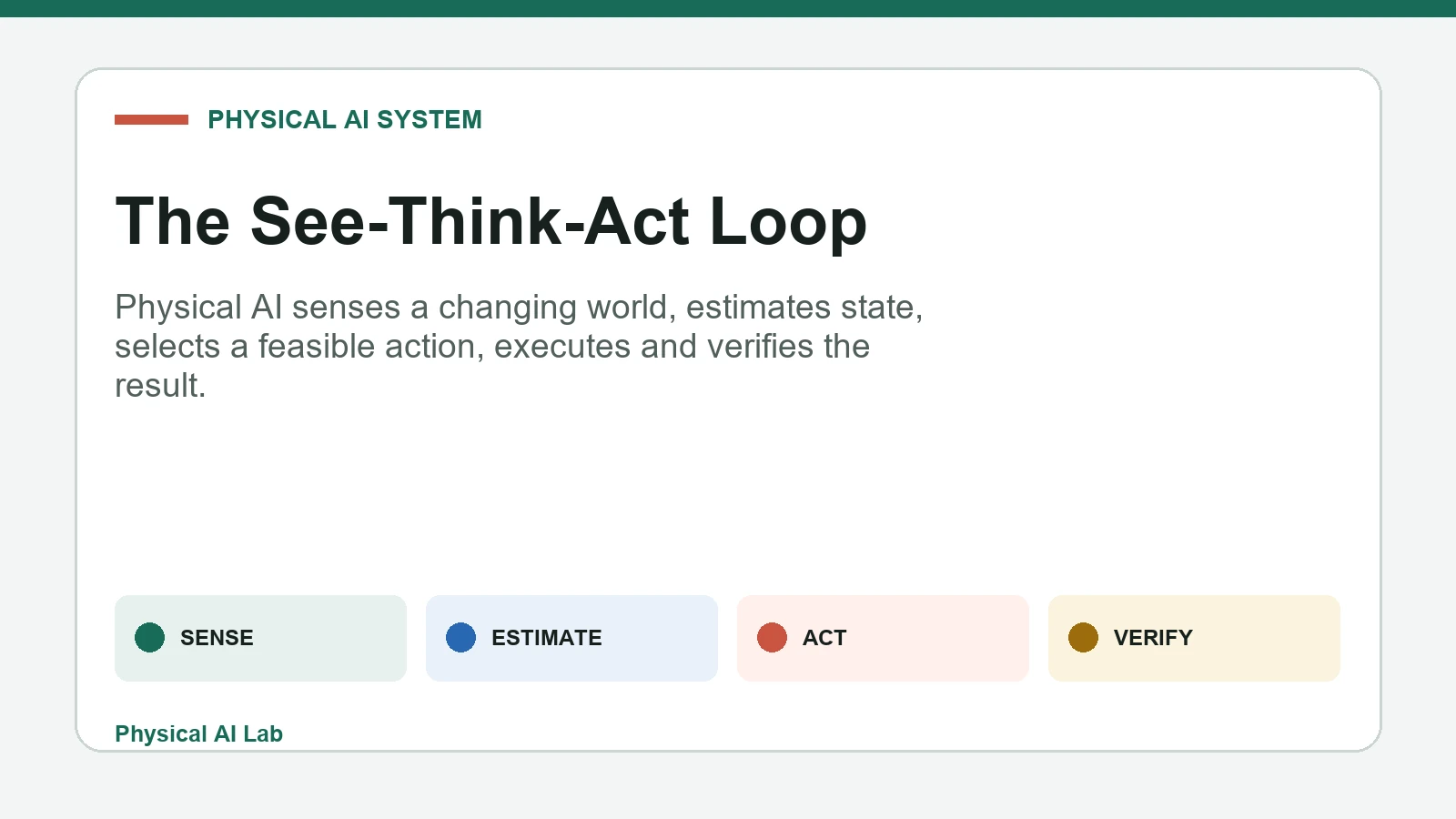
Physical AI is a system that observes a real environment, estimates what is happening, selects an action, moves a machine and checks what changed. The important idea is not one model name. It is the closed loop connecting sensors, models, planning, control, safety and new evidence from the physical result.
A robot picking up a cup illustrates the loop. Cameras and joint sensors describe the scene and the robot body. Software estimates the cup pose, reachable surfaces and nearby people. A planner chooses an approach, the controller moves the arm, and sensors verify contact, lift and placement. A failed grasp changes the next decision.
This framework connects the site’s introductions to what Physical AI means, vision-language-action models and robot action data. It also prevents a fluent model response from being confused with reliable operation on hardware.
Seeing means measuring an actionable state
A camera image is only one observation. Robots may combine RGB and depth cameras, lidar, microphones, encoders, inertial sensors, force-torque sensors, tactile arrays and safety devices. Each sensor measures a limited part of the world with its own range, resolution, delay, noise and failure modes.
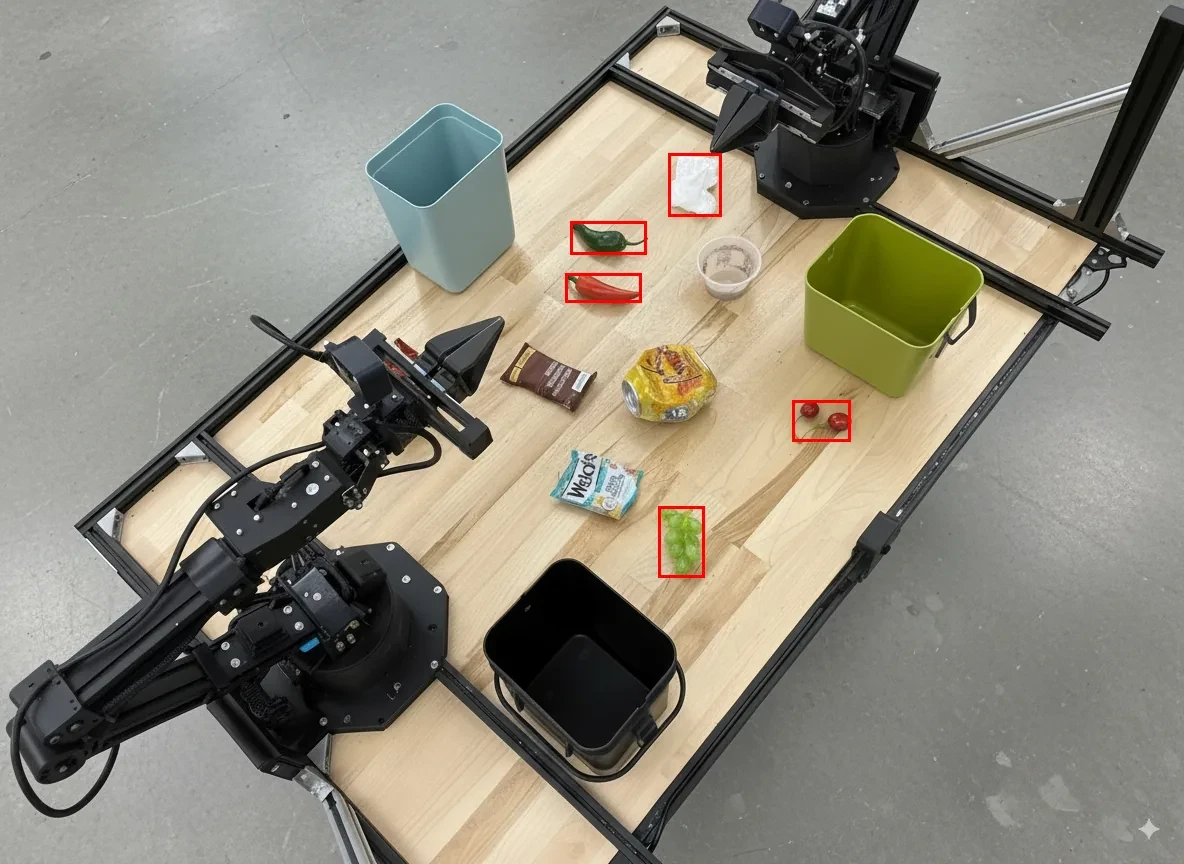
Actionable perception asks more than what an object is. It estimates where the object is, whether a grasp surface is exposed, how the robot is moving and which regions must remain collision-free. Calibration and timestamps connect those measurements to a common coordinate frame before a decision can use them.
State estimation turns measurements into a working belief
Sensor readings can disagree or arrive at different rates. State estimation combines them into a belief about robot pose, object pose, velocity, contact and uncertainty. The result is not a perfect copy of reality; it is the best task-relevant estimate available at the decision time.
A deeper guide to robot sensors for Physical AI explains why fusion and synchronization matter. The system should retain confidence or covariance where possible. Hidden uncertainty is dangerous because a planner may treat a weak visual guess as a precise geometric fact.
Thinking means selecting feasible actions
For a robot, reasoning is useful when it changes the set or order of feasible actions. The system may identify a target, interpret an instruction, predict contact outcomes, choose a grasp, order subtasks or reject a goal that violates safety constraints. A textual scene description is not yet a robot plan.
Planning can be hierarchical. A task planner decides that a container must be opened before an item is removed. A motion planner finds a collision-free path, while a controller converts that path into joint commands. Learned policies may combine some stages, but the same feasibility and safety questions remain.
| Decision layer | Typical output | Primary evidence | Failure signal |
|---|---|---|---|
| Task | Ordered subgoals | Instruction and scene state | Goal cannot be completed |
| Action | Grasp or motion candidate | Geometry and affordance | Candidate is unreachable |
| Motion | Collision-free trajectory | Robot and obstacle model | No valid path |
| Control | Timed actuator commands | Feedback and limits | Tracking or contact error |
Acting is a timed control problem
An action prediction must be converted into motion the hardware can execute. Joint limits, speed, torque, payload, balance, communication rate and actuator saturation shape the result. Commands that are valid in an abstract model can still be unsafe or dynamically impossible on the robot.
Fast feedback often runs below the large AI model. A real-time controller tracks position, velocity, torque or force while safety logic monitors limits and protective devices. This layered design allows slower semantic reasoning to guide the task without placing every emergency response inside a generative model.
Feedback closes the Physical AI loop
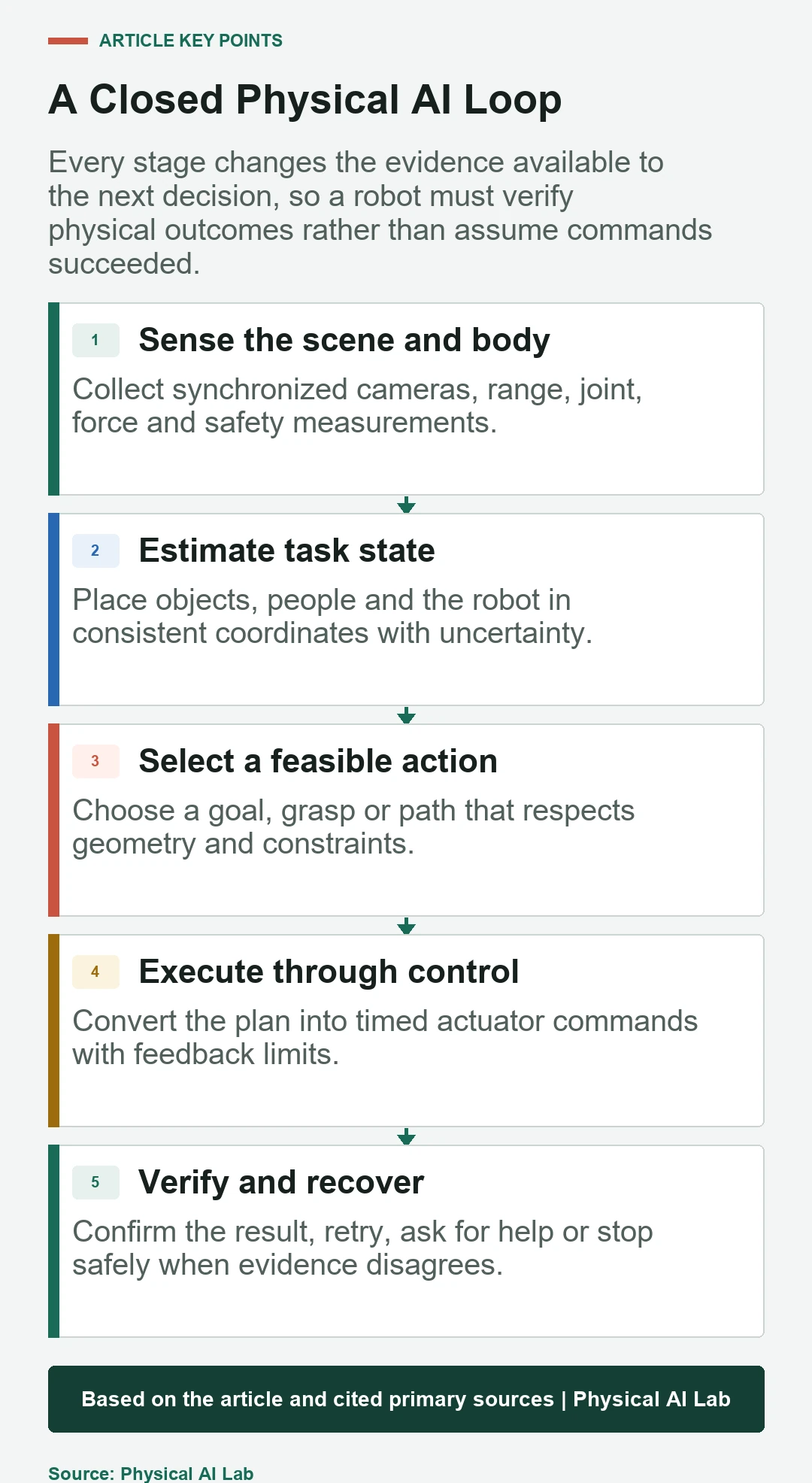
The robot must observe what actually happened after acting. Did the gripper contact the intended object? Did the object move with the hand? Was it placed inside the destination, and did a person enter the work area? Verification creates evidence for success, retry, recovery or a safe stop.
Open-loop demonstrations can hide this requirement because the clip ends after a plausible motion. Production systems need explicit success conditions and timeouts. When the observation differs from the predicted result, the system should update state rather than continue from an assumption that has become false.
Safety constrains every stage rather than one final check
Safety begins with sensing coverage and continues through uncertainty handling, planning constraints, control limits and monitored stopping. A model should not be allowed to issue arbitrary actuator commands outside the validated envelope. Independent protective functions may be required when people can approach the machine.
Define the robot’s operating domain, permitted contacts, maximum forces, fallback states and responsibility for restart. Uncertainty should change behavior: the machine can slow down, request another view, ask for help or stop. Confidence that never affects action is only a display value.
Learning depends on complete episodes and failures
Robot learning data should align observations, state, actions, timing and outcomes. Successful episodes teach useful behavior, while failures reveal occlusion, poor calibration, contact instability and recovery states. Removing every failed attempt can produce a dataset that never teaches the policy when to stop or correct itself.
Demonstration data may come from teleoperation, scripted controllers, simulation or autonomous trials. The teleoperation data guide shows why synchronization and curation are as important as the number of episodes. Deployment logs can then reveal which states deserve more data.
| Loop signal | What to record | Why it matters |
|---|---|---|
| Observation | Sensor streams and calibration | Reconstructs what the policy could know |
| State | Robot pose, joints and contact | Separates perception from body condition |
| Action | Command and execution time | Links intention to physical motion |
| Outcome | Success, failure and intervention | Supports evaluation and recovery learning |
| Context | Task, object and environment | Explains coverage and distribution shift |
Latency changes what the robot can safely do
A perception result describes the past by the time it reaches a controller. Camera exposure, transfer, preprocessing, inference, planning and communication each add delay. When a person or object moves, the robot can act on a state that is already stale even if every model is individually accurate.
Onboard inference can shorten the loop for time-sensitive functions, as discussed in the edge AI for robots guide. Measure end-to-end age of information and jitter, not only model inference time. The slowest path and worst observed delay often determine safe speed.
A useful evaluation tests the complete loop
Offline model accuracy does not prove task success. Evaluate repeated physical trials with representative objects, people, lighting, surface conditions and starting states. Report first-attempt success, eventual success, intervention, completion time, safety events and the portion of the task distribution that was included.
Ablation tests help locate the bottleneck. Replace perception with ground-truth state, replace the learned policy with a scripted plan, or replay recorded sensor data through a new model. These comparisons show whether the next improvement belongs in sensing, reasoning, planning, control or operations.
Read robot demonstrations as evidence, not theater
A strong demonstration states the task boundary, number of trials, human involvement, speed, environment changes and failure handling. A single edited success can show a capability exists, but it cannot establish reliability, autonomy or coverage. The loop must keep working after the first unexpected event.
Use the site’s humanoid video evaluation guide and teleoperation checklist when examining public claims. Look for continuous footage, independent task verification and disclosed intervention rather than judging natural-looking motion alone.
- Define the task and success condition.
- Identify every observation and control input.
- Measure end-to-end latency and uncertainty.
- Record retries, interventions and failures.
- Verify results across representative repeated trials.
Frequently asked questions
Is the see-think-act loop one AI model?
No. It is a system pattern that may combine learned models, state estimation, planners, controllers, safety functions and hardware. Some models join several stages, but the physical interfaces remain.
Does a robot need a VLA model to be Physical AI?
No. A robot can close the perception-action loop with conventional vision, rules, planning and feedback control. A VLA is one architecture for connecting observations and language to actions.
Why is feedback necessary after an action?
Physical execution can differ from the command because of contact, slip, obstruction, calibration error or a changing environment. Feedback confirms success and determines retry, recovery or stop.
Where should safety logic run?
Safety is layered. Task policies can respect constraints, while time-critical protective functions and certified devices may run independently of the high-level AI model.
What is the best metric for the loop?
Use task-level success with defined coverage, completion time, interventions, safety events and recovery behavior. Add stage-level metrics to diagnose why the complete loop succeeds or fails.
Engineering Evidence Note
Physical AI architectures and model capabilities change quickly. Verify current documentation and evaluate the complete sensing-to-action loop on representative hardware, environments and safety conditions.