Robot grasp planning chooses where and how an end effector should contact an object, then determines whether the robot can approach, close, lift and continue the task. The planner connects perception, contact geometry, gripper capability, inverse kinematics, collision checking and motion planning. A contact score alone is not an executable pick.
Parallel-jaw, suction and dexterous hands need different candidates and quality assumptions. Object pose and shape are uncertain, friction may be unknown, and clutter hides surfaces. The useful output is therefore a ranked set of feasible strategies with explicit rejection reasons and recovery behavior, not one perfect pose.
Use this guide with the inverse kinematics guide and motion planning comparison. Validate grasp planning with real objects, calibrated collision geometry and the complete approach-to-retreat sequence.
Represent the object, support and uncertainty
Estimate object pose, visible geometry, support surface and nearby obstacles in a common frame. A mesh, point cloud, primitive or learned feature can support candidate generation, but each preserves different detail. Store pose covariance or a sampled uncertainty set instead of treating a single estimate as exact.
Include bin walls, table edge, neighboring objects, camera occlusion and the robot tool in the scene. Calibrate the transform from perception to robot base and measure its drift. A few millimeters of error can change a narrow parallel-jaw grasp from clearance to collision.
Generate candidates that match the end effector
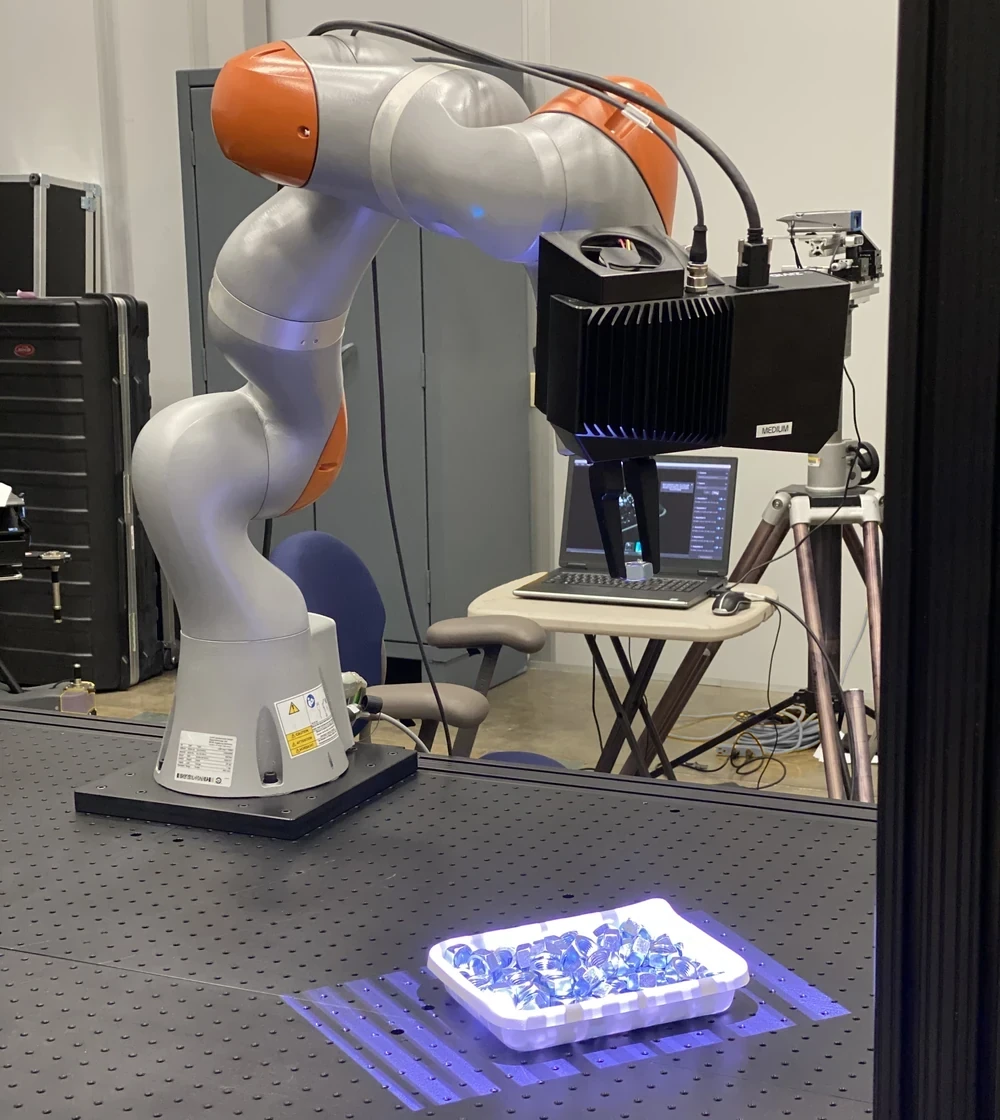
A parallel-jaw generator proposes gripper poses and openings around opposing contact regions. A suction planner needs seal area, normal direction, cup compliance and an airflow strategy. A dexterous hand additionally chooses several contacts and a joint configuration. Do not apply one quality function to incompatible hardware.
Sample approach direction and roll, not only final contact pose. Respect jaw width, finger depth, palm clearance, suction-cup diameter and cable or wrist geometry. Candidate diversity should cover several object regions so occlusion or one blocked approach does not eliminate the complete plan.
| End effector | Candidate basis | Key assumption | Execution check |
|---|---|---|---|
| Parallel jaw | Opposing surfaces | Friction and opening | Finger and palm clearance |
| Suction cup | Surface patch and normal | Seal and pressure | Peel and leak |
| Soft gripper | Envelopment region | Compliance model | Object escape |
| Dexterous hand | Multi-contact configuration | Contact force model | Hand kinematics |
| Magnetic tool | Material and face | Magnetic attraction | Residual attachment |
Contact quality is a model-based ranking signal
Force closure asks whether allowable contact forces can resist arbitrary external wrenches under a contact and friction model. Related scores measure wrench-space margin, contact separation or sensitivity to perturbation. These are useful comparisons only when friction coefficient, contact type and object geometry are credible.
Task-specific quality may matter more than generic closure. A handoff, pour or insertion needs a pose that leaves required surfaces accessible and controls object orientation. Add center-of-mass, expected acceleration and downstream task constraints. High analytic quality cannot compensate for unreachable robot posture.
Filter inverse kinematics and joint limits early
Solve inverse kinematics for the grasp and pre-grasp poses with the correct tool center point and grasp frame. Reject joint-limit, self-collision and singularity conflicts, and retain multiple IK branches where possible. The closest joint solution is not always the one with the best approach clearance.
The inverse kinematics versus inverse dynamics guide explains why pose feasibility and required motion or force are separate questions. Score manipulability and limit margin as preferences, but verify actual trajectories. A feasible endpoint can still be disconnected from the current robot state.
Collision checking needs complete gripper geometry
Check the open gripper during approach, fingers during closure, attached object during lift and robot links along every transition. Allow only intentional contact pairs and restore collision rules after attachment. Simplified geometry can speed planning but must conservatively represent protrusions, fingertips and carried objects.
Inflate obstacles or sample object pose to account for calibration uncertainty. Excessive inflation can remove all solutions, while no margin produces brittle paths. Track whether candidates fail at object contact, environment collision, self-collision or attached-object clearance so perception and planning problems are not mixed.
| Planning gate | Input | Reject when | Log |
|---|---|---|---|
| Contact geometry | Object and gripper | Poor or impossible contact | Quality components |
| IK | Grasp frame and robot | No valid joint state | Solver and branch |
| Collision | Scene and geometry | Unallowed overlap | Contact pair |
| Approach | Pre-grasp to grasp | No clear path | Minimum clearance |
| Lift and retreat | Attached object | Blocked extraction | Failed stage |
Approach, closure, lift and retreat form one task
Plan a pre-grasp with enough distance to establish a collision-free approach, then define closure and attach behavior. After grasping, lift far enough to verify separation from the support before transport. Retreat direction should fit the clutter and preserve object stability, not simply reverse the approach.
Current MoveIt Task Constructor documentation composes complex manipulation from generator, propagator and connector stages. This makes stage-level failure visible. The older monolithic pick-and-place interface is deprecated in current documentation in favor of MTC for new workflows.
MoveIt Grasps has an intentionally limited scope
The MoveIt Grasps tutorial describes grasp generation, visualization and filtering for simple shapes, with reachability and motion-planning integration. Its documented limitations include simplified cuboid-oriented generation rather than a general contact-dynamics solution.
Use the package as a pipeline component, not proof that a physical grasp is stable. Add perception uncertainty, gripper-specific contact scoring and task stages. Pin the MoveIt and robot configuration version because collision meshes, kinematics plugins and planning parameters directly change which candidates survive.
Clutter couples perception and extraction
In a bin, neighboring objects occlude contact surfaces and may move during approach. A candidate with strong finger contact can still be impossible to extract without hitting a wall or another object. Plan the carried-object path through the visible free space and account for unseen regions conservatively.
NIST grasping and manipulation performance work emphasizes measurable system performance. Build test sets by object shape, material, packing density and presentation rather than showing only selected successful picks. Record perception, planning and execution failures separately.
Tactile and force evidence verify the physical grasp
After closure, use finger position, motor current, tactile distribution, vacuum pressure or wrist wrench to decide whether contact occurred and the object is retained. The expected signature depends on object compliance and gripper. One current threshold can confuse a hard stop, an object and debris.
Perform a small bounded lift or verification motion before fast transport when the task permits. Detect slip and unexpected mass, then retreat or replace the object through a defined recovery. Coordinate thresholds with the controller and collision monitor so a verification action does not create a new hazard.
Evaluate candidate quality through task outcomes
Measure candidate-generation time, IK and collision rejection rates, plan time, approach completion, grasp acquisition, lift retention and final placement. Report denominators at each stage. A high grasp-success rate after excluding planning failures hides system throughput and selection bias.
Use held-out objects, materials, poses and clutter patterns, then compare against a simple baseline such as top-down picks. Coordinate controller evidence with the joint gain-tuning guide. Preserve scene snapshots, chosen candidate, rejection reasons, path and synchronized video for every trial.
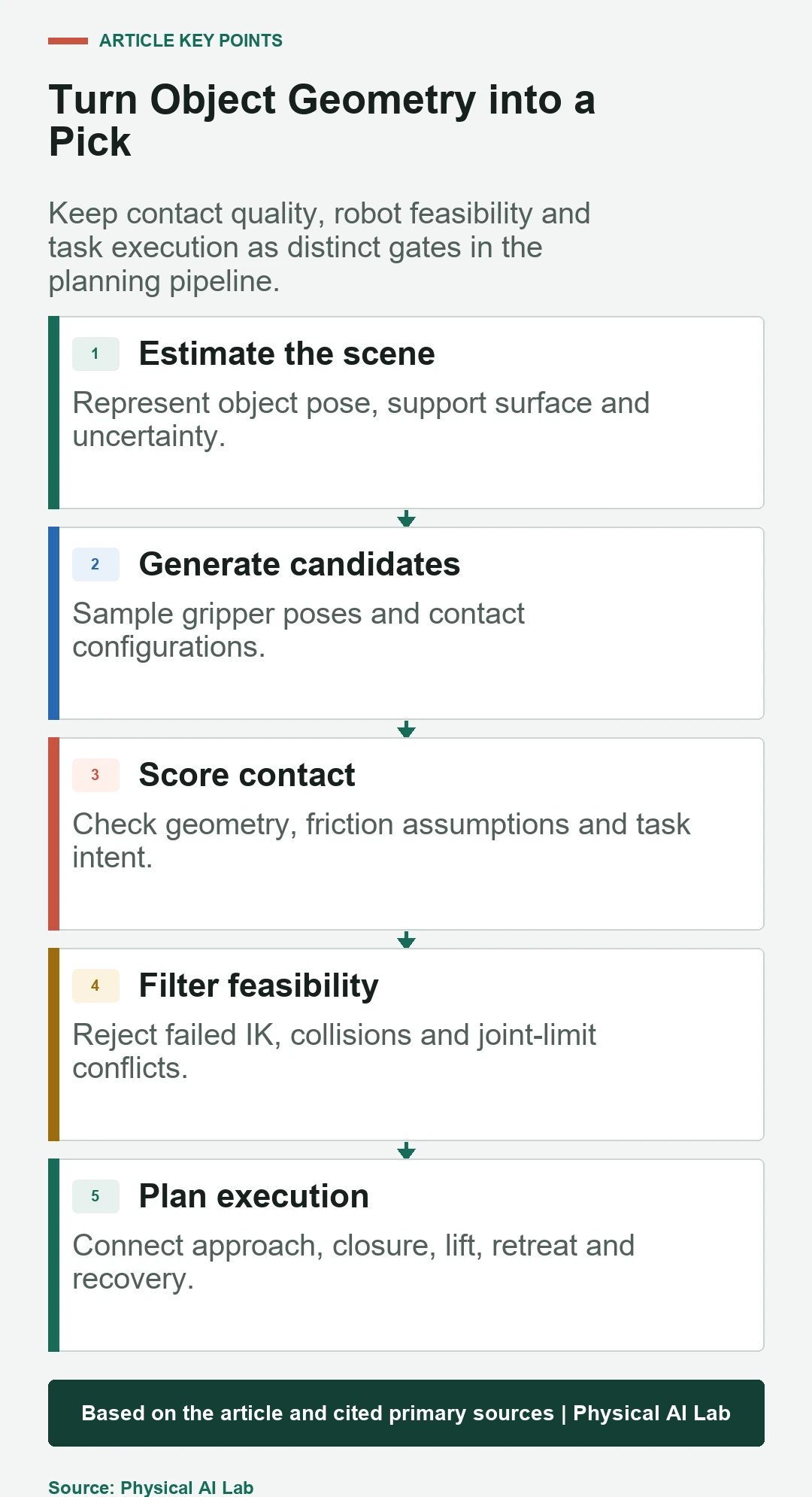
- Represent pose, support and uncertainty.
- Generate gripper-specific candidate diversity.
- Separate contact quality from robot feasibility.
- Plan approach, closure, lift and retreat as stages.
- Validate on held-out objects and clutter with full denominators.
Frequently asked questions
Does an object pose directly determine the grasp?
No. It enables candidate generation, but contact quality, gripper geometry, IK, collision, approach and extraction still determine executability.
Does force closure guarantee a successful pick?
No. It depends on contact and friction assumptions and says nothing by itself about perception error, reachability, collision or controller execution.
Why keep several IK solutions?
Different branches can have very different joint margins and approach clearance. Discarding all but the nearest solution can remove the only executable path.
Should more grasp candidates always be generated?
No. More candidates can improve coverage but increase IK and collision cost. Use staged filters and measure whether added diversity improves real task success.
How can unseen objects be grasped?
Geometry- or learning-based generators can propose grasps, but the sensor must observe enough surface and the candidate must remain inside the validated object, material and clutter range.
Grasp Planning Application Boundary
Grasp-planning scores depend on perception, geometry, friction and gripper assumptions. Verify complete approach, contact, lift, retreat and recovery behavior on the target robot and object set.