A factory acceptance test, or FAT, demonstrates selected requirements before equipment leaves the vendor or integration facility. A site acceptance test, or SAT, demonstrates selected requirements after installation with the real utilities, interfaces, environment, operators and production context.
They are one contractual evidence chain with different available conditions. FAT should find defects while correction is easiest; SAT should verify that shipment, installation and site integration did not invalidate the accepted factory baseline.
This guide is an engineering framework, not legal advice. Use it with the robot risk-assessment guide and the robot uptime and OEE guide, then align the plan with the governing contract and standards.
Assign FAT and SAT evidence from the contract
For every user requirement, name the verification method, responsible party, prerequisites, test location, input conditions, measurement, acceptance rule, witness or approval authority and required record. Mark items that can be fully closed at factory and those that need site confirmation.
Avoid vague clauses such as demonstrate normal operation. Define product, tool, cycle, duration, tolerance and permitted exclusions before the equipment is built.
Use current acceptance-test guidance within scope
The official IEC page states that IEC 62381:2024 defines requirements and checklists for FAT, FIT, SAT and SIT for automation systems in the process industry and supports project-specific plans. Its third edition has a stability date of 2029.
A robot application may have additional product, machinery, sector and legal requirements. Treat this standard as applicable guidance within its scope, not a universal substitute for the contract or ISO 10218-2:2025 integration responsibilities.
Close correctable factory defects before shipment
FAT commonly covers equipment identity, mechanical completion, wiring and I/O, software functions, modes, alarms, interfaces, safety-related evidence, documentation, backups and representative performance with available fixtures and materials.
Record what was simulated or unavailable, including utilities, upstream and downstream systems, production products and operator procedures. An excluded condition becomes a planned SAT item, not an implied pass.
Distinguish a witnessed demonstration from objective evidence
A live cycle can help stakeholders understand the system, but observation alone does not prove repeatability or tolerance. Preserve test inputs, calibrated instruments, raw results, acceptance calculation, software baseline and deviations.
Control who may change parameters during the run. If tuning occurs, invalidate affected data, capture the new baseline and restart the official acceptance sequence.


Use readiness gates before official FAT
Require design and risk reviews, mechanical and electrical completion, calibrated equipment, approved procedures, representative test material, safe work controls, trained participants, software freeze and backup verification before the clock starts.
A pre-FAT dry run may find setup defects. Keep its exploratory results separate from witnessed acceptance evidence unless the contract explicitly permits their use.
| Gate | Required input | Evidence | Stop condition |
|---|---|---|---|
| Requirements | Approved trace matrix | Test ownership | Ambiguous criterion |
| Configuration | Hardware and software baseline | Version and checksum | Uncontrolled change |
| Safety | Approved test controls | Briefing and permits | Unsafe setup |
| Measurement | Calibrated instruments | Range and uncertainty | Expired calibration |
| Material | Representative product | Lot and condition | Nonrepresentative sample |
Control the baseline through shipment and installation
Record disassembly, protective packaging, transport conditions, shock or tilt evidence where relevant, received condition, damage, reassembly, alignment, utilities, cabling and approved modifications. Compare the installed system with the FAT baseline.
Classify each difference by affected requirements and tests. Even a replacement cable, tool or firmware patch can change timing, geometry, safety or performance evidence.
Use SAT for real site integration and operation
SAT verifies site power, air, network, environmental conditions, guarding, material flow, upstream and downstream interfaces, recipes, identity systems, production data, recovery, maintenance access and operator procedures.
Test normal, setup, changeover, fault recovery, cleaning and maintenance modes under controlled conditions. A successful automatic cycle cannot close non-production hazards or business-system interfaces.
Separate commissioning data from acceptance data
Commissioning adjusts and debugs the installed system; acceptance demonstrates a frozen configuration against agreed criteria. The activities may occur close together, but records must show when tuning ended and the official test began.
If a failed acceptance run leads to a change, assess its scope, repeat affected prerequisites and rerun the defined test. Do not average failed commissioning cycles into a later passing result.
Keep requirement, deviation and retest traceability
Use one matrix linking requirement, FAT case and result, shipment change, SAT case and result, deviation, concession, corrective action and closure approval. Preserve who accepted a temporary waiver and its expiry or residual obligation.
The matrix prevents a factory pass from being copied into the site column after an integration change. It also makes final handover and future modification review auditable.
Manage punch lists by risk and contractual effect
Classify open items as blocking safety or function, conditional acceptance, minor documentation or cosmetic work with an owner and due date. State whether operation is prohibited, restricted or permitted while the item remains open.
Do not let a signed punch list silently transfer unresolved design risk to the user. Define temporary controls, verification after correction and financial or warranty consequences in the governing agreement.
Test sustained production separately from a short cycle
A short cycle-time trial measures one controlled sequence. A sustained run can expose thermal limits, replenishment, queueing, drift, nuisance stops, maintenance access, scrap and operator interventions.
Define duration, product mix, planned stops, good-output rules, availability, performance and quality evidence. Use the predictive-maintenance guide to establish condition baselines without replacing contractual production criteria.
Release the system with a complete ownership handover
Final acceptance should transfer exact hardware and software baselines, source and licenses as contracted, drawings, risk files, validation, certificates, manuals, spare parts, backups and restoration tests, training records, maintenance schedules, residual risks, punch-list obligations and support contacts.
Close review with the following checks.
| Acceptance area | FAT focus | SAT focus | Final record |
|---|---|---|---|
| Configuration | Built baseline | Installed comparison | Approved as-built state |
| Function | Controlled factory inputs | Site interfaces and modes | Signed results |
| Safety | Design and chain evidence | Installed validation | Residual risk file |
| Performance | Representative cycles | Sustained production | KPI definition and data |
| Handover | Draft documents | User verification | Controlled package and owners |
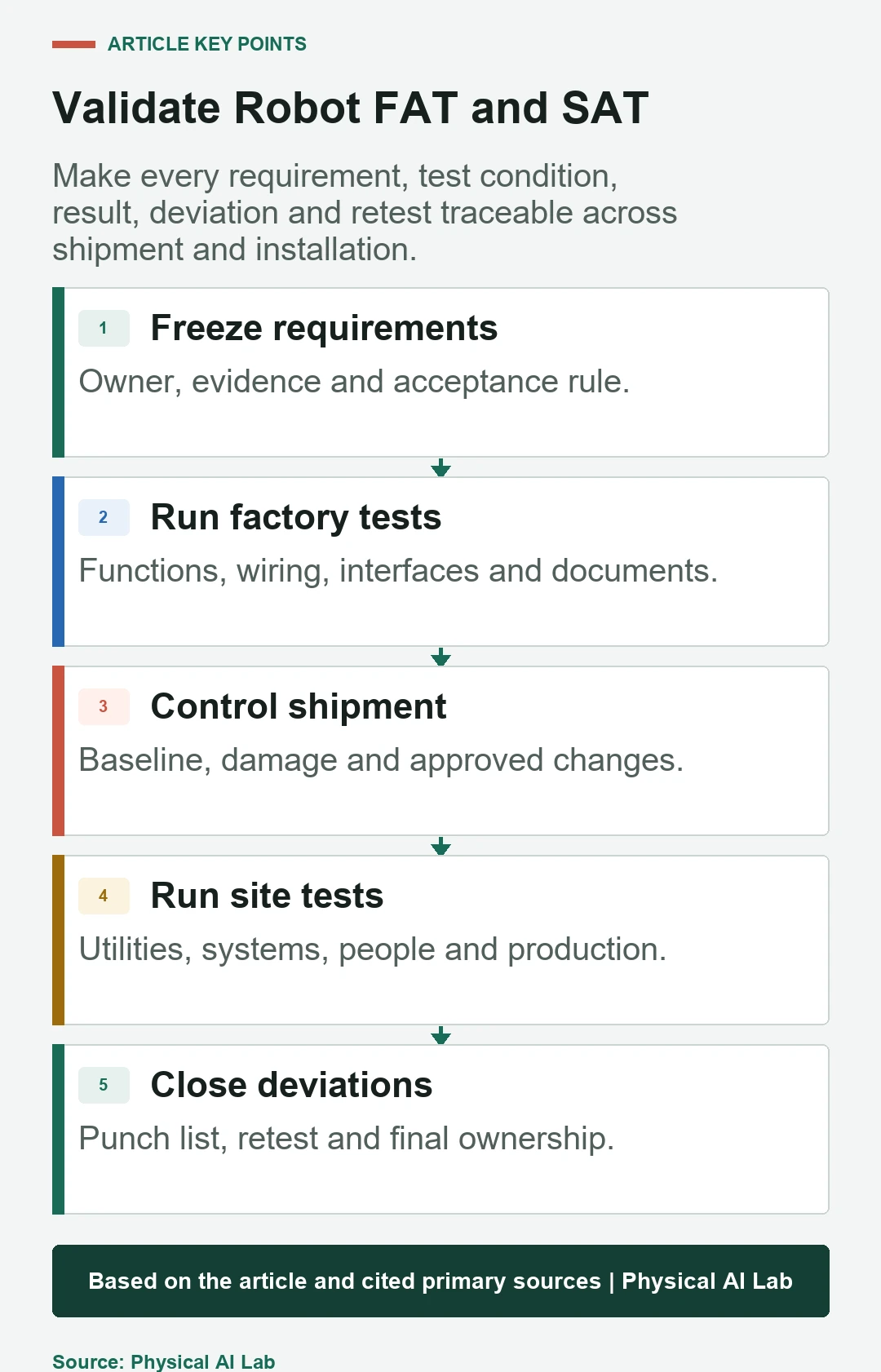
- Trace every requirement to FAT, SAT or both.
- Record every unavailable or simulated factory condition.
- Freeze and compare the shipment baseline.
- Separate commissioning adjustments from official test data.
- Close deviations, backups, training and residual ownership.
Frequently asked questions
Can SAT be brief after a successful FAT?
Only for items that site conditions cannot affect; installation, utilities, interfaces, environment and operation still require agreed site evidence.
Are commissioning and SAT the same activity?
No. Commissioning tunes and debugs; SAT demonstrates a controlled baseline against acceptance criteria.
Can equipment be accepted with an open punch list?
The contract may allow conditional acceptance, but safety and critical function blockers need explicit restrictions, owners and closure evidence.
How many cycles prove production performance?
No universal count applies. Define duration, mix, losses, confidence and decision criteria from the contract and process.
Does a FAT or SAT signature certify robot safety?
No. It records contractual acceptance evidence and does not replace required conformity, validation or legal duties.
Contract Acceptance Evidence Boundary
FAT and SAT are defensible when one requirement trace survives factory testing, shipment, installation, site integration, deviations, sustained operation and final ownership transfer.