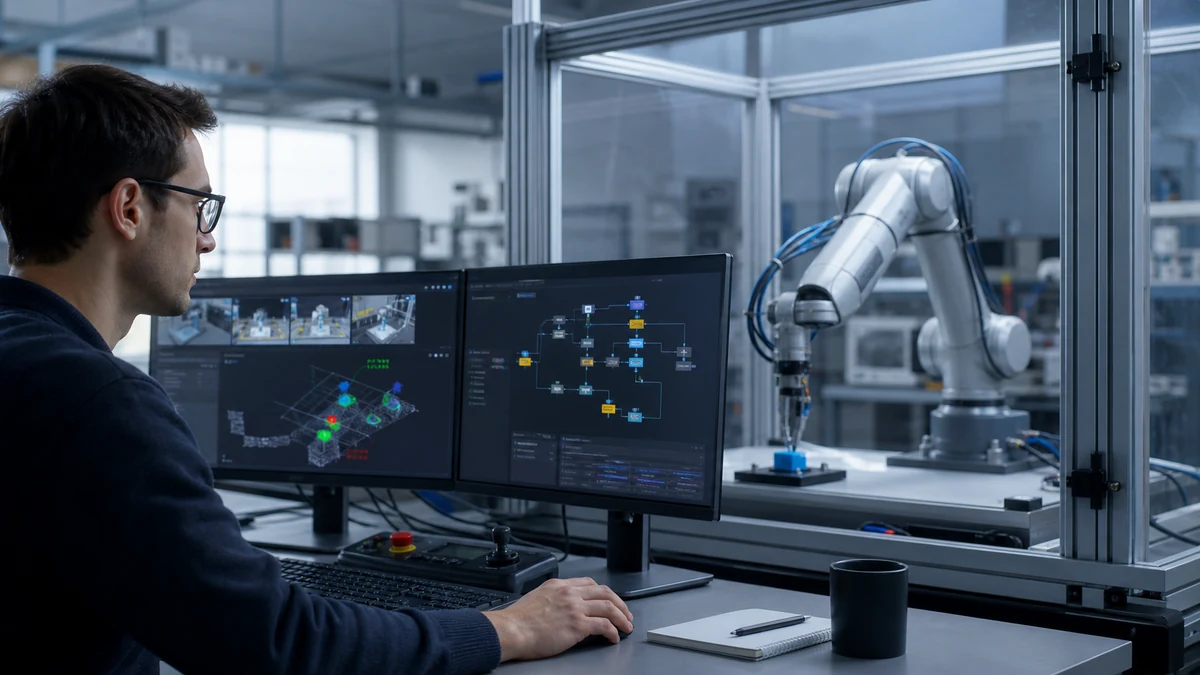
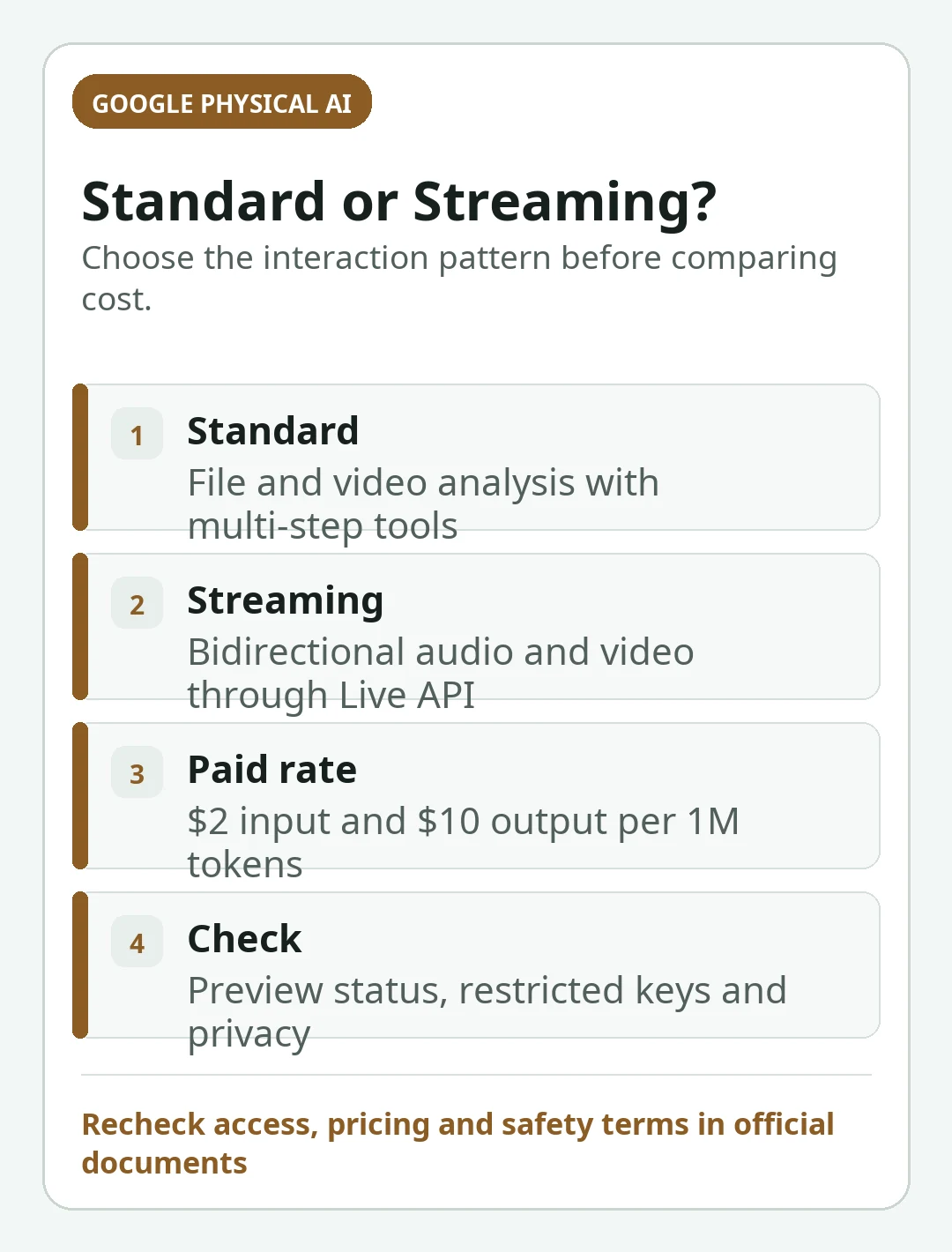
Gemini Robotics ER 2 is available in public preview through the Gemini API and Google AI Studio. The standard model ID is gemini-robotics-er-2-preview; the low-latency streaming model is gemini-robotics-er-2-streaming-preview. As of August 6, 2026, Google lists both at $2 per million paid input tokens and $10 per million paid output tokens, including thinking tokens, while a free tier is also available.
The identical headline price does not make the endpoints interchangeable. The standard endpoint supports more Gemini tools and batch processing; streaming uses the Live API for ongoing interaction. Data-use terms also differ sharply between unpaid and paid services. This guide covers the operational choices; our ER 2 model explainer covers what the model does inside a robot stack.
Current ER 2 prices at a glance
Google's pricing page lists a free tier for both ER 2 preview variants. On the paid tier, standard and streaming input cost $2 per million tokens, while output costs $10 per million tokens. Output billing includes thinking tokens. The standard model also supports a discounted batch price of $1 per million input tokens and $5 per million output tokens.
Standard-context caching is listed at $0.20 per million tokens, with cache storage at $1 per million tokens per hour. The batch caching rate is $0.10 per million tokens. Search grounding on paid Gemini 3.x usage includes 5,000 requests per month shared across eligible models, then costs $14 per 1,000 requests according to Google's current table.
Prices and preview terms can change; these figures are a dated baseline.
| Usage item | Free tier | Paid tier |
|---|---|---|
| ER 2 standard input | Free | $2 per 1M tokens |
| ER 2 standard output, including thinking | Free | $10 per 1M tokens |
| ER 2 standard batch input | Not listed | $1 per 1M tokens |
| ER 2 standard batch output | Not listed | $5 per 1M tokens |
| ER 2 streaming input | Free | $2 per 1M tokens |
| ER 2 streaming output, including thinking | Free | $10 per 1M tokens |
| Standard context caching | Not listed | $0.20 per 1M tokens plus $1 per 1M tokens per hour storage |
| Paid Search grounding after allowance | Not applicable | 5,000 shared requests per month, then $14 per 1,000 requests |
Standard preview favors feature-rich planning
The standard gemini-robotics-er-2-preview endpoint uses conventional request-response calls. Google documents support for caching, code execution, computer use, file search, function calling, Google Maps and Search grounding, structured output, thinking and URL context. It does not use the Live API. This combination suits workflows that pause at decision points or need structured integration with external information.
A warehouse application could send images and an instruction, validate a structured tool call and ask a robot SDK to execute it. Batch pricing may help with offline evaluation or large test sets. Give the model a narrow function allowlist, validate every argument and keep physical safety enforcement outside the model.
Streaming preview supports lower-latency supervision
The gemini-robotics-er-2-streaming-preview endpoint uses Google's Live API. It supports function calling, Search grounding and thinking, but Google does not list caching, code execution, computer use, file search, Maps grounding, structured output, URL context or batch mode for this variant. Its value is the ability to keep an interactive multimodal session open while observations arrive.
Streaming can reduce stop-start supervision, but it remains a networked preview model that produces text. It should not sit in a hard real-time motor-control path, collision-avoidance loop or safety interlock. Network loss, variable latency and model error need defined fallbacks.
| Feature | Standard: gemini-robotics-er-2-preview | Streaming: gemini-robotics-er-2-streaming-preview |
|---|---|---|
| Interaction | Request and response | Live API session |
| Input modalities | Text, image, video, audio | Text, image, video, audio |
| Output | Text | Text |
| Input/output limits | 131,072 / 65,536 tokens | 131,072 / 65,536 tokens |
| Function calling | Yes | Yes |
| Structured output | Yes | No |
| Code execution and computer use | Yes | No |
| Search grounding | Yes | Yes |
| Live API | No | Yes |
| Batch processing | Yes, with discounted pricing | No |

Free and paid tiers have different data-use rules
The free price is not the only cost to evaluate. Google's pricing table marks free-tier content as used to improve its products and paid-tier content as not used for that purpose. The Gemini API Additional Terms state that when unpaid services or Google AI Studio are used, Google may use submitted content and generated responses to provide, improve and develop products and machine-learning technologies. Human reviewers may process that data.
For paid services, Google states that prompts and responses are not used to improve its products. That does not mean zero retention or zero processing: the terms allow limited logging for safety and abuse detection. Teams should read the current terms, configure retention where available and complete their own privacy and security review before deployment.
| Question | Unpaid API / Google AI Studio | Paid API service |
|---|---|---|
| Used to improve Google products | Yes, according to current pricing and terms | No for prompts and responses |
| Human review possible | Yes | Limited processing can still occur for safety and abuse controls |
| Suitable for sensitive robot footage | No; Google says not to submit sensitive, confidential or personal data | Requires organizational review, minimization and consent |
| Recommended prototype data | Synthetic or staged non-sensitive scenes | Minimized operational data with documented controls |
API keys need explicit restrictions
The robotics API documentation warns that calls made with unrestricted API keys are rejected with a 403 response. Developers need a properly configured and restricted key rather than copying a general-purpose key into a robot application. Restrictions reduce the harm if a key leaks from a device, log or repository.
Keep the key off client-facing interfaces, limit it to the required API and project, and rotate it through a managed secret store. A robot on an untrusted network should call a controlled backend rather than carrying a broadly privileged credential.
Robot video creates notice, consent and minimization duties
The Gemini API terms require sufficient notice and consent when services process personal data, including identifiable people captured in robot video or audio. This is an application responsibility. A model provider's privacy statement does not replace signage, employee consultation, customer notice or other requirements that apply in the operating location.
Data minimization starts before the API call. Point cameras away from unnecessary areas, crop frames to the task, blur faces when identity is irrelevant, remove audio if it is not needed and avoid retaining raw streams by default. Log tool decisions and safety events without duplicating entire videos unless the evaluation plan requires them.
For an edge-heavy design, compare cloud orchestration with a local action layer such as the models discussed in our edge AI for robots guide. Local processing can reduce data transfer, but it does not eliminate privacy or security obligations.
ER 1.6 migration after August 31, 2026
Availability update, October 13, 2026: Google’s current robotics overview states that ER 1.6 was deprecated on August 31, 2026 and directs users to ER 2. Inventory old model IDs and choose the standard or streaming endpoint for the application’s request pattern. The pricing figures elsewhere in this article retain their August 6 check date.
A migration should be treated as a behavior change, not a string replacement. Re-run representative videos, measure task completion and false tool calls, compare standard and streaming latency, and verify token cost with real prompts. Google's reported benchmarks do not substitute for tests on your camera placement, robot APIs and workspace.
Our ER 1.6 guide provides historical context. Keep a rollback path while ER 2 remains in preview, and isolate the Gemini client so future model changes do not reach robot control code directly.
Frequently asked questions
How much does Gemini Robotics ER 2 cost?
On August 6, 2026, Google listed a free tier and paid pricing of $2 per million input tokens and $10 per million output tokens, including thinking, for both standard and streaming ER 2. Standard batch usage was $1 input and $5 output per million tokens.
Why does an ER 2 API request return 403?
Google's robotics documentation says unrestricted API keys are rejected with 403. Verify that the key is securely restricted to the required service, belongs to the correct project and has the necessary billing and preview access configuration.
What is the current ER 1.6 migration status?
As checked on October 13, 2026, Google’s deprecation table lists August 31, 2026 for ER 1.6 and recommends ER 2. This is a documentation check, not a live test of the old endpoint. Migrate and rerun representative inputs before using the replacement in a robot workflow.
Official sources checked
- Google AI for Developers: Gemini API pricing
- Google AI for Developers: Gemini Robotics API overview
- Google AI for Developers: Gemini API release notes
- Google AI for Developers: Gemini API Additional Terms
- Google DeepMind: Gemini Robotics ER 2 model card
Last checked: August 6, 2026