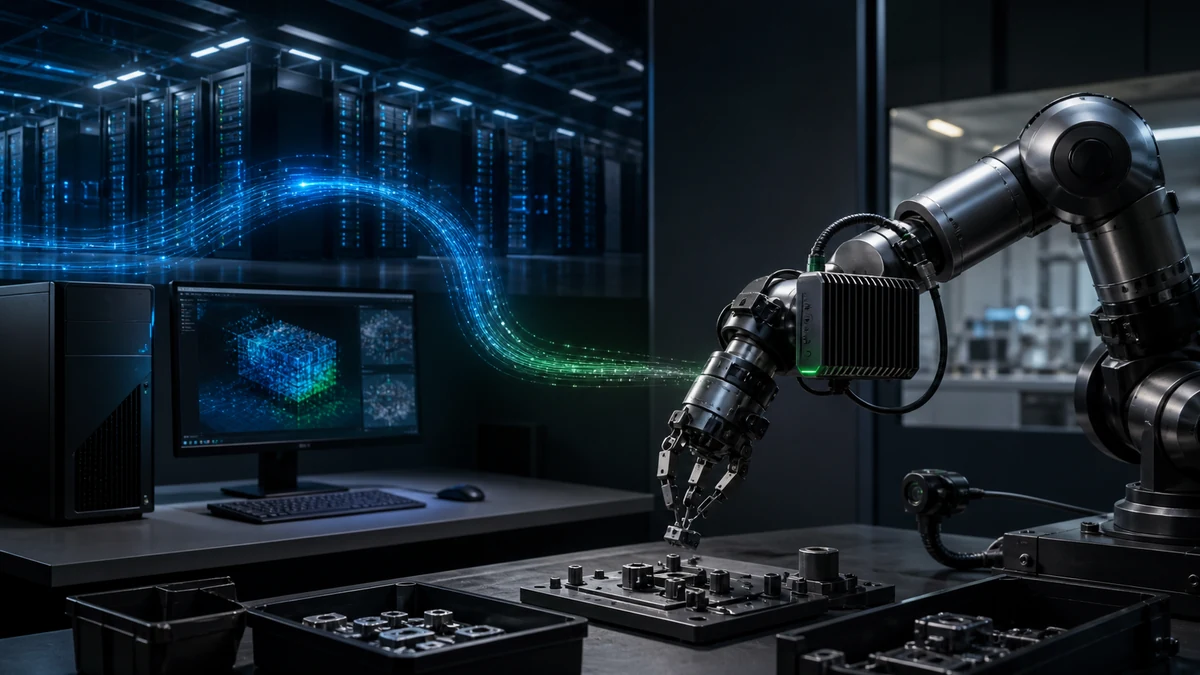
NVIDIA Cosmos 3 Super, Nano and Edge are not merely large, medium and small editions. The May 31, 2026 launch positioned Super for post-training and synthetic data that need maximum physical accuracy and generation quality, while Nano targets fast video and action reasoning. NVIDIA said both were available at launch.
Edge was marked coming soon in May, then introduced on July 15 as a 4B on-device model with an official model link. A stale May table should not freeze its status, yet a model release also does not prove production deployment by every named partner.
Start with execution location and required output
Super is the first candidate for large synthetic-video jobs and difficult physical reasoning in a datacenter. Nano fits iterative inference on workstation-class hardware, while Edge should be evaluated when perception and action need to run close to a robot or camera with a tight latency budget.
Parameter count alone cannot make the choice. Specify whether inputs are text, video or action; whether outputs are explanations, future video or action sequences; and the allowed latency, memory, power and cost.
| Model | Published size | Primary official use | Representative placement |
|---|---|---|---|
| Cosmos 3 Super | 64B | Maximum quality, synthetic data and advanced reasoning | Hopper or Blackwell datacenter |
| Cosmos 3 Nano | 16B | Efficient video and action reasoning | RTX PRO 6000-class workstation |
| Cosmos 3 Edge | 4B | On-device vision reasoning and action generation | RTX, DGX and Jetson edge |
All three belong to a family that connects reasoning and generation
NVIDIA's technical overview describes an autoregressive reasoner over text, image, video, audio and action connected to a diffusion-based generator for future observations and actions. The shared idea is to bring understanding and generation into one family.
Broad modality support does not mean every checkpoint has equal quality on every input-output combination. Robot data format, camera viewpoint, action representation, post-training recipe and evaluation environment still determine results. For the base concept, see world models for physical AI.
Super trades datacenter cost for maximum quality
Super is a 64B model designed for maximum capability, with NVIDIA targeting Hopper and Blackwell datacenter deployment. Candidate uses include robotics or autonomous-vehicle post-training, large synthetic data generation and demanding physical reasoning.
A vendor-leading benchmark does not guarantee the best task success or return on your robot. Compare generation quality, physics violations, wall time and GPU cost against Nano and a task-specific baseline on identical prompts, videos and actions.
.jpg)
Nano is efficient at 16B but is not a tiny embedded model
Nano is the 16B efficient option, with an RTX PRO 6000 workstation as NVIDIA's example. It can suit fast video and action reasoning and rapid experimentation, but the name does not promise real time on a laptop or a small robot computer.
Video length, resolution, quantization, batching and output length alter latency. Record p50 and p95 latency, memory, power and quality loss on the real workload, and apply the failure reporting discipline in the robot VLA evaluation guide.
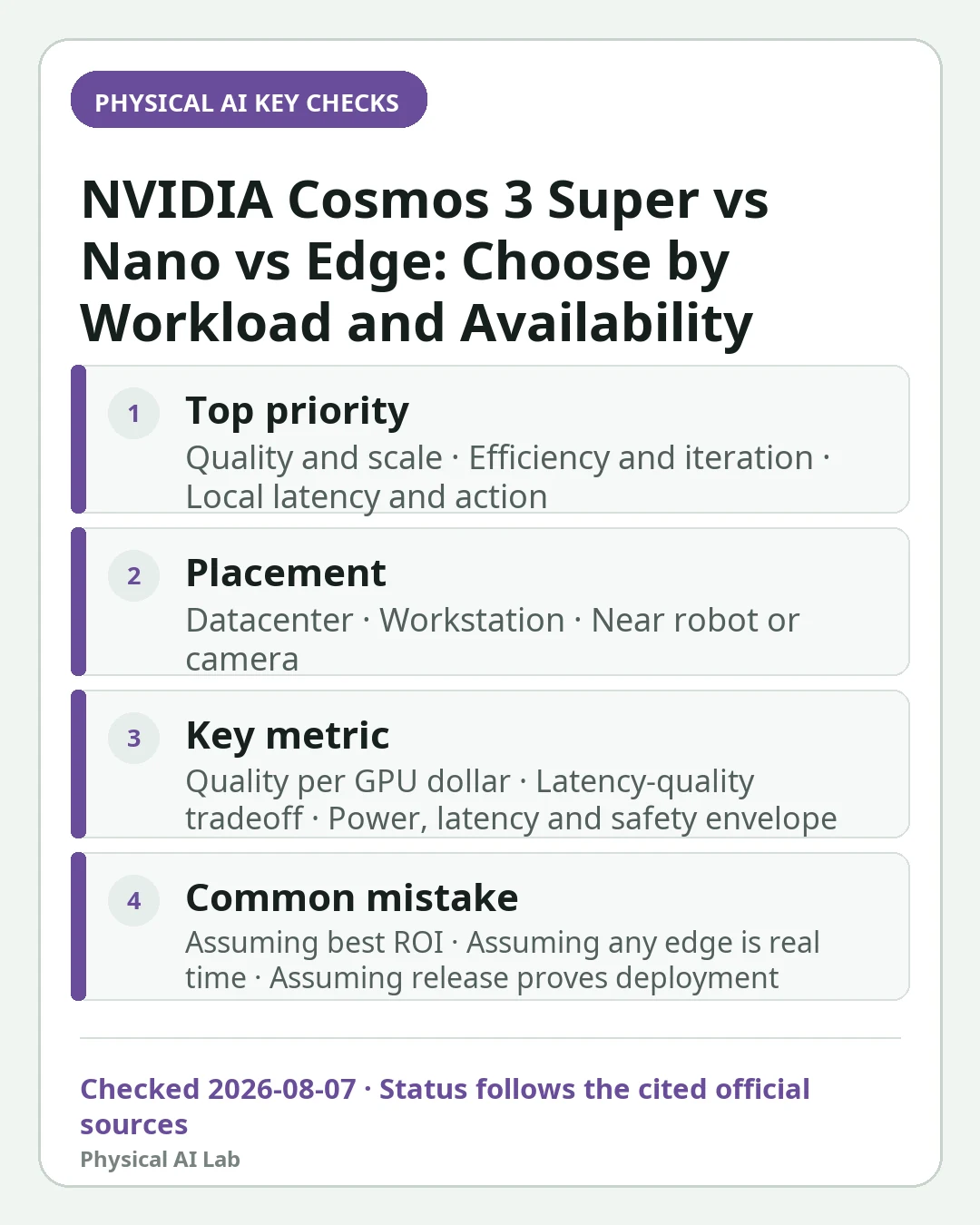
| Selection question | Super | Nano | Edge |
|---|---|---|---|
| Top priority | Quality and scale | Efficiency and iteration | Local latency and action |
| Placement | Datacenter | Workstation | Near robot or camera |
| Key metric | Quality per GPU dollar | Latency-quality tradeoff | Power, latency and safety envelope |
| Common mistake | Assuming best ROI | Assuming any edge is real time | Assuming release proves deployment |
Edge is the later 4B on-device action model
The July release describes Edge as a 4B Nemotron-based model for local environment understanding, real-time reasoning and robot action generation. NVIDIA names RTX, DGX and Jetson, including the T2000 and T3000 modules, as deployment targets.
That is newer evidence than May's coming-soon language, but an official model link is not production safety approval for a robot. Do not generalize NVIDIA's adaptation time or performance claims across bodies, sensors and action spaces without local testing.
Compare the family on one small, fixed pilot
Freeze representative, rare and failure scenes from real data, then compare explanations, predicted observations and actions on the same inputs. Record quality, throughput, p95 latency, GPU time, energy, safe-action yield and human corrections.
Partner language such as uses, builds, explores and intends to join represents different evidence levels. Set promotion gates with the physical AI proof-of-concept guide and prevent overlap between post-training, validation and final deployment data.
Frequently asked questions
Is Cosmos 3 Super always better than Nano?
No. Super is the starting point when maximum quality and large generation matter; Nano is often better when workstation efficiency and fast iteration matter. Compare quality, latency and cost on the same real data.
Is Cosmos 3 Edge still coming soon?
The May 31 launch said coming soon, but NVIDIA introduced the 4B Edge model with an official model link on July 15. Access does not by itself prove production deployment or certification in a specific product.
Will Nano or Edge make a robot autonomous in real time immediately?
No. Latency depends on video, precision, hardware and action cycle, while real autonomy also needs post-training, control, safety layers and physical validation.
Official sources checked
- NVIDIA Cosmos 3 launch announcement
- NVIDIA Cosmos 3 Edge and Japan ecosystem announcement
- NVIDIA technical guide to developing with Cosmos 3
Last checked: 2026-08-07