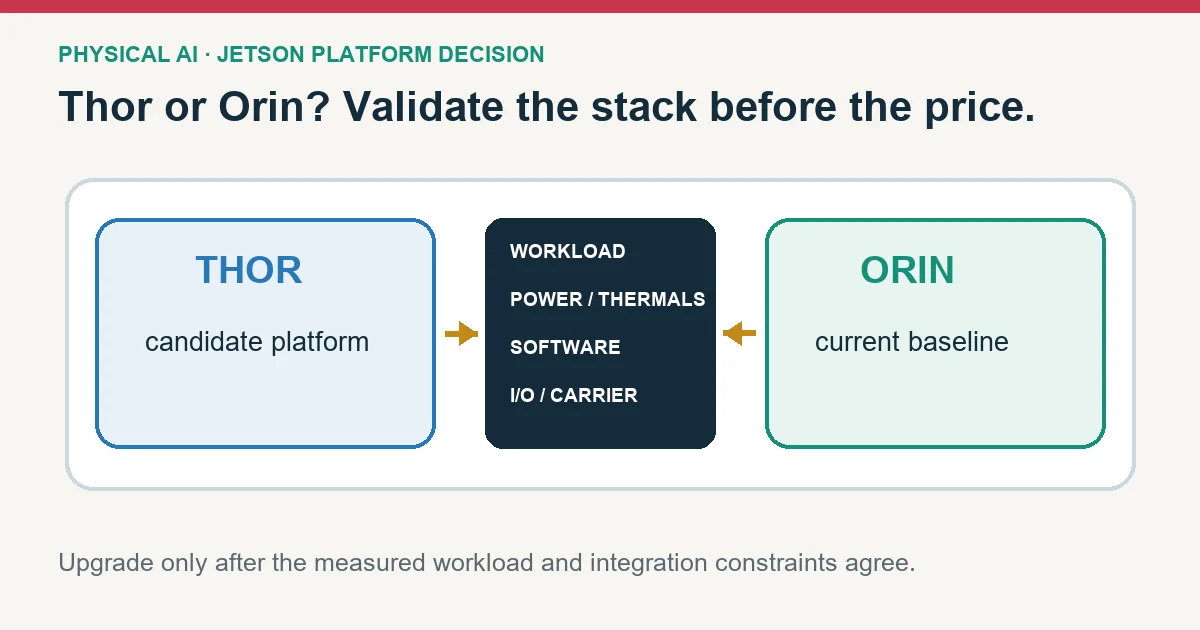
NVIDIA’s current Jetson FAQ and US Marketplace, checked August 14, 2026, list the Jetson AGX Thor Developer Kit at $5,499 and the 64GB Jetson AGX Orin Developer Kit at $3,499. Both Marketplace listings were out of stock when checked. Compare those developer-kit prices separately from 1KU+ production-module pricing, then weigh Thor’s 128GB LPDDR5X memory, Blackwell GPU, 40–130W power envelope and higher-speed I/O against Orin’s 64GB LPDDR5 memory, Ampere GPU, 15–60W envelope and the required software migration work.
Thor is built around a Blackwell GPU, 128GB of memory and FP4 support for large VLM, VLA and multisensor pipelines. Orin remains a rational choice when an existing ROS 2, Isaac or vision workload already meets latency, memory and power targets. Start with the robot edge-compute roles before treating a higher peak number as a complete system upgrade.
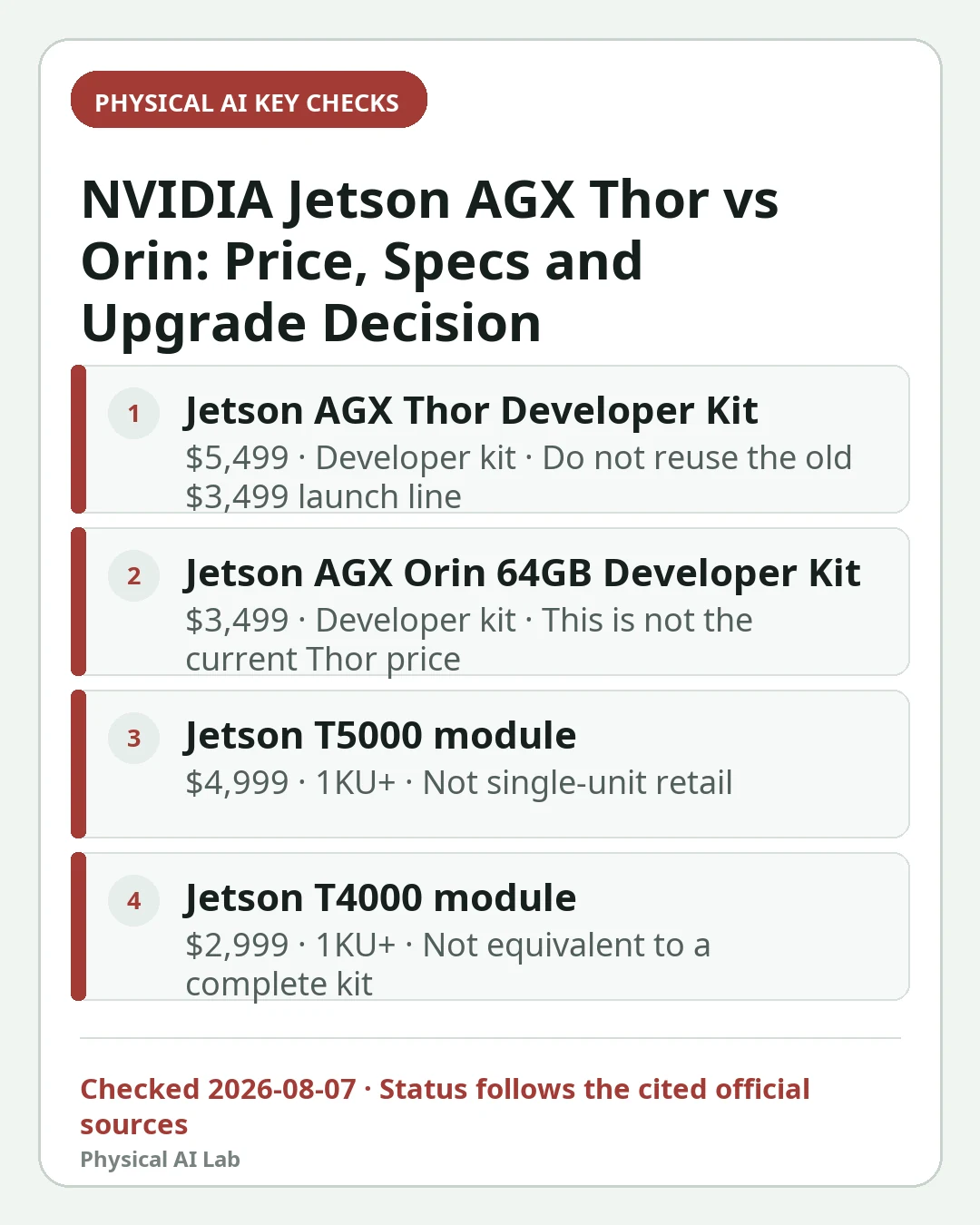
The current official prices are $5,499 for Thor and $3,499 for Orin
NVIDIA's FAQ separates the $5,499 Thor developer kit, the $4,999 T5000 module at 1KU+, the $2,999 T4000 module at 1KU+ and the $3,499 AGX Orin 64GB developer kit. The 1KU+ label is suggested volume pricing for at least one thousand modules, not a quote for one developer kit.
The August 2025 Thor introduction still ends with a $3,499 launch-era sentence. Where official pages conflict, use the latest FAQ and an authorized distributor quote, then budget tax, shipping, power, storage and camera adapters separately.
| Product | Current official MSRP | Basis | Caution |
|---|---|---|---|
| Jetson AGX Thor Developer Kit | $5,499 | Developer kit | Do not reuse the old $3,499 launch line |
| Jetson AGX Orin 64GB Developer Kit | $3,499 | Developer kit | This is not the current Thor price |
| Jetson T5000 module | $4,999 | 1KU+ | Not single-unit retail |
| Jetson T4000 module | $2,999 | 1KU+ | Not equivalent to a complete kit |
Raw TOPS and TFLOPS cannot be divided into a universal speedup
The T5000 is specified at up to 2,070 sparse FP4 TFLOPS with 128GB LPDDR5X, while the AGX Orin developer kit is commonly specified at 275 TOPS with 64GB. FP4 floating-point throughput under sparsity and INT8 TOPS are different measurement conditions. Dividing 2,070 by 275 does not show how every robot model will run.
NVIDIA cites up to 7.5 times higher AI compute and 3.5 times better energy efficiency, while its model table shows workload speedups ranging from roughly the low 1x range to about 5x. Test the actual VLM or VLA with the same input, precision, batch, power mode and latency target. The GR00T N1.7 guide helps frame how model architecture changes the runtime demand.
Thor's 128GB and FP4 matter most when several large models must coexist
The Thor kit's T5000 combines 128GB LPDDR5X, a 14-core Arm Neoverse-V3AE CPU, Blackwell GPU and MIG. That memory and partitioning can help a robot run a VLM, action policy, multiple camera streams and less time-sensitive analytics concurrently. The kit also includes a 1TB NVMe drive.
A single detector, light segmentation model or compact policy may already fit comfortably on Orin. If measured latency and memory headroom are adequate, Thor's price and thermal load may not return useful throughput. Map the model to the full physical AI system so sensor, control and network bottlenecks are not mistaken for GPU limits.
Power and I/O can dominate the mechanical integration cost
The Jetson AGX Thor Developer Kit User Guide gives the T5000 a 40W-to-130W power range. The developer kit provides 5GbE RJ45, a QSFP28 interface supporting four 25GbE links, USB, CAN and integrated 1TB NVMe. Running near the top power mode can change the robot's power conversion, battery budget, cooling, enclosure and acoustic design.
A shared outline does not guarantee an electrical drop-in migration. NVIDIA distinguishes form-factor compatibility from pin compatibility, and it says developer kits are not intended as production systems. A product still needs a production module, carrier, thermal solution and lifecycle validation.
| Decision area | Thor is compelling when | Staying on Orin makes sense when |
|---|---|---|
| Models | Large VLM/VLA or several models run together | Compact models meet target latency |
| Memory | The workload exceeds 64GB or needs headroom | It runs reliably within 64GB |
| Sensors | High-bandwidth multisensor and 25GbE matter | Existing CSI, USB and Ethernet are sufficient |
| Power and heat | The design can support 40–130W | Lower power and validated cooling dominate |
| Software | A JetPack 7 migration is funded | The product depends on a mature JetPack 6 stack |
Moving to JetPack 7 is more than copying a container
JetPack 7 supports both Thor and Orin, while Thor uses Ubuntu 24.04 LTS, Linux kernel 6.8 and an SBSA-aligned platform. A deployed Orin product may still depend on JetPack 6 drivers, kernel modules, camera software and prebuilt TensorRT engines. Operator, precision and toolchain changes can alter performance or accuracy even when the application source is unchanged.
Inventory camera, CAN, EtherCAT and GPIO dependencies, CUDA extensions, TensorRT plugins, ROS 2 packages, real-time priorities and recovery procedures. NVIDIA lists Orin as fully supported by JetPack 7, but the exact board, carrier, kernel modules and application dependencies still need verification before a migration schedule is committed.
Use three representative workloads to make the upgrade decision
Measure worst-case sensor-to-action latency, peak memory with all required models and on-robot power and temperature. If Orin passes all three with margin, an upgrade has a weak operational case. If it fails, rerun the same model and accuracy settings on Thor rather than comparing vendor peaks.
The $2,000 kit-price gap is only the first line. Include porting labor, carrier and cooling redesign, validation, spares and deployment interruption. Thor earns its place when it enables a larger reliable robot pipeline, not merely because its headline compute number is higher.
Frequently asked questions
Is the Jetson AGX Thor Developer Kit $3,499?
Not under the current NVIDIA FAQ. It lists Thor at $5,499 and the AGX Orin 64GB developer kit at $3,499. The older Thor launch article contains a stale $3,499 line.
Is Thor 7.5 times faster than Orin for every AI model?
No. That is an up-to compute comparison with precision and sparsity context. NVIDIA's own workload table shows different gains by model, so the intended model must be benchmarked directly.
Can a Thor module be dropped into an Orin carrier board?
Do not assume it can. NVIDIA distinguishes form-factor and pin compatibility. Power, pinout, thermal, I/O and software adaptation all require product-document verification.
Official sources checked
- NVIDIA Jetson FAQ and current pricing
- NVIDIA Jetson AGX Thor Developer Kit User Guide
- NVIDIA Technical Blog: Introducing Jetson Thor
Last checked: August 14, 2026