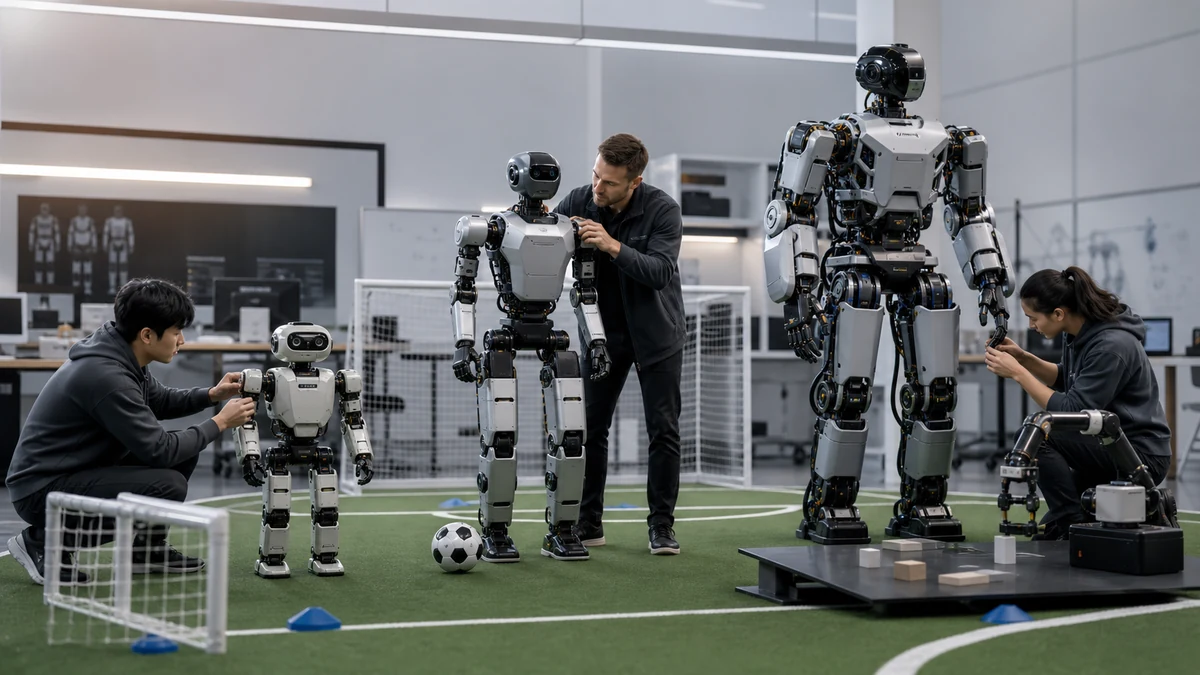
Booster's three current humanoids do not form a simple good-better-best price ladder. On August 7, 2026, the Booster K1 page advertised a starting price of US$5,999, while the T1 page and T2 page offered Buy Now paths without a public list price. K1 is a roughly 95 cm, 19.5 kg entry platform; T1 is a roughly 1.18 m, 30 kg developer and RoboCup platform; T2 is a roughly 1.4 m, 42–43 kg flagship with 31 degrees of freedom and manipulation-oriented configurations.
Choose from the experiment backward. K1 or T1 is the direct comparison for locomotion, robot soccer, portability and classroom iteration. T2 becomes relevant when the work needs a three-degree-of-freedom waist, seven-degree-of-freedom arms, wrist vision and a posture-dependent dual-arm payload claim of up to 10 kg. The types of humanoid robots, humanoid robot price guide and physical AI company map help turn those labels into a requirements list before the sales call.
K1 favors accessible iteration, T1 full-body development, and T2 manipulation
K1 is the smallest model and the only one with a public starting price. Its Geek, Education and Professional variants use the same 22-degree-of-freedom body but differ in compute, battery and warranty. That makes K1 attractive for transport between classrooms, KidSize soccer and introductory reinforcement-learning work. Its 95 cm scale can become a limitation when the research object is a human-height counter, shelf or door handle.
T1 moves into a larger torque and workspace class while preserving a manageable research-platform form. T2 is not merely a taller T1: it standardizes seven-degree-of-freedom arms and a three-degree-of-freedom waist, then separates P1, P2 and P3 by end effector and wrist-camera configuration. A larger platform also increases fall energy, exclusion-zone requirements, handling equipment and staffing. Those costs can outweigh a capability that the actual benchmark never exercises.
| Model | Current public price status | Size and weight | Primary development fit |
|---|---|---|---|
| K1 | From US$5,999 | About 95 cm and 19.5 kg | Education, locomotion, KidSize, entry embodied AI |
| T1 | No public list price; request purchase quote | 118×47×23 cm and about 30 kg | AdultSize, full-body motion, research expansion |
| T2 | No public list price; request purchase quote | About 140 cm and 42–43 kg | Dual-arm manipulation and flagship development |
K1's starting price does not describe every K1 configuration
K1 specifies 22 total degrees of freedom, six per leg, four per arm and two at the head, with 60 Nm maximum peak joint torque. Geek lists 48 TOPS of dense AI performance, a 2 Ah battery, about 30 minutes while walking at 0.4 m/s and a three-month warranty. Education lists 117 TOPS; Professional lists 200 TOPS. Both higher variants list a 5 Ah battery, about 80 minutes at the same walking condition and a one-year warranty.
The phrase from $5,999 therefore must not be attached to the 200 TOPS Professional specification. Ask for a variant-level quote that names compute module, camera, microphone array, battery, networking, warranty and included software. The page marks secondary development as supported across the variants, but practical model size, thermal behavior and control latency still depend on the selected compute and the workload.
T1 combines 200 TOPS with a configurable upper body
T1 lists dimensions of 118 by 47 by 23 cm, a weight of about 30 kg, 23 degrees of freedom in the basic body and 130 Nm maximum peak torque. Basic, Standard and Customized all show an NVIDIA AGX Orin rated at 200 TOPS; Standard and Customized additionally list an Intel i7-1370P. The 10.5 Ah battery is described as providing about two hours of walking or four hours of standing, which are operating-condition figures rather than guarantees under maximum inference and motion load.
Basic and Standard list the 23-degree-of-freedom arrangement. Customized expands to 31 degrees of freedom with grippers or 41 with dexterous hands. USB and Ethernet expansion, firmware upgrades, secondary development and a one-year warranty are shown across the table. A quote must still identify the arms, end effectors, CPU and software package because the word T1 alone does not describe the delivered research system.
.jpg)
T2 is the Thor T5000 platform with manipulation-specific tiers
T2's Professional P1, P2 and P3 configurations all list 31 degrees of freedom: six per leg, seven per arm, three at the waist and two at the head. The compute line says Thor T5000, and all tiers list binocular cameras at the head and waist. P1 leaves the end effector optional and does not list a wrist camera; P2 adds a gripper and wrist vision; P3 adds a six-degree-of-freedom dexterous hand and wrist vision.
The official maximum dual-arm payload is 10 kg, immediately qualified by a note that actual capacity varies significantly with arm posture. A 10 Ah battery, two hours of continuous walking and 2 m/s walking speed are also published specifications, not proof that the robot can sustain maximum payload, maximum speed and full compute load together. At 42–43 kg, T2 also requires a more demanding fall-control plan, transport procedure and emergency-stop layout than K1.
An open-source portal is not a promise of identical coverage for every model
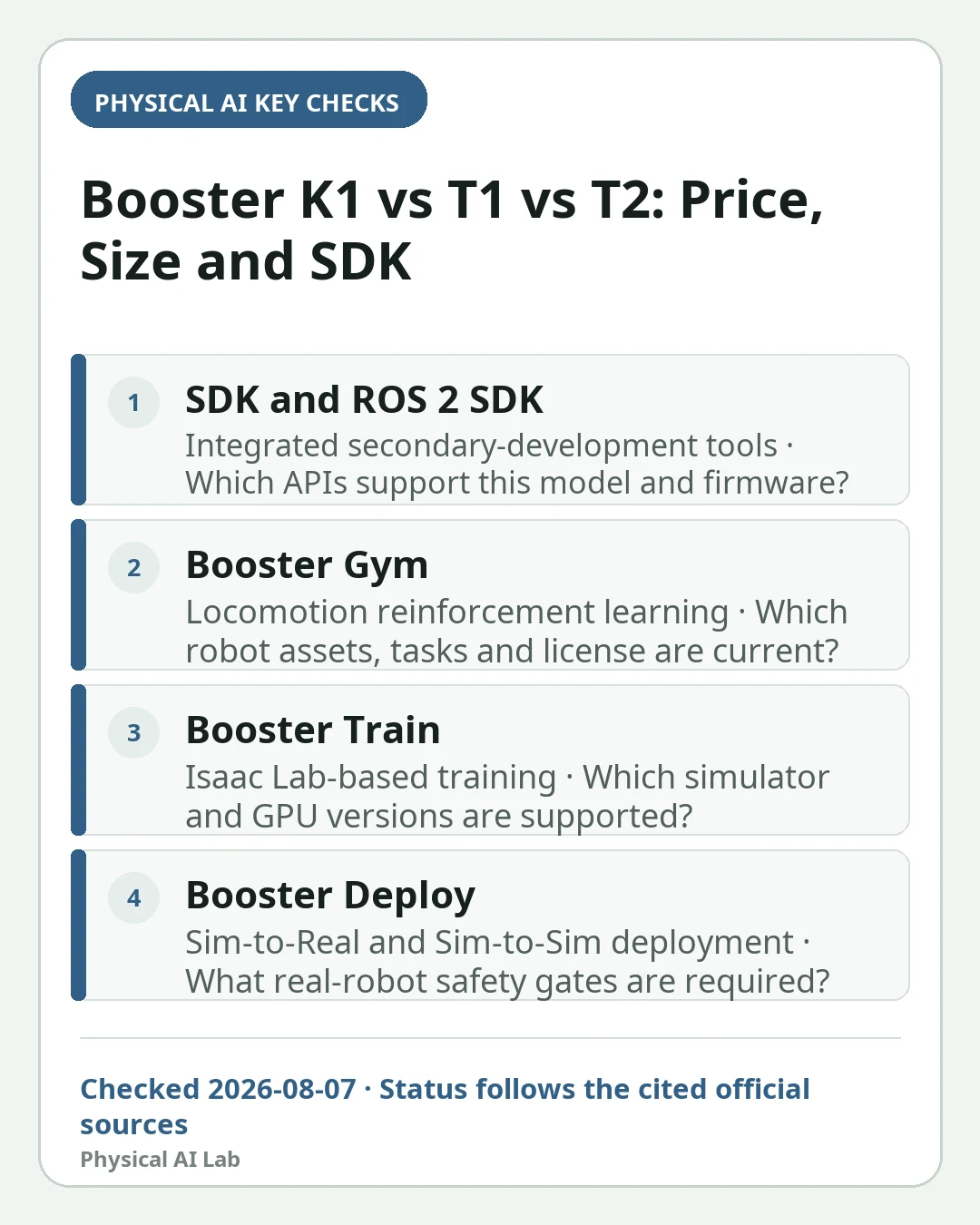
The official Booster open-source portal links an integration SDK, a ROS 2 SDK, Booster Gym, Train, Deploy, Assets and a RoboCup Demo. Booster describes Gym as an open-source locomotion reinforcement-learning framework, Train as an Isaac Lab-based training framework, and Deploy as a lightweight Sim-to-Real and Sim-to-Sim framework. Those are useful building blocks, but the manual buttons visible at the check date explicitly named T1 and K1; the page did not establish equivalent T2 manual coverage.
Confirm the target robot, variant, firmware and repository release before procurement. Open-source development tools do not imply that every firmware component or control layer is open source. The team needs a written matrix for joint commands, sensor topics, simulation model, license, safety limits, example compatibility and support channel. Otherwise a general link to an SDK can hide the exact integration work that dominates the schedule.
| Developer asset | Officially described role | Question before purchase |
|---|---|---|
| SDK and ROS 2 SDK | Integrated secondary-development tools | Which APIs support this model and firmware? |
| Booster Gym | Locomotion reinforcement learning | Which robot assets, tasks and license are current? |
| Booster Train | Isaac Lab-based training | Which simulator and GPU versions are supported? |
| Booster Deploy | Sim-to-Real and Sim-to-Sim deployment | What real-robot safety gates are required? |
| RoboCup Demo | Perception-to-decision stack for 3v3 soccer | Which parts are soccer-specific and non-transferable? |
RoboCup results validate a soccer stack, not general autonomy
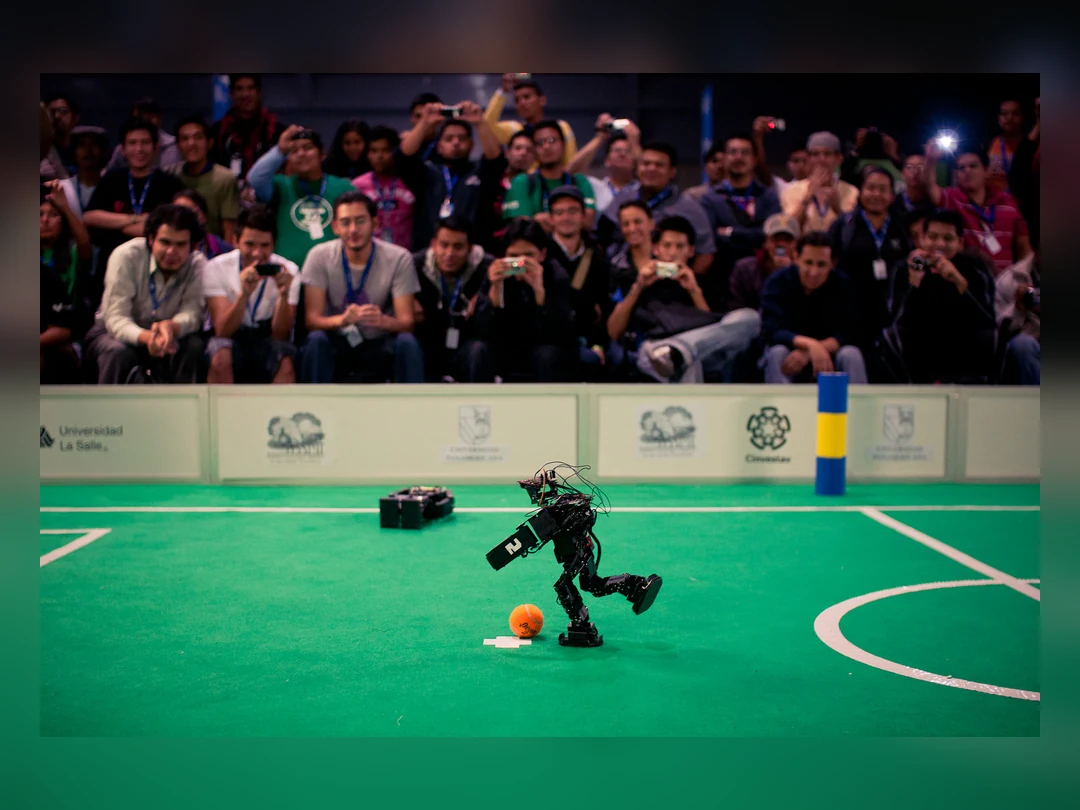
The official Booster RoboCup solution presents T1 as the 2025 AdultSize champion platform and K1 as the KidSize champion platform. It connects those robots to locomotion training, perception and localization, decision-making and a 3v3 deployment package. That is meaningful evidence that real teams used the hardware and tools in a repeated-contact, fall-prone competition. T2 is not the model represented in that result table, so the achievement should not be assigned to the full product line.
Robot soccer does not demonstrate unattended household work, industrial picking or open-ended social autonomy. It operates on a defined field with a known ball, rules and interfaces. The official Booster store routes buyers to K1, T1 and T2 but did not expose public T1 or T2 prices at the check date. Request separate line items for robot variant, hands, compute, batteries, software support, freight, tax, training and warranty, then score the quote against the benchmark the lab will actually run.
Frequently asked questions
Which Booster robot has a public price?
On August 7, 2026, K1 showed a starting price of US$5,999. T1 and T2 had purchase paths but no public list price, so their configurations require a current sales quote.
Should a RoboCup team choose K1 or T1 instead of T2?
Booster's official solution directly maps K1 to KidSize and T1 to AdultSize competition work. T2 is a manipulation-oriented flagship, so soccer teams should begin with the K1 and T1 rules, dimensions and released tools.
Do the same Booster SDK and open-source files support K1, T1 and T2 equally?
That is not established by the portal. Common SDK tools are listed, but the visible manual links specifically named T1 and K1 at the check date. Verify model, variant, firmware and repository release before purchase.
Official sources checked
- Booster Robotics official K1 product page
- Booster Robotics official T1 product page
- Booster Robotics official T2 product page
- Booster Robotics official open-source portal
- Booster Robotics official RoboCup solution
- Booster Robotics official store
2026-08-07