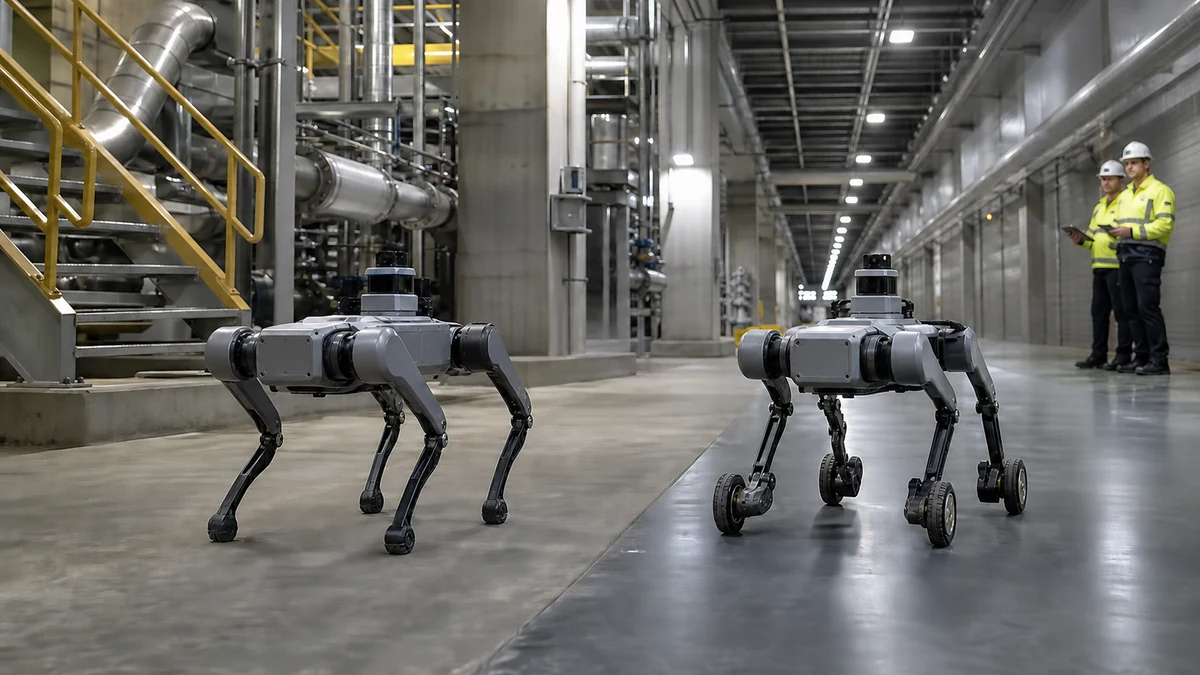
The practical difference is architectural. Unitree As2 is an approximately 20 kg, 12-joint legged quadruped. As2-W adds 7-inch wheels and four more joint motors, bringing it to roughly 25 kg. Start with As2 for compact, irregular and stair-heavy routes; start with As2-W for long corridors, paved patrols and routes where rolling efficiency matters.
Do not choose from maximum speed or static payload alone. Match payload, surface, slope, stops, compute draw and protection requirements, then compare task completion and intervention rate. The site's guides to robot sensors, edge AI on robots and robot risk assessment help turn the product table into a deployment test.
Legs versus wheel-legs changes the route before it changes the spec sheet
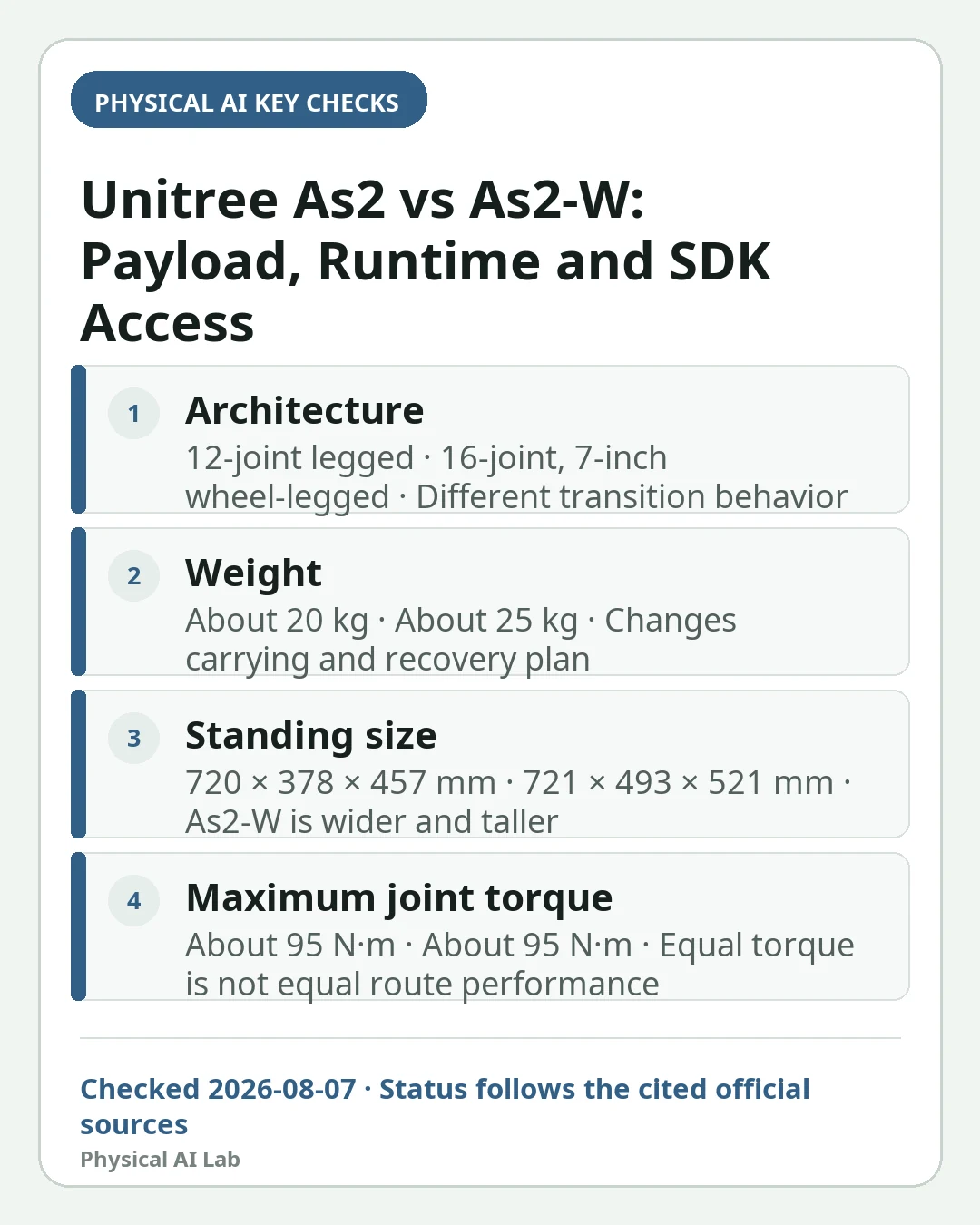
As2 measures 720 × 378 × 457 mm and weighs about 20 kg with its battery. As2-W measures 721 × 493 × 521 mm, weighs about 25 kg and uses 178 mm, 7-inch wheels. The wheel-legged system is wider and heavier, but it avoids lifting the body through every step on smooth ground.
A legged robot can select footholds across stairs and broken terrain. A wheel-legged robot can roll efficiently and use its legs when the surface changes. Mark aisle width, door thresholds, cable covers, stair nosing, drainage channels, gravel and turning space on the real route before deciding which advantage matters.
| Specification | As2 X | As2-W X | Deployment meaning |
|---|---|---|---|
| Architecture | 12-joint legged | 16-joint, 7-inch wheel-legged | Different transition behavior |
| Weight | About 20 kg | About 25 kg | Changes carrying and recovery plan |
| Standing size | 720 × 378 × 457 mm | 721 × 493 × 521 mm | As2-W is wider and taller |
| Maximum joint torque | About 95 N·m | About 95 N·m | Equal torque is not equal route performance |
Static payload and continuous moving payload answer different questions
The current As2 X table states about 65 kg maximum standing load and about 15 kg continuous walking load. As2-W X lists about 150 kg standing load and about 16 kg continuous moving load. A standing figure is not a safe allowance for a sensor mast or tool that must travel through every turn and slope.
Center of mass, bracket stiffness, emergency braking, tether forces and lateral slopes all reduce margin. Install the real payload and repeat starts, stops, turns, recovery and emergency stops on the target grade before accepting a continuous-load claim.
Runtime only compares cleanly when payload and motion are matched
As2 X is listed at roughly four hours and 20 km unloaded, then more than 2.5 hours and about 13 km with 15 kg. As2-W X is listed at roughly three hours and 30 km unloaded, then more than two hours and about 25 km with 16 kg. The pattern favors As2 on time and As2-W on distance, but even the loaded tests differ by one kilogram.
Temperature, rolling resistance, grade, idle time, sensors and an expansion computer change the result. Reserve at least a return-to-base energy margin and measure P50 and P95 consumption over three or more repetitions of the actual mission loop.
| Published condition | As2 X | As2-W X |
|---|---|---|
| Unloaded | About 4 h and 20 km | About 3 h and 30 km |
| Loaded | >2.5 h and 13 km at 15 kg | >2 h and 25 km at 16 kg |
| Speed | 0–3.7 m/s, up to about 5 m/s | 0–3.7 m/s, up to about 6 m/s |
| Slope | About 40° | About 45° |

Obstacle figures and IP54 are test inputs, not mission guarantees
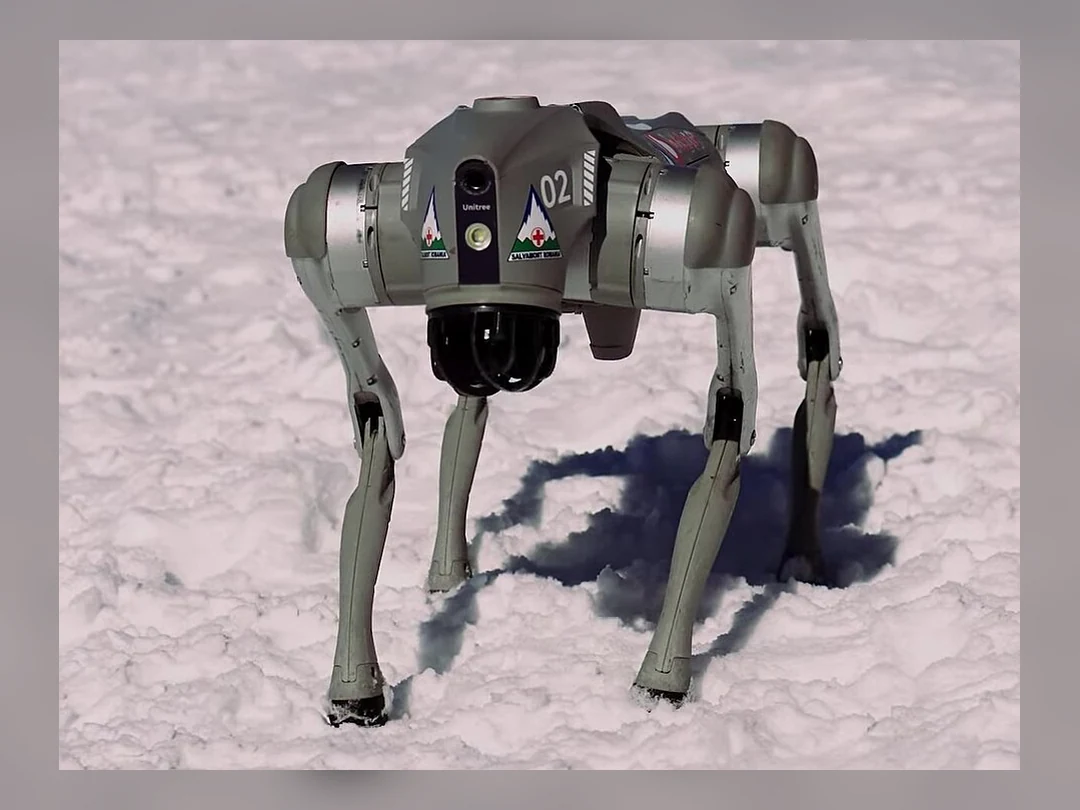
The detailed tables list a 25 cm stair capability for As2 X and a 30 cm stair plus approximately 0.4–0.8 m maximum climb height for As2-W X. Those figures do not guarantee the same success rate on wet metal, crumbling edges, diagonal approaches or a moving payload.
Both X configurations carry a manufacturer-stated IP54 rating. Describe that as a protection rating, not as waterproofing. Long rain exposure, immersion, pressure washing, salt spray and unsealed payload connectors require their own environmental limits and tests.
Developer access starts at As2 X and is present on both As2-W versions
The As2 matrix marks AIR and PRO as not supporting secondary development, while X and EDU support it. The current As2-W matrix contains X and EDU, both marked as supporting secondary development. Unitree's official timeline records the As2 launch on February 24, 2026, so the live August 7 matrix should take priority over launch-day summaries.
The EDU rows also separate charging-dock and high-compute expansion options. Still, supported does not define the SDK layer, low-level command rights, simulator assets, safety interlocks, regional access or support term. Pin those items and the manual version in the quotation.
A quote must include the mission kit because neither page posts a price
Both product pages say Contact Sales and state that tax and freight are excluded. Compare a complete kit: batteries, charger or dock, LiDAR, compute expansion, communications, controller, SDK, training, warranty, import charges and spares—not just the chassis.
Before selection, write a 24-hour mission profile with surface mix, payload distribution, charging windows, communication dead zones and manual recovery. Run both platforms with the same payload and score completed routes, interventions, energy used and post-run temperature.
Frequently asked questions
Is As2-W faster than As2 on every surface?
No. Its wheels favor smooth, long routes, while narrow stairs, irregular footholds or low-traction wheel surfaces may favor As2. Test the actual route rather than the headline top speed.
Do As2 AIR and PRO include secondary-development access?
The official matrix checked on August 7, 2026 marks AIR and PRO as not supported for secondary development, and X and EDU as supported. Recheck the current regional offer and manual before purchase.
Does IP54 mean the robot is waterproof?
No. IP54 is the manufacturer-stated dust and water-splash protection rating. It does not establish immersion, pressure-wash or unlimited rain operation for the whole integrated payload.
Official sources checked
- Unitree As2 official product and specification page
- Unitree As2-W official product and specification page
- Unitree official company timeline
2026-08-07