Published rules for the 100m at the 2026 World Humanoid Robot Games described a fully autonomous format. A useful record would pair start detection, lane keeping, balance recovery, falls and outside intervention with time; the rule itself is not a race outcome.
What the autonomy rule changes
Official material explicitly identifies the 100m as fully autonomous. Sensor restrictions, track specifications and the treatment of a fall still need to be checked against the published rules and actual race records.
Race and organizer figures are used only for the conditions and period stated in the original material. Unpublished pricing, delivery timing and field success rates remain unknown.
| Metric | What is measured | What to verify |
|---|---|---|
| Time | Start-to-finish duration | Whether falls and stops remain in the result |
| Autonomy | Completion without external control | Check the restart rules |
| Stability | Lane departures and falls | Recovery success rate |
Faster running leaves less room for estimation error
Locomotion control links state estimation, footstep planning, whole-body balance and joint-torque control on a millisecond timescale. As speed rises, even a small accumulated estimation error reduces the time available to recover.
The full physical AI loop still needs synchronized sensors, planning, low-level control, safety limits and post-failure recovery. Race speed cannot substitute for a complete system.
Compare pace, energy and recovery together
Request repeat attempts, external-intervention records and recovery behavior, not only the fastest run. A robot that cannot stabilize after a slip is less autonomous than its finish time suggests.
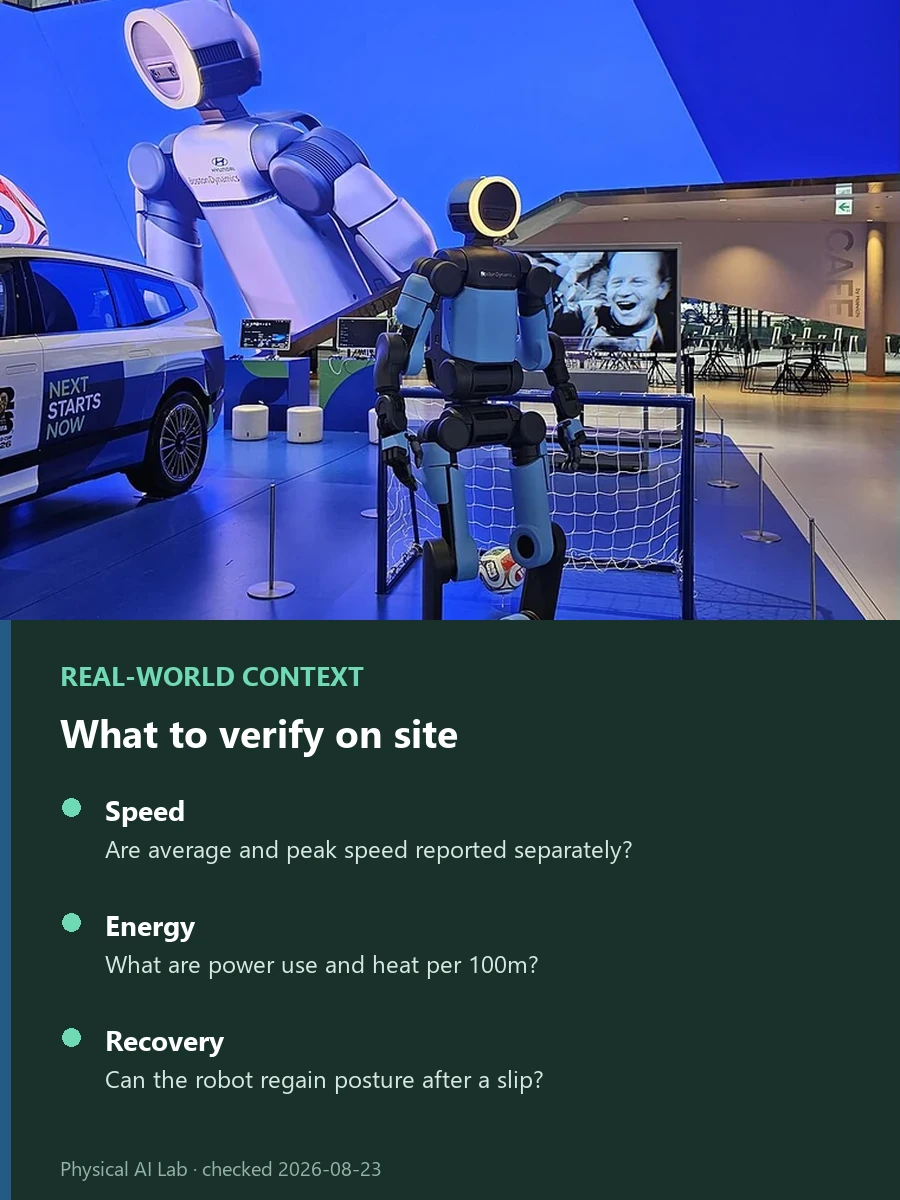
| Check | Question to ask |
|---|---|
| Speed | Are average and peak speed reported separately? |
| Energy | What are power use and heat per 100m? |
| Recovery | Can the robot regain posture after a slip? |
.jpg)
A sprint time is not a factory productivity metric
A straight-track 100m result cannot be converted directly into warehouse or factory productivity. Real sites add turns, thresholds, people, payloads, narrow aisles and hours of continuous operation.
Official event material remains the current primary evidence. Add customer-site data, independent tests and regulatory documents when they become available.
Technical context behind an autonomous humanoid sprint
Read what physical AI means for the autonomy boundary, the core ideas behind Sim-to-Real for track-to-site transfer and robot foundation models for policy scope. Those concepts anchor this August 2026 sprint analysis.
The metric that speed alone misses
Only fully autonomous robots can enter the 100m at the 2026 World Humanoid Robot Games. The most informative result combines time with repeatability, fall and intervention records, energy use and autonomous recovery under disclosed conditions.
Frequently asked questions
What must accompany a fast autonomous sprint before it informs deployment?
Report the autonomy boundary, course conditions, falls, external corrections, energy use, thermal limits and repeat runs. Finish time without that context cannot show whether the same control system is stable enough for work.
Which metrics should be reported with the finish time?
Look at the human-intervention rate, mean recovery time, continuous operating time and failure conditions alongside task success. Those four measures show whether the robot remained autonomous throughout the run.
Does race recovery predict recovery on a factory floor?
Only partly. The track tests fast locomotion in a narrow setting; a worksite adds turns, thresholds, payloads, people and long operating periods. Those conditions need separate trials.
Official sources checked
- Beijing municipal government's official guide to the 2nd World Humanoid Robot Games
- Beijing municipal government's official WRC 2026 event guide
- Beijing municipal government's World Humanoid Robot Games operations update
Last checked: August 23, 2026