
The published humanoid-games program listed clothes folding, cooking and firefighting as different manipulation and safety problems. Deformable fabric, food hygiene and hazardous environments require different evidence, and the task list supplies no verified scores or outcomes.
What the games are asking humanoids to do
Beijing's official guide presents the three tasks as examples of precision manipulation and practical scenarios. Success criteria and permitted tools can vary by event, so the individual rules still matter.
We keep published facts separate from analysis. Figures and claims are used only within the original source's date and scope; undisclosed pricing, delivery schedules and success rates remain unverified.
| Task | Core technical problem | Common failure source |
|---|---|---|
| Clothes folding | Estimate the state of a deformable object | Wrinkles and slipping |
| Cooking | Coordinate tools, temperature and hygiene | Contact force and contamination |
| Firefighting | Perceive hazards and move safely | Heat, smoke and communications |
One VLA policy still needs task-specific sensing and safety
Deformable objects have a large state space, cooking imposes force and temperature constraints, and perception failures are especially costly in firefighting. Even with the same VLA model, the sensors, hands, safety supervision and control cycle may need to differ.
The broader physical AI loop still requires synchronized sensors, state estimation, planning, low-level control, safety limits and failure recovery for repeatable work.
Change objects and layouts before judging generality
Request repeat attempts and the conditions that caused failure. Human-intervention points and recovery time after a stop reveal whether the robot can continue when the object, tool or placement differs from the rehearsal.
| Check | Question to ask |
|---|---|
| Variety | Can it handle unseen objects and arrangements? |
| Safety | What force, temperature and access limits are enforced? |
| Recovery | What happens after a missed grasp or dropped tool? |
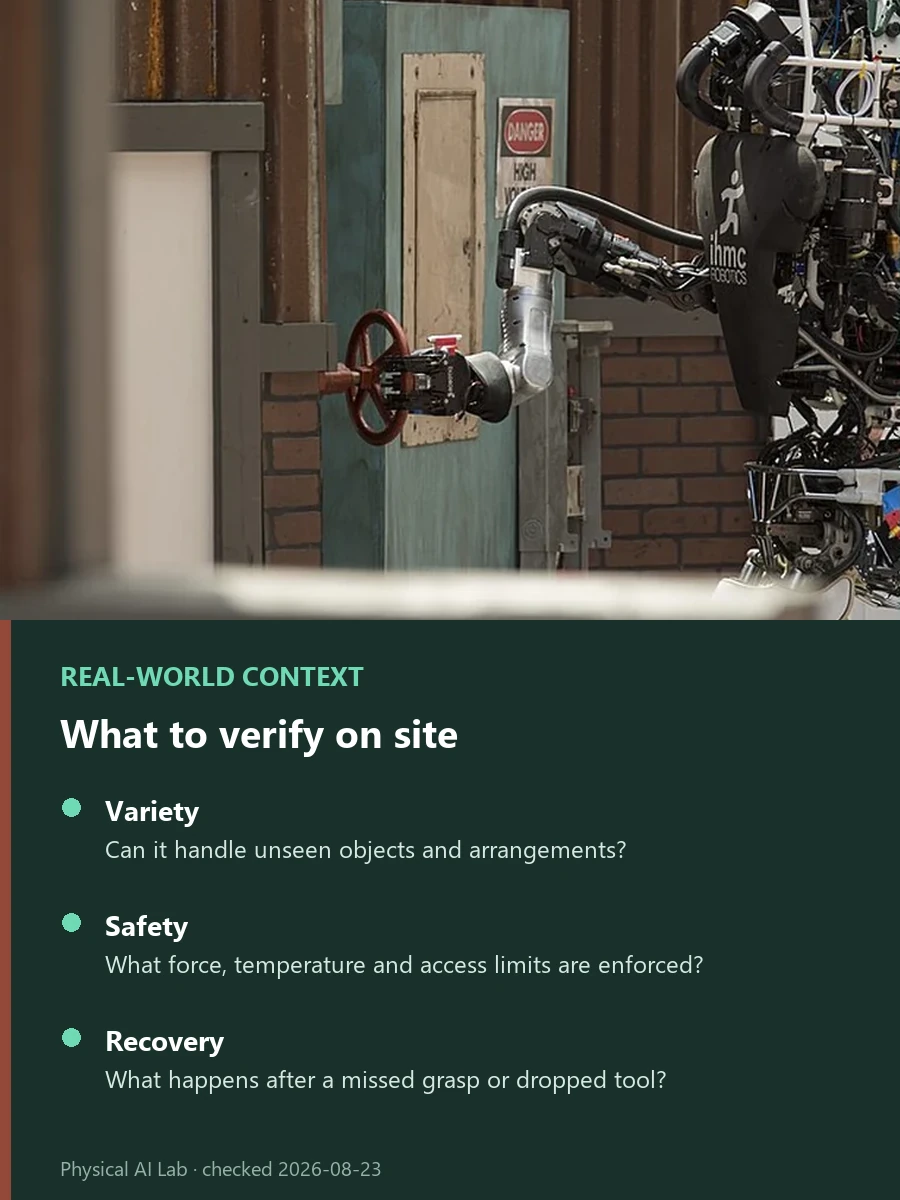

Success at one task does not prove a general-purpose humanoid
Difficulty changes sharply with object type, starting layout, lighting and tolerance for failure. A strong result in one carefully bounded task should not be generalized to all household or emergency work.
Official event material is the current primary evidence. Add customer-site data, independent testing and regulatory documentation when they become available.
Concepts behind manipulation and transfer
Use what physical AI means to define the closed loop, the core ideas behind Sim-to-Real to examine material and hazard transfer and robot foundation models to keep task scope explicit. The comparison reflects evidence available in August 2026.
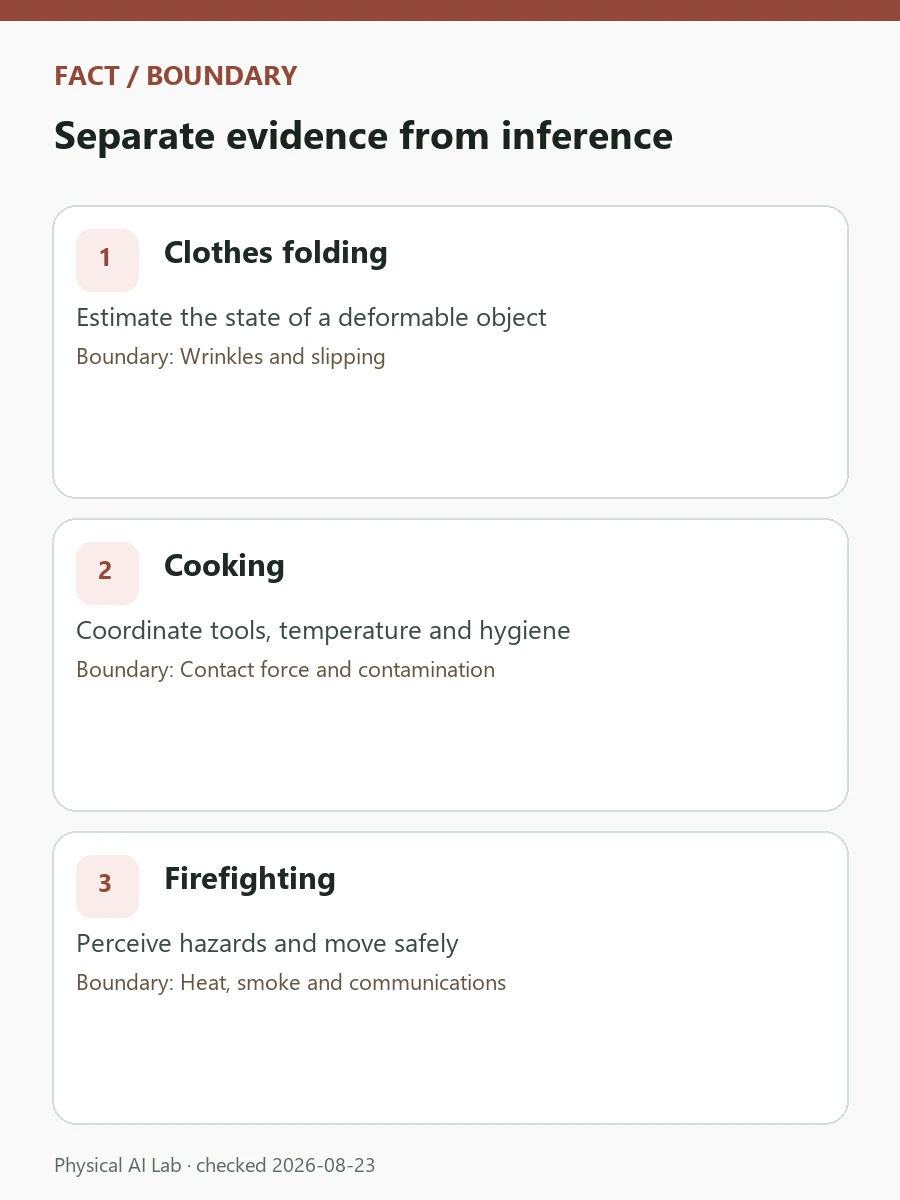
There is no single hardest humanoid task
Clothes folding, cooking and firefighting stress different parts of the system: deformable-object reasoning, controlled contact and hazardous-environment autonomy. Compare repeatability and disclosed limits within each task instead of using one success as proof of general intelligence.
Frequently asked questions
Can clothes-folding evidence stand in for cooking or firefighting readiness?
No. Fabric manipulation, food-safe contact and hazardous-environment operation create different sensing, control and safety requirements. Each task needs its own failure conditions, intervention rules and acceptance test.
Why is clothes folding difficult even without heavy loads?
Fabric has no fixed shape, can hide its own edges and changes after every contact. The robot must infer the garment's state continuously rather than follow one rigid grasp sequence.
Which humanoid task carries the highest safety burden?
Cooking and firefighting both raise the cost of error through heat, contamination or hazardous surroundings. The safer system is the one with explicit force, temperature, access and shutdown limits—not simply the fastest completion.
Official sources checked
- Beijing municipal government's official guide to the 2nd World Humanoid Robot Games
- Beijing municipal government's official WRC 2026 event guide
- Beijing municipal government's World Humanoid Robot Games operations update
Last checked: August 23, 2026