MotionBricks is NVIDIA research aimed at running one character-and-robot motion model, trained on more than 350,000 motion clips, at game-engine speed. The same model driving animated characters and Unitree G1 shows a direct connection between computer graphics and physical AI.
What NVIDIA has demonstrated with MotionBricks
NVIDIA's official SIGGRAPH material says MotionBricks uses more than 350,000 motion clips, runs in real time and was demonstrated on G1. A public demo does not establish generalization to every robot or terrain.
This guide separates the published result from our interpretation. Source claims remain bounded by their date and stated scope; undisclosed price, delivery and success-rate information remains unknown.
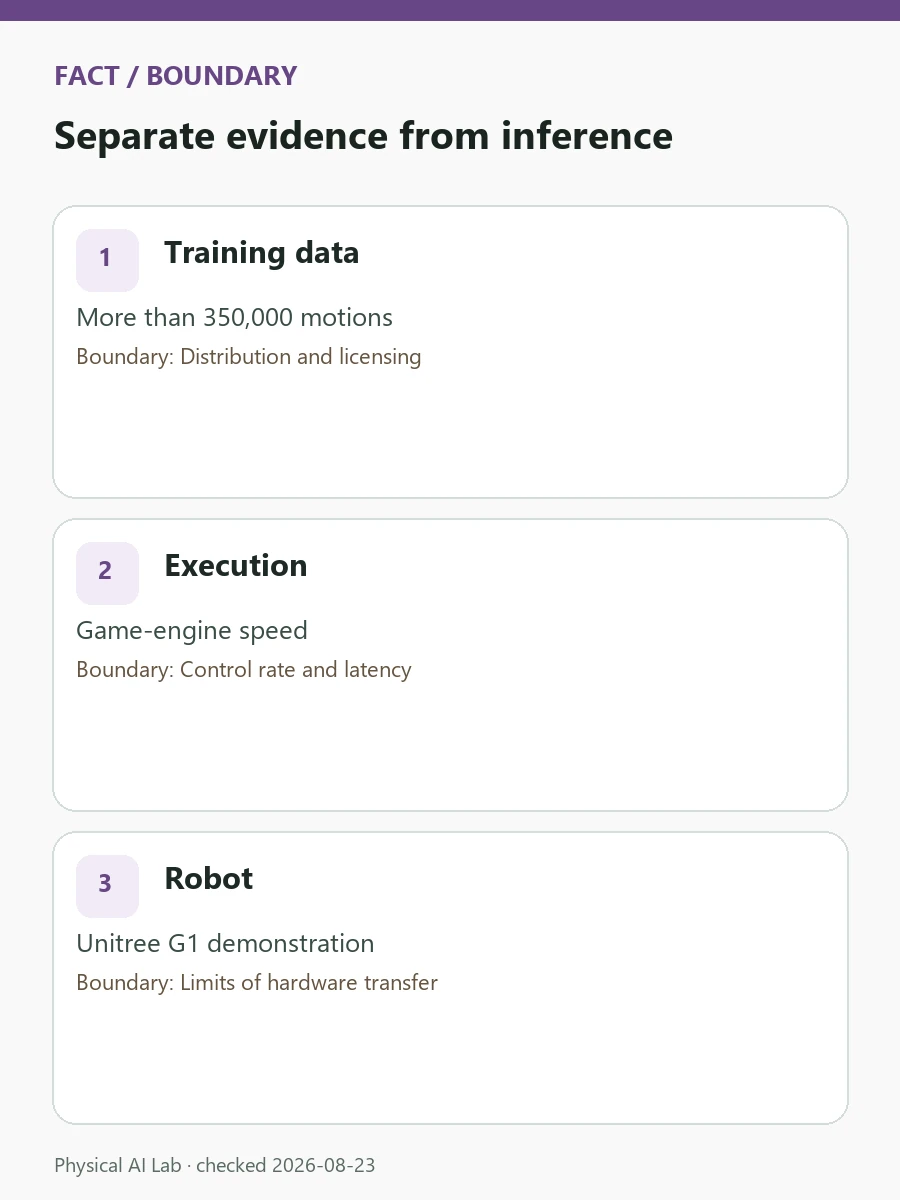
| Layer | What is confirmed | What still needs checking |
|---|---|---|
| Training data | More than 350,000 motions | Distribution and licensing |
| Execution | Game-engine speed | Control rate and latency |
| Robot | Unitree G1 demonstration | Limits of hardware transfer |
The model generates motion rather than retrieving a fixed clip
The central idea is a policy trained across a broad motion distribution that produces the next movement from the current pose and target. A physical robot adds joint limits, latency, contact dynamics and motor heat to the problem.
Motion quality also depends on the wider physical AI loop: synchronized sensors, state estimation, planning, low-level control, safety limits and recovery must work together.
Evaluate tracking, disturbances and hardware stress together
Ask how many repeated attempts were run, when an operator intervened and how the robot recovered after a stop or push. Those records separate a visually smooth clip from robust robot control.
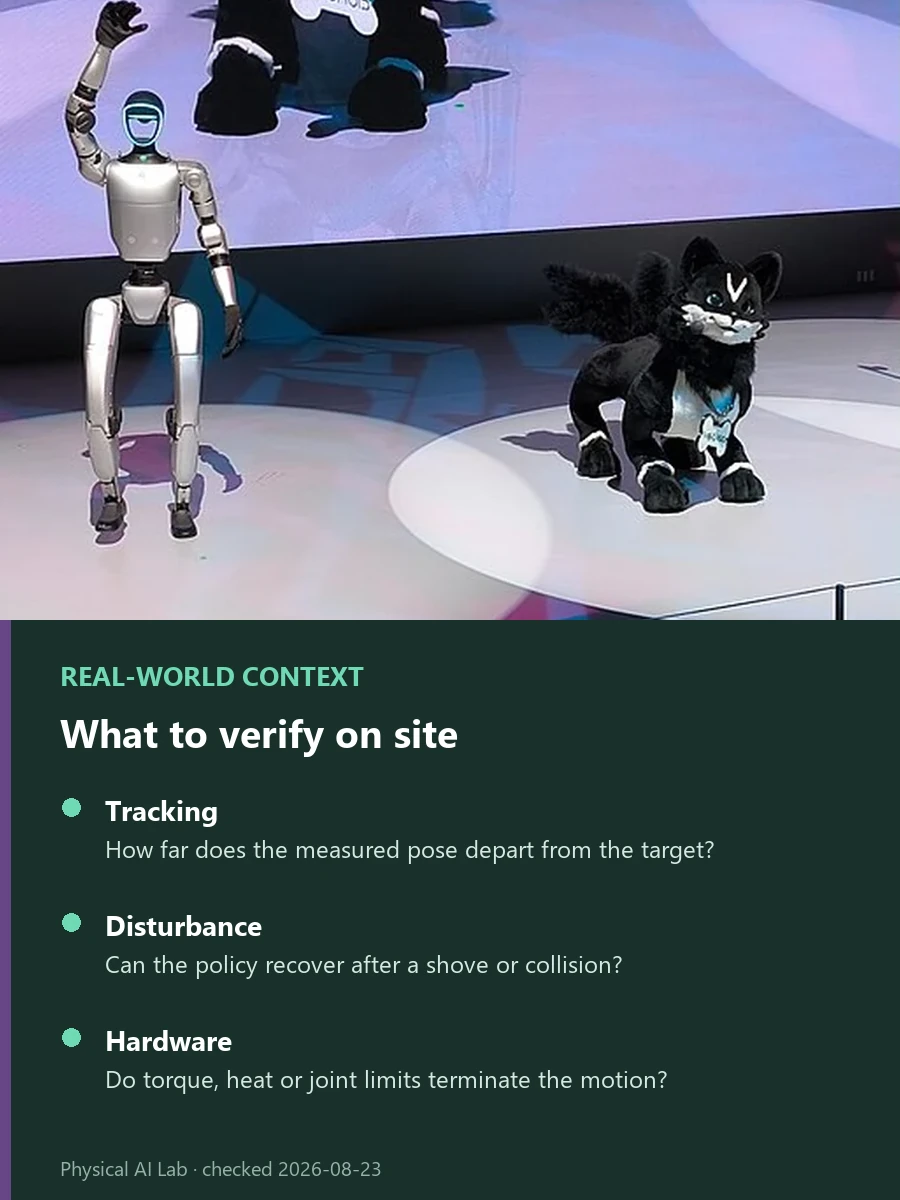
| Check | Question to ask |
|---|---|
| Tracking | How far does the measured pose depart from the target? |
| Disturbance | Can the policy recover after a shove or collision? |
| Hardware | Do torque, heat or joint limits terminate the motion? |

Natural-looking motion and robot safety are different metrics
A serious hardware evaluation needs fall rate, tracking error, disturbance recovery, power use and hardware-damage records. Visual quality alone cannot establish safe control.
The available evidence comes from NVIDIA's research and platform material. Independent hardware tests and longer operating records should update the assessment when available.
Technical background for the transfer to hardware
Use what physical AI means to place motion generation in the control loop, the core ideas behind Sim-to-Real to inspect hardware transfer and robot foundation models to define model scope. This review covers the MotionBricks evidence available in August 2026.
Why MotionBricks matters for physical AI
MotionBricks is an NVIDIA effort to run one character-and-robot motion model trained on more than 350,000 clips at game-engine speed. The decisive evidence will be repeatable hardware performance and clearly reported operating limits.
Frequently asked questions
Does MotionBricks prove one policy can control every robot?
No. It demonstrates a broad motion model and a hardware example, but robot geometry, actuation, latency, contact and safety limits still constrain transfer.
Which MotionBricks metrics matter on real hardware?
Track pose error, fall rate, disturbance recovery, intervention, power, thermal limits and hardware damage. A natural animation is not a substitute for those measurements.
What can make MotionBricks fail after Sim-to-Real transfer?
Unmodeled latency, friction, compliance, actuator saturation, sensor noise and contact can all push the robot outside the policy's training distribution.
Official sources checked
- NVIDIA's official SIGGRAPH 2026 announcement
- NVIDIA MotionBricks research page
- NVIDIA Physical AI platform
Last checked: August 23, 2026