A physical AI drone is not simply an aircraft with an AI model attached to its camera. It is a closed loop that estimates position and surroundings from sensors, plans a mission, makes low-latency decisions at the edge, and executes them through flight control and safety constraints.
The architecture extends beyond the onboard model
WRC 2026 identifies UAV reconnaissance and cooperation with ground embodied intelligence as a competition topic. FAA and NASA material shows why airspace safety and traffic management for multiple unmanned aircraft are requirements outside model performance.
This guide separates sourced facts from interpretation. Claims stay within the date and scope of their original material; undisclosed pricing, delivery and success-rate information remains unknown.
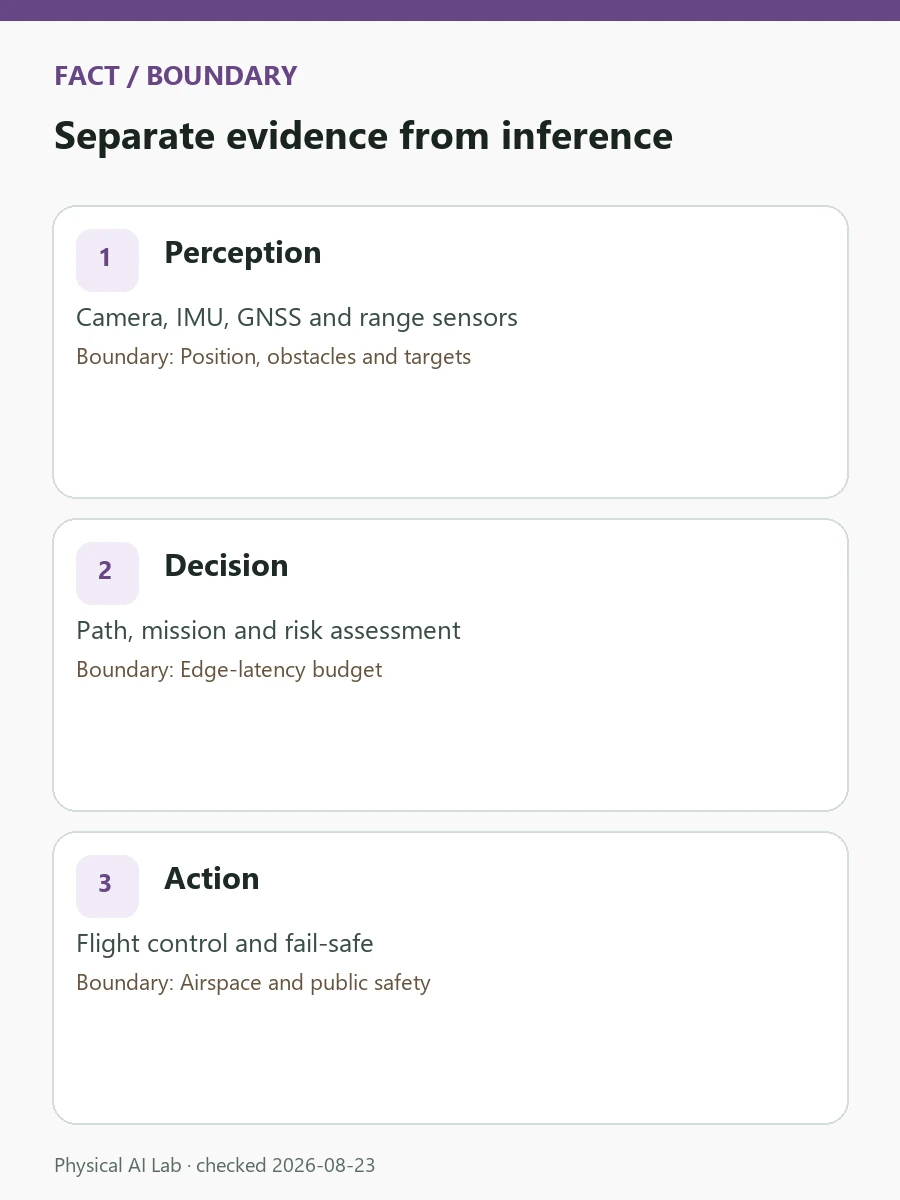
| Architecture layer | Core components | Decision it supports |
|---|---|---|
| Perception | Camera, IMU, GNSS and range sensors | Position, obstacles and targets |
| Decision | Path, mission and risk assessment | Edge-latency budget |
| Action | Flight control and fail-safe | Airspace and public safety |
Weight, power and latency compete on the same aircraft
A drone's limited mass and power budget force tradeoffs among model size, sensor count and flight time. If safety depends on a cloud decision, latency or a lost link becomes a hazard, so the aircraft needs a minimum safe capability onboard.
Its physical AI loop must synchronize sensors, estimate state, plan, control flight, enforce safety limits and recover from failures without interruption.
Design the behavior after link or position loss first
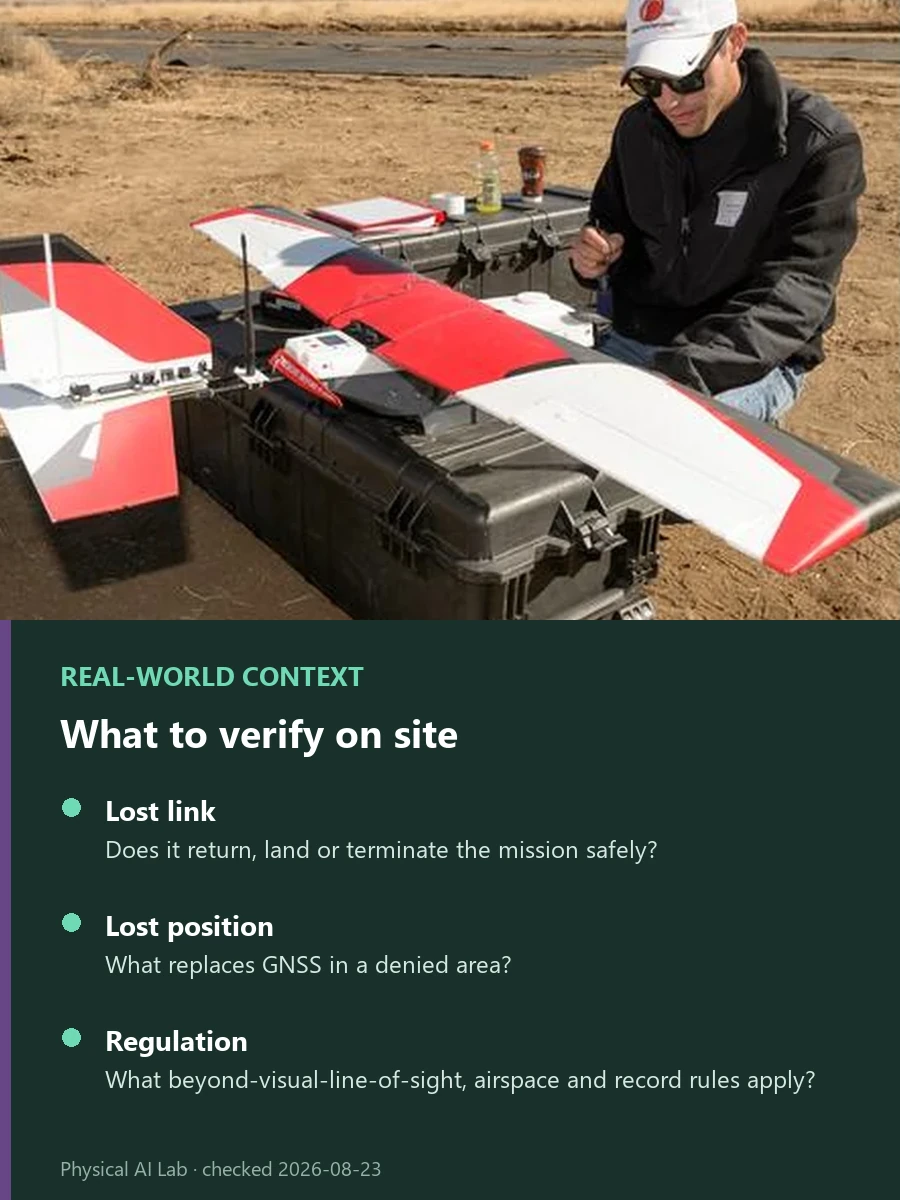
Ask how the aircraft behaves after communications, localization or perception fails. Repeated tests, intervention records and recovery time reveal whether the system is autonomous only on its normal route.
| Failure | Question to ask |
|---|---|
| Lost link | Does it return, land or terminate the mission safely? |
| Lost position | What replaces GNSS in a denied area? |
| Regulation | What beyond-visual-line-of-sight, airspace and record rules apply? |
“Autonomous drone” is not a complete capability description
Automatic takeoff and landing, route following, obstacle avoidance, target understanding and mission replanning are separate capabilities. A vendor should say which are onboard and under what conditions they work.
Official event and agency material defines the current scope. Customer flight records, independent tests and regulatory decisions should update the assessment when available.
Related navigation and multi-robot layers
The warehouse picking robot guide provides task metrics, Open-RMF multi-robot integration explains cross-platform coordination and VIO versus SLAM clarifies navigation state. This August 2026 architecture review connects those ideas to flight.
A physical AI drone is defined by its closed loop
The useful unit is not the camera model but the complete chain from sensing and state estimation to mission planning, edge decisions, flight control and safe failure behavior. Each layer needs repeatable evidence within a disclosed operating envelope.
Frequently asked questions
Does calling a drone autonomous mean it can replan a mission?
No. Some systems only automate takeoff, landing or waypoint flight. Mission replanning requires environment understanding, new route generation, safety checks and authority to change the task.
Which physical AI drone decisions must remain onboard?
At minimum, stabilize flight, avoid an immediate hazard, enforce geofencing and choose a safe response to link or localization loss without waiting for the cloud.
How should a drone architecture expose uncertainty?
Report confidence in position, obstacle and target estimates to the planner, log it with each decision, and trigger conservative behavior when uncertainty crosses a defined limit.
Official sources checked
- Official WRC 2026 guide to UAV–ground robot collaboration
- U.S. FAA official unmanned aircraft systems guide
- NASA's official UTM research overview
Last checked: August 23, 2026