
G1 is closer to a mobile dual-arm workstation than a walking person
Calling G1 a humanoid can create the wrong expectation of a stair-climbing biped. Its lower body is a four-wheel omnidirectional chassis. It can move sideways and rotate in place, fitting organized indoor aisles in stores, pharmacies and warehouses. Stairs, wet floors, large thresholds and rough outdoor ground are outside its documented operating envelope.
The official Galbot G1 developer documentation specifies indoor operation from 0–40°C and at no more than 90% non-condensing humidity. It warns against standing water, unstable Wi-Fi, uneven roads and crossing even small bumps at speed. Those limits reveal field fit more clearly than a product video.
| Item | Official specification | Condition to evaluate with it |
|---|---|---|
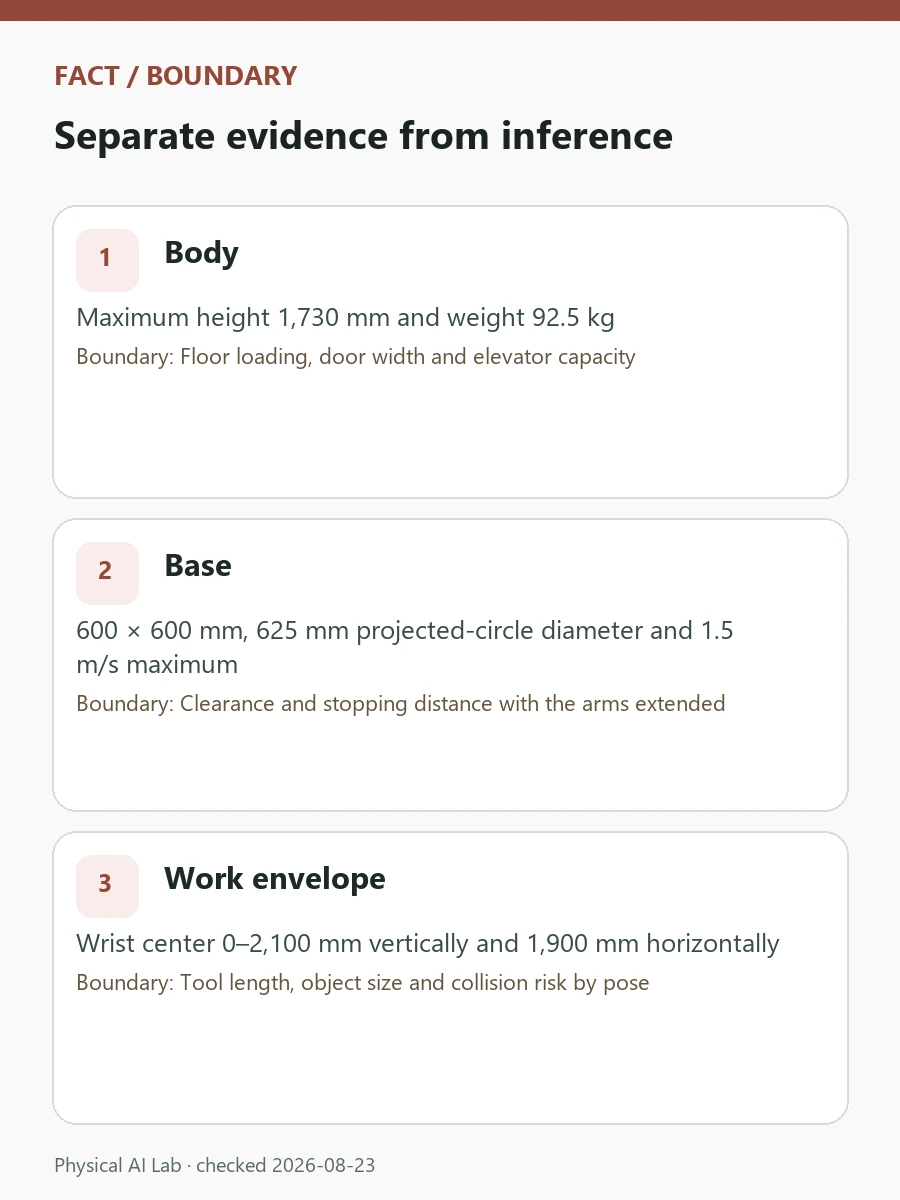
| Body | Maximum height 1,730 mm and weight 92.5 kg | Floor loading, door width and elevator capacity |
| Base | 600 × 600 mm, 625 mm projected-circle diameter and 1.5 m/s maximum | Clearance and stopping distance with the arms extended |
| Work envelope | Wrist center 0–2,100 mm vertically and 1,900 mm horizontally | Tool length, object size and collision risk by pose |
| Payload | 5 kg per arm and 10 kg total | Confirm whether hand or gripper mass is included |
| Power | 48 V 30 Ah, 3.5-hour wired charge and 8-hour listed runtime | Integrated laboratory test at 60% average speed |
The arm sweep matters more than the 600 mm chassis width
A layout that includes only the 600 mm body width is incomplete. The wrist center can reach 1,900 mm horizontally, sending an arm or workpiece into the aisle. Shared spaces need one safety envelope covering chassis clearance, arm sweep and stopping distance after an emergency stop. The official document requires people to stay at least 1.5 m away during operation.
A corridor test should include an approaching cart, sideways motion at a shelf and packaging caught in a wheel—not merely one pass through the narrowest door. Galbot's troubleshooting guidance says wheel debris can reduce mobility accuracy. Weekly cleaning of lidar and camera windows, plus regular checks of wheels, emergency stops and collision sensors, also belongs in the labor estimate.
A wide reach does not guarantee stable picking
The lift stroke is 650 mm and the shoulder-to-wrist arm length is 710 mm, enabling one platform to reach low displays and high shelves. Reach and reliable grasping are different metrics. Raising the torso while holding a heavy object changes center of mass and joint torque, while reflective or occluded packaging can disrupt vision.
A pilot should group actual products or parts by weight, surface and shape. Similar pharmacy boxes may still create glare and wrist-camera occlusion in tight shelves. Bottles tip easily; thin pouches produce different suction or gripper failures. Record slips, double picks, drops and human restaging separately from aggregate success.

The sensor suite is extensive, but occlusion and timing remain weak points
The head carries 1 stereo camera; the torso carries 4 RGB cameras and 2 IMUs. Each wrist has a depth camera and a 6-axis force sensor, while the chassis carries 1 3D lidar, 8 ultrasonic sensors and 1 IMU. The layout separates sensors for global localization from close-range views of the hands.
More sensors do not automatically create robustness. Arms may occlude torso cameras; black packaging or glass may drop depth values; dust on the lidar window alters coordinates. Misalignment between force data and video also records the wrong contact moment for training. Repeat the same task across lighting, occlusion, network latency and sensor cleanliness.
AGX Orin 64 GB is a starting point; site integration is still scoped separately
The onboard computer is listed as NVIDIA AGX Orin 64 GB at 275 TOPS. Networking includes 2.4/5 GHz Wi-Fi and Bluetooth 5.2, with 2 USB 3.0 ports and HDMI for expansion. The documented actuation includes a 2-axis neck, 14 axes across both arms, a 3-axis waist and a 2-axis lift, excluding the chassis and end effectors. These figures indicate research potential; they do not prove plug-and-play integration with a customer's WMS, MES, doors or elevators.
Review the official Galbot G1 Python SDK documentation for hardware-version compatibility, available sensor data, control rate, safety limits and logs. Galbot's quick-start material also directs customers to sales for secondary development support. Integration quotes should cover API development, authentication, safe behavior after network loss, software updates and rollback. See why robots need edge AI and the robot simulator comparison for adjacent design choices.
The 8-hour figure is not a guaranteed shift uptime
G1 lists 8 hours of operation and 3.5 hours to charge by adapter. A footnote says the 8-hour result comes from an integrated laboratory test at 60% average speed. It should not be read as a guarantee of 8 hours under continuous arm motion, heavy onboard inference, maximum-speed travel and an aging battery.
The robot should not operate during wired charging. The manual also says to recharge promptly below 20% and recharge a depleted battery within 24 hours. A wireless dock and spare battery are optional. For two shifts, measure energy per mission, dock success, charging queues, battery-swap labor and which tasks stop under low power.
| Pilot record | Measurement method | Stop or redesign signal |
|---|---|---|
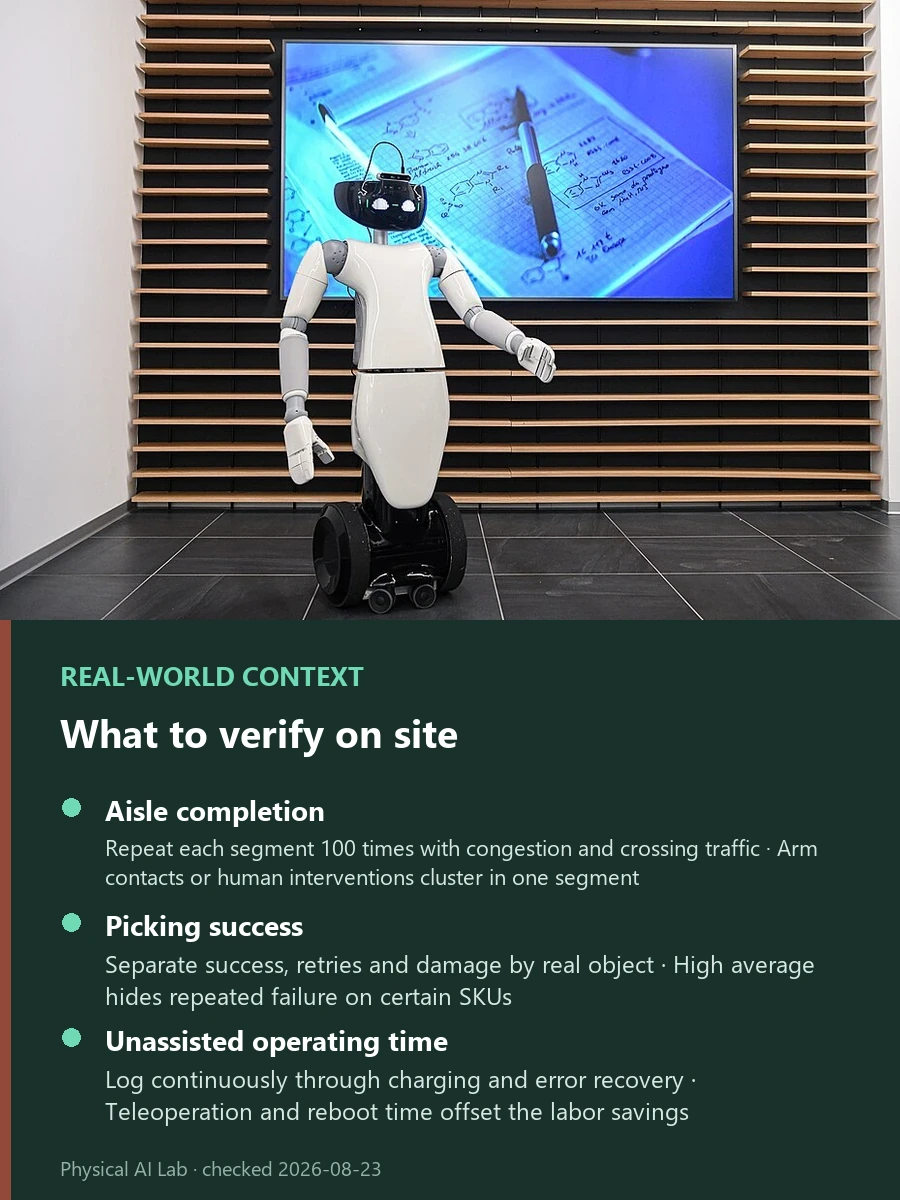
| Aisle completion | Repeat each segment 100 times with congestion and crossing traffic | Arm contacts or human interventions cluster in one segment |
| Picking success | Separate success, retries and damage by real object | High average hides repeated failure on certain SKUs |
| Unassisted operating time | Log continuously through charging and error recovery | Teleoperation and reboot time offset the labor savings |
| Dock success | Repeat autonomous return below 20% battery | Charging failures delay the next mission |
| Recovery time | Reproduce network loss, sensor occlusion and wheel debris | On-site staff lack a safe recovery procedure |
A purchase decision ends with a quote and real-workpiece test
The official Galbot G1 product page provides an inquiry channel but no public list price, country-level inventory, lead time or installation cost. Developer documentation mentions a 12-month limited warranty from the sale date, subject to local law and contract. Freight for spares, battery degradation and exclusions for unauthorized hardware or software changes need confirmation.
Ask the written quote to separate the robot, hand or gripper, wireless dock, spare battery, remote controller, SDK support, integration, training and maintenance response. A product page proves that inquiries are accepted, not that a standard configuration ships immediately everywhere. The physical AI company ecosystem can widen the comparison set.
G1 fits a flat indoor site with varied shelf heights, combined dual-arm picking and transport, and no need for legged travel. Stairs, water, dust or rough floors put documented limits ahead of its strengths. A useful first pilot combines the heaviest item, highest shelf, narrowest aisle and battery below 20% to locate the failure boundary.
Maintenance time belongs in the throughput denominator
Galbot's schedule calls for weekly lidar and camera cleaning and monthly checks of chassis wheels, emergency stops and collision sensors. Dust on sensor windows and debris in wheels can reduce mobility accuracy. A store or warehouse with packaging dust may require shorter intervals. Cleaning removes the robot from productive work and should be subtracted from available uptime.
Practice recovery by failure class: blocked routes, lost networks and missions rejected below the battery threshold need different owners. Define what staff may reboot, when remote support is required and when a part returns to the manufacturer, then measure mean time to recover. Even with a 12-month warranty, shipping damage, normal wear, battery degradation and unauthorized changes may be excluded, so spares and replacement labor belong in total cost of ownership.
Frequently asked questions
Does Galbot G1 walk on two legs?
No. G1 uses a 4-wheel omnidirectional base. Its torso and two arms are humanlike, but it is not a biped designed for stairs.
How much does Galbot G1 cost?
The official product and developer pages do not publish a list price. Buyers need a written quote covering region, end effector, charging dock, development support, warranty and maintenance.
Can the Galbot mobile manipulator work for 8 hours at maximum payload?
The official 8-hour result comes from an integrated laboratory test at 60% average speed. Runtime under maximum payload and continuous arm work needs a site-specific test.
Official sources checked
- Official Galbot G1 product page
- Official Galbot G1 developer documentation
- Official Galbot G1 Python SDK documentation
Last checked: August 23, 2026