Deformable object manipulation is the problem of perceiving and controlling objects whose shape changes during contact. Cloth can fold into hidden layers, cable can create crossings or knots, and a bag can collapse around its contents. A single six-degree-of-freedom pose cannot describe those states.
The practical design question is not how to reconstruct every particle perfectly. It is which geometry, topology and uncertainty the task needs, which action can change that state predictably, and when the robot must reobserve or recover instead of continuing under a false model.
Use this guide with the visual-tactile fusion guide and grasp stability guide. Qualify the object set, perception stack, gripper, motion and recovery policy together.
Define success in geometry and topology
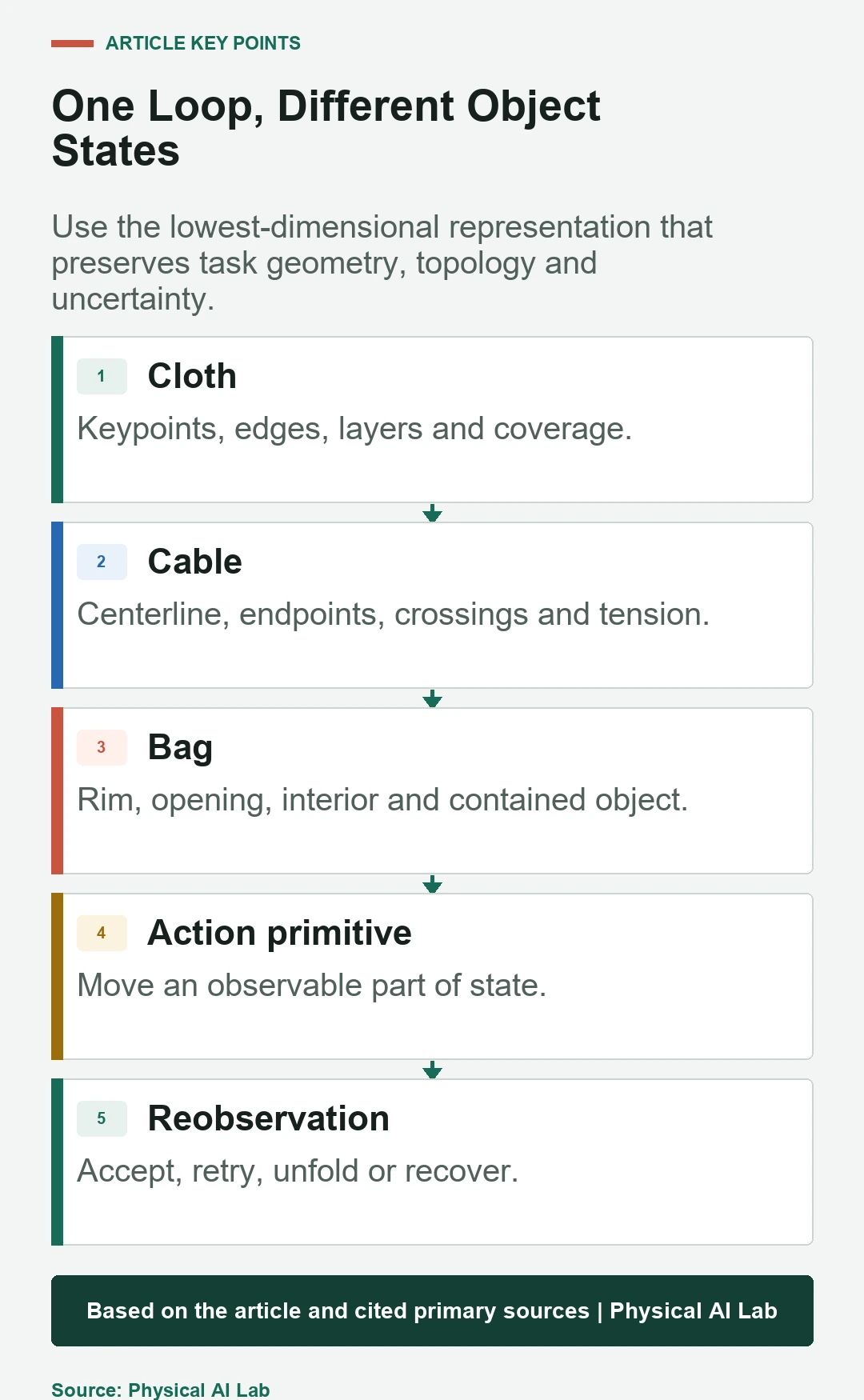
A cloth-flattening task may need visible coverage and corner locations, while folding also needs edge alignment and layer order. Cable routing needs endpoints, centerline and crossing relations. Bag opening needs rim geometry, aperture and confidence that the intended interior is accessible.
Write success and failure labels before choosing a model. Pixel similarity alone can reward a wrong cable crossing or a folded cloth whose hidden layer makes the next action impossible. Include damage, excessive tension and irrecoverable entanglement as explicit failures.
Choose a representation that preserves the task
Useful representations include keypoints, contours, centerlines, masks, meshes, graphs and learned latent states. The smallest useful state is often better than a visually complete but unstable reconstruction, provided it preserves the relations needed for action and verification.
Keep ambiguity instead of forcing one confident answer. Occluded cloth layers, overlapping cable segments and a collapsed bag rim can support several hypotheses. The controller should know when those hypotheses imply different actions.
| Object | Minimum useful state | Critical relation | Typical hidden failure |
|---|---|---|---|
| Cloth | Corners, boundary, coverage | Layer and edge order | Occluded fold |
| Cable | Endpoints and centerline | Crossing and routing order | False intersection |
| Bag | Rim and opening | Inside versus outside | Collapsed lip |
| Soft package | Surface and grasp regions | Contents and load path | Internal shift |
| Garment | Landmarks and boundary | Sleeve or opening identity | Self-occlusion |
Separate shape from topology
Two configurations may have nearly the same visible curve or mask but different topology. A cable segment crossing above instead of below another segment can determine whether pulling untangles or tightens it. Cloth layer order can determine whether a fold completes or traps material.
Represent crossings, containment and layer relations explicitly where they affect action. Use multi-view or active perception when one image cannot resolve them, and propagate an unknown state when the evidence remains insufficient.
Build perception around occlusion and contact
Before contact, RGB-D can estimate visible geometry. During grasping, the gripper and object occlude each other and the depth surface may become unreliable. Tactile or force evidence can confirm contact, tension and slip but remains local to the contact area.
Time-align camera, robot state and contact measurements, then mark stale or invalid regions. The robotic deformable-object manipulation review surveys representations, sensing and manipulation methods, but deployment still depends on the exact material and task envelope.
Use action primitives with observable effects
Pick, place, drag, stretch, fling, shake, insert and tension are useful because each has an intended state change that can be checked. A primitive is not merely a named trajectory; it includes preconditions, contact conditions, termination rules and the observation expected afterward.
Choose primitives that expose hidden state when possible. Lifting a corner can reveal a cloth layer, tensioning a cable can expose its path, and pulling a bag rim apart can make the opening measurable. Limit force and travel so information gathering does not damage the object.
Reobserve after every material state change
Deformable motion is sensitive to friction, stiffness, grasp location and unmodeled contact. Open-loop prediction degrades quickly even when the initial state is accurate. Reobserve after contact, release and large inertial motion rather than assuming the commanded result occurred.
The goal-conditioned Transporter Networks study demonstrates a common visual action framework across cables, fabrics and bags. Treat its reported conditions as research evidence, not a universal hardware guarantee.
Control tension without exceeding material limits
Cable tension can make a centerline easier to control, and cloth tension can reduce wrinkles. Excess tension can tighten a knot, tear fabric, deform a seam or pull a fixture. Estimate load direction and distinguish useful tension from a jam.
Specify limits from the weakest supported object and contact. Use wrist force, motor current or deformation rate as evidence, then stop or unload when force rises without the expected geometric progress.
Treat grasp selection as part of state estimation
A visible corner may be two layers, a cable endpoint may be underneath another segment, and a bag rim may be folded inward. Grasp selection therefore changes what state becomes observable and which topology is preserved.
Score reachability, collision, layer confidence, local curvature and expected information gain in addition to geometric distance. After closing the gripper, verify acquisition and material count before executing a long motion.
Model material variation and generalization honestly
Thickness, stiffness, damping, friction, weave, stretch and mass distribution change perception and action outcomes. A model trained on one towel color or cable diameter can learn shortcuts that fail on a new batch even when the task appears identical.
Split validation by object instance and material family, not only by images from the same trial. Report both interpolation and held-out performance. The Cloth Funnels project shows strong long-horizon cloth manipulation, while its assumptions and hardware scope should remain visible when comparing systems.
Use simulation for coverage, then close the reality gap
Simulation can generate varied configurations and test action logic without consuming hardware time. Its contact, friction and bending models may not reproduce real seams, layered self-contact or gripper compliance. Apparent success can therefore depend on simulator-specific dynamics.
Randomize parameters only within physically defensible ranges and record which real measurements set those ranges. Finish every important claim with held-out real objects, real sensors and the production timing budget.
Design recovery as a first-class policy
Recovery states include reobserve, change viewpoint, regrasp, unfold, reduce tension, release and reset. The policy needs a progress measure so it does not repeat an action that preserves the same ambiguity or tightens an entanglement.
Set retry limits and a safe handoff condition. If the robot cannot distinguish two topologies or force rises without progress, requesting human reset may be the correct outcome rather than a hidden failure after repeated motion.
| Test dimension | Levels to cross | Primary metric | Required failure record |
|---|---|---|---|
| Material | Stiffness, friction, thickness | Success by family | Object identity |
| State | Flat, folded, tangled, collapsed | State coverage | Initial topology |
| Observation | Occlusion, glare, missing depth | Confidence calibration | Validity mask |
| Action | Primitive, speed, grasp point | Progress and damage | Force timeline |
| Recovery | Reobserve, regrasp, reset | Safe recovery rate | Retry sequence |
Release with a deformable-task contract
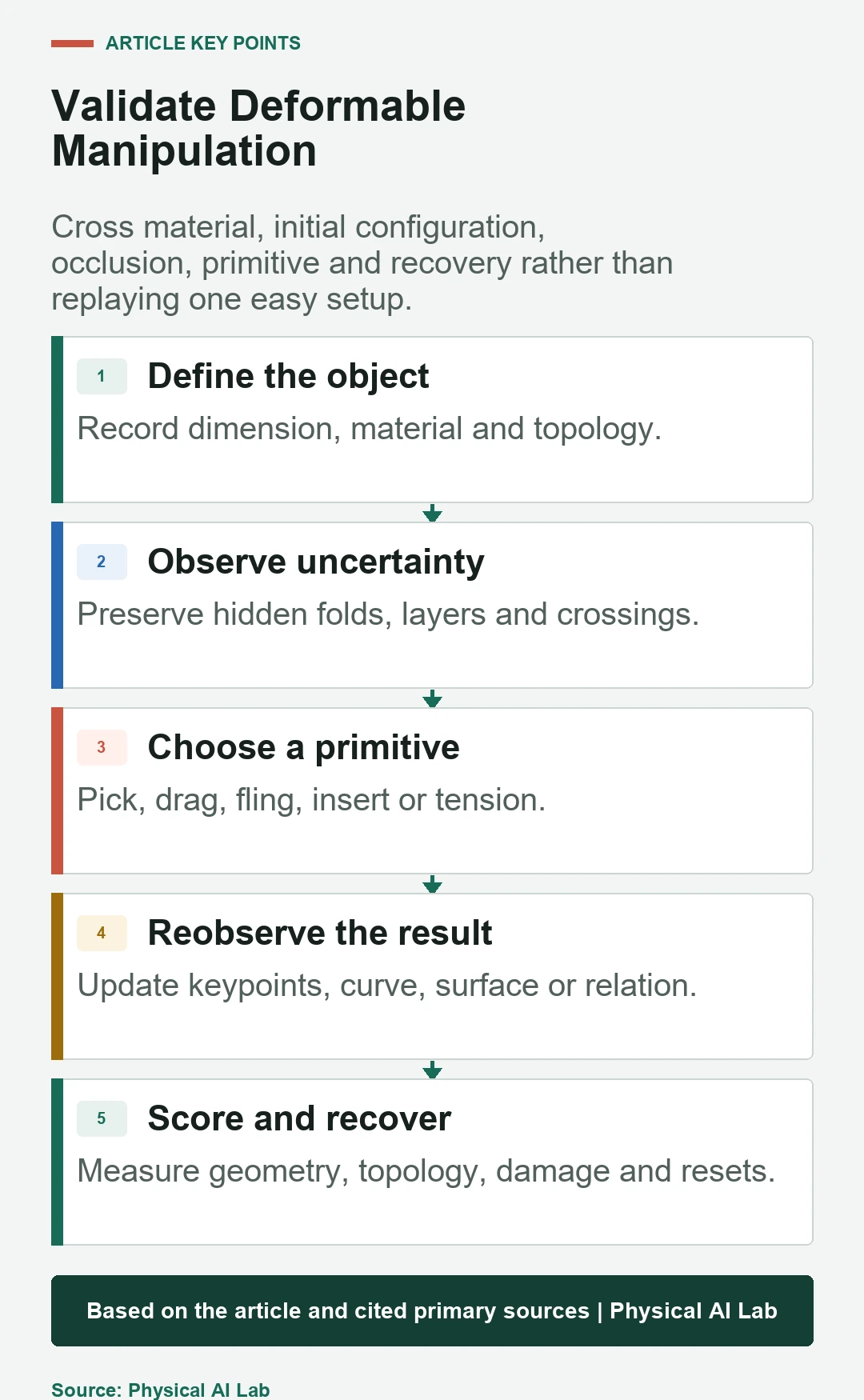
Document supported object dimensions and materials, state representation, observation requirements, primitives, force limits, success metrics, retry policy and reset boundary. Keep camera, gripper, surface and software versions with every benchmark.
Close validation with the following checklist.
- Define geometry, topology and damage criteria.
- Preserve uncertainty under occlusion and self-contact.
- Use primitives with observable preconditions and outcomes.
- Reobserve after every meaningful contact action.
- Cross material, configuration, perception fault and recovery.
Frequently asked questions
Can cloth or cable be represented by one 6D pose?
No. A rigid pose cannot describe folds, centerlines, crossings, layer order or an opening whose shape changes during contact.
Is a full mesh always the best state representation?
No. Use the simplest representation that preserves the task geometry, topology and uncertainty and remains stable enough for control.
Why must the robot reobserve so often?
Small errors in friction, stiffness, grasp location and contact can create large shape differences, so the commanded result cannot be assumed.
Can simulation replace hardware testing?
No. Simulation is useful for coverage, but real self-contact, seams, friction, compliance and sensing require held-out hardware validation.
What is the most important recovery trigger?
Stop repeating the nominal action when state ambiguity, excessive force or lack of geometric progress leaves the qualified envelope.
Task-Specific State and Safe Recovery Boundary
Deformable objects can hide task-changing topology behind similar images. Maintain uncertainty, limit force and require observable progress before continuing.