Mobile manipulation couples a moving base, torso or lift, robot arm and end effector. A navigation goal that places the base near an object may still leave the tool unreachable, singular, occluded or in collision. Conversely, a favorable arm pose may require an unsafe or impossible base approach.
The system needs layers with clear responsibilities. Navigation handles longer-horizon travel through the environment. Base-pose sampling and reachability connect the tool task to a useful arrival region. Coupled planning or whole-body control handles motions where base and arm interaction matters.
Use this guide with the mobile robot planning guide and motion-planning comparison. Validate commanded and measured arrival states separately.
Begin from the tool task, not the nearest base point
Define the desired tool pose, approach corridor, orientation tolerance, contact direction and retreat. Generate base and torso candidates that make this task feasible rather than choosing the geometrically nearest stopping point.
Include sensor viewpoint and human access. A base pose can satisfy inverse kinematics while hiding the target behind the arm or blocking a cabinet door that must open next.

Separate sequential, coupled and hybrid planning
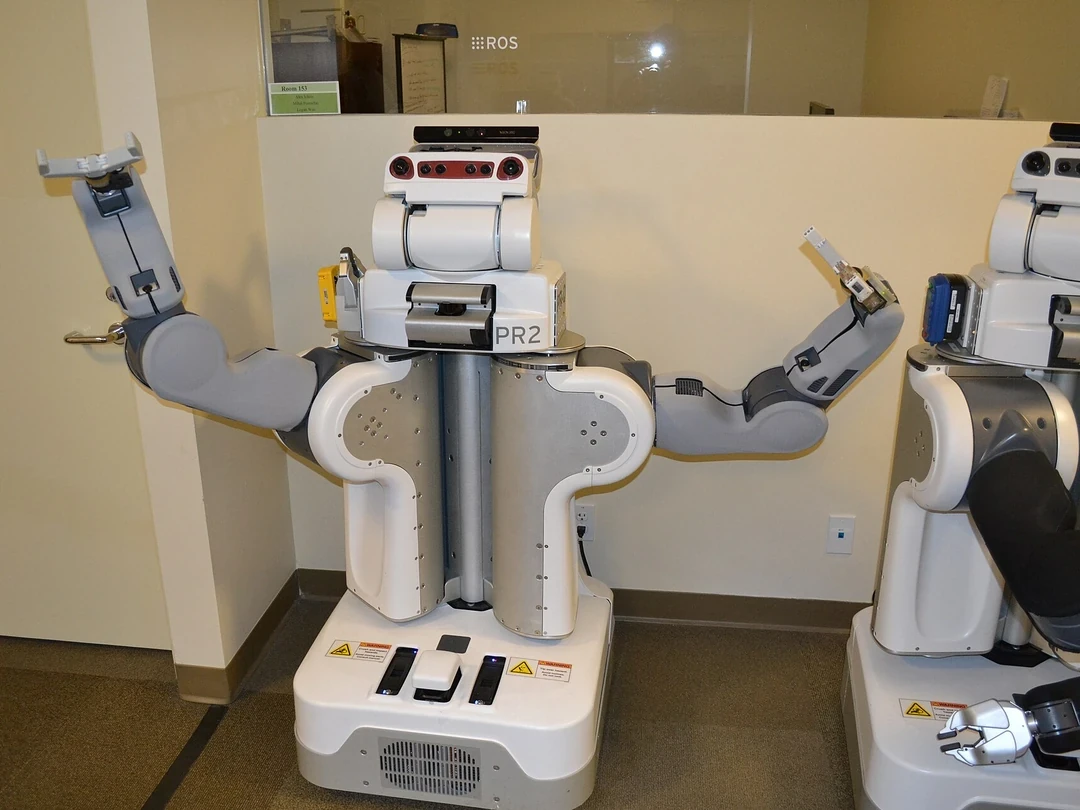
Sequential planning navigates, stops and then plans the arm. It is simple and appropriate when arrival uncertainty is small and the task is stationary. Coupled planning searches base and arm state together, which can exploit more reach but increases dimension and modeling demands.
A hybrid system uses navigation for long travel, then a local coupled adjustment near the task. Select the architecture from required precision, contact, space and recovery rather than treating full coupling as automatically superior.
| Architecture | Best fit | Main advantage | Primary failure |
|---|---|---|---|
| Sequential | Open space and tolerant reach | Simple interfaces | Unreachable after arrival |
| Base-pose sampling | Many acceptable stops | Task-aware navigation goal | Weak scoring model |
| Coupled planning | Tight coordinated motion | Uses full workspace | High-dimensional search |
| Whole-body control | Online contact or tracking | Continuous correction | Model and stability demand |
| Hybrid | Long travel plus precise task | Layered compute | Transition mismatch |
Generate base candidates from inverse reachability
Instead of solving one arm inverse-kinematics problem after arrival, sample or optimize base poses that place the tool goal inside a favorable arm workspace. Score multiple IK solutions, not only existence.
Reject candidates that violate base footprint, approach direction, sensor view or navigation clearance. The inverse kinematics guide explains why a pose solution is only one feasibility layer.
Use reachability margin rather than a binary IK result
A reachable pose near a joint limit or singularity may be fragile to base error. Reachability maps or repeated IK sampling can estimate solution density, manipulability, joint margin and approach feasibility around each base candidate.
Score a region that tolerates localization and object-pose uncertainty. The best nominal candidate is often worse than a slightly farther pose with a wider feasible neighborhood.
Represent the full mobile manipulator collision geometry
Collision checks must include the base, wheels, mast, torso, arm links, end effector, cables and payload. The attached object changes the swept volume after grasping. A base rotation can swing a raised arm into obstacles even when the endpoint moves little.
Keep static map, local obstacles and manipulation scene synchronized. Use conservative geometry for unmodeled protrusions and test perception latency during people or carts entering the workspace.
Use Nav2 and manipulation planning at the right horizons
The current Nav2 concepts documentation describes planners, controllers and behavior orchestration for mobile navigation. It does not solve arm reachability or contact constraints by itself.
The MoveIt mobile-base-and-arm tutorial demonstrates a combined planning group and explicitly recommends Nav2 for pure navigation. Treat the example as an architecture reference and validate the versions used in deployment.
Respect nonholonomic base motion and path execution
A differential-drive base cannot translate sideways. A planar joint modeled as holonomic can return a geometric motion that the platform cannot execute. Turning radius, wheel slip and local-controller behavior also affect the final base pose.
Use a motion model that matches the base and check the actual controller interface. Record path tracking and final covariance, not only planner success.
Include stability, payload and contact in coupled motion
Extending an arm shifts the center of mass and increases wheel and structural load. Braking or turning with a heavy payload can reduce stability. Contact tasks add wrench constraints and may require a fixed or braked base.
Use the whole-body control guide for shared constraints, then validate tip or wheel-load margin and base motion under the real payload and floor.
Reobserve after navigation instead of trusting the command
The commanded base goal is not the measured arrival pose. Localization error, wheel slip, obstacle avoidance and stopping dynamics change the arm’s relationship to the target. Object pose may also move during travel.
After arrival, acquire a fresh robot and target state, recompute transforms and gate the arm plan. If the target is outside the tolerant reach region, reposition the base rather than forcing a marginal arm trajectory.
Plan safe transitions and recovery postures
Define when the arm is stowed for travel, when it may extend and which posture preserves sensors and braking. Recovery can include retracting the tool, lowering a payload, backing away, repositioning and reobserving.
A failed arm plan should return a reason that the task executive can use. Repeating the same navigation goal and IK request without changing state is not recovery.
Evaluate task success across uncertainty and clutter
Measure navigation success, arrival error, reachable-goal rate, planning time, minimum joint and collision margin, replans, task success, contact force and recovery. Vary object uncertainty, base error, clutter, floor friction and payload.
The Google Research table-wiping study shows a whole-body constrained execution approach for one contact-rich mobile task. Keep task and hardware scope explicit when drawing conclusions.
| Test factor | Variation | Primary metric | Failure evidence |
|---|---|---|---|
| Arrival | Pose error and covariance | Reachable-task rate | Measured base pose |
| Scene | Clutter and dynamic obstacles | Collision margin | Scene timestamp |
| Target | Pose and visibility uncertainty | Reobservation success | Sensor frame |
| Payload | Mass and reach | Stability and torque margin | Wheel and joint load |
| Recovery | Failed IK, blocked path, contact | Safe completion rate | State transitions |
Publish the base-arm execution contract
Document tool-goal tolerance, base candidate generator, reachability score, planning groups, motion model, scene source, arrival gate, stability limits and recovery states. Keep map, calibration, robot model and software versions with each benchmark.
Release with a concise checklist.
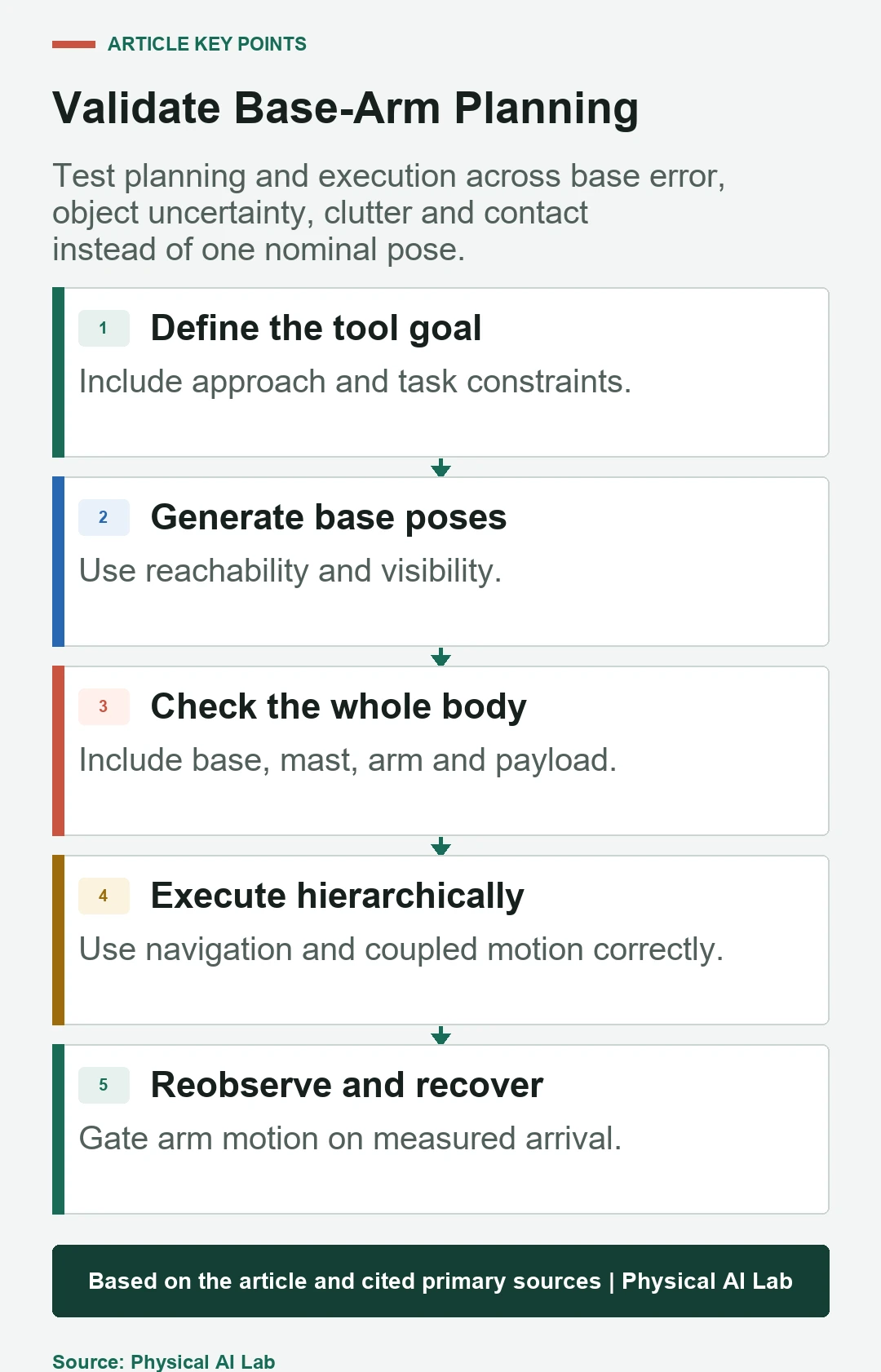
- Generate base poses from the tool task.
- Score reachability margin, visibility and navigation feasibility.
- Check the full moving body and attached payload.
- Reobserve the measured arrival state before arm motion.
- Test repositioning, retraction and safe recovery.
Frequently asked questions
Must the base and arm always be planned together?
No. Sequential planning is effective for tolerant tasks; coupled or hybrid planning is useful when base motion and arm feasibility strongly interact.
Is the closest base pose usually best?
No. It may create joint limits, singularity, occlusion, collision or poor approach geometry; score a robust feasible region.
Can Nav2 plan the complete mobile manipulation task?
Nav2 handles mobile navigation; arm reachability, manipulation collision, contact and task constraints need additional planning and control.
Can the arm compensate for base stopping error?
Only inside a measured reach and margin envelope. Larger errors require reobservation and base repositioning.
How should coupled planning be compared?
Measure task success, arrival tolerance, reach and collision margin, runtime, replans, contact behavior and recovery across controlled uncertainty.
Commanded Arrival and Executable Tool-Pose Boundary
A successful navigation command does not authorize arm motion. Reobserve the base, target and scene, then gate the tool plan against reach, collision, stability and contact limits.