
Humanoid robot actuators convert electrical power into controlled joint motion. The industry includes magnetic materials, copper, bearings, motors, reducers or alternative transmissions, encoders, torque sensors, drives, brakes, housings, cables, joint modules, test equipment and manufacturing services.
The value does not belong to one component alone. A high-torque motor can overheat inside a compact joint. A precise reducer can add friction and limit backdrivability. An encoder can resolve tiny motion while the structure deflects under load. Integration determines torque density, efficiency, bandwidth, noise, safety and service life.
This market view connects the robot actuator structure guide with the humanoid platform landscape. It explains technical layers and procurement questions, not company valuation or investment advice.
Electric motors create joint torque and speed
Permanent-magnet brushless motors are common because they can provide high power density and controllability. Kollmorgen’s frameless-motor overview illustrates how a rotor and stator can be integrated into the joint housing, reducing packaging overhead but transferring mechanical, thermal and manufacturing responsibility to the robot maker.
Compare continuous and peak torque at defined temperature, speed-torque envelope, winding, voltage, efficiency, rotor inertia and cooling. A peak number without duration and thermal conditions cannot predict a humanoid duty cycle.
Reducers trade speed for torque
Harmonic, planetary, cycloidal and belt transmissions offer different ratios, backlash, stiffness, efficiency, mass and shock tolerance. Some joints use quasi-direct drive with a low ratio to preserve backdrivability and control bandwidth. Others need higher reduction for compact torque.
Reducer suppliers must hold geometric tolerances and material quality across production. Robot makers should test lost motion, hysteresis, efficiency, acoustic noise, lubrication, wear and impact. Catalog ratings are starting points, not a complete joint-life model.
Encoders and torque sensing close the control loop
Motor-side encoders support commutation and rotor position. Output-side encoders observe joint motion after the transmission and can reveal backlash or elastic deflection. Joint torque can be measured directly with a load path sensor or estimated from motor current and a friction model.
Resolution, absolute position, latency, interface, functional safety features and environmental limits all matter. Dual sensing improves observability but adds cost, calibration and wiring. Sensor placement should match the control and safety decisions the joint must make.
| Layer | Primary role | Key metric | Integration risk |
|---|---|---|---|
| Motor | Electromagnetic torque | Continuous torque density | Heat and saturation |
| Transmission | Torque multiplication | Efficiency, stiffness and backlash | Wear and shock |
| Encoder | Position feedback | Accuracy, rate and latency | Alignment and interface |
| Torque sensor | Interaction load | Range, drift and bandwidth | Overload and calibration |
| Drive | Current and control | Bandwidth and protection | EMI and thermal load |
Drives and power electronics control current
The motor drive switches voltage to regulate phase current and torque. It handles commutation, sensing, limits, communication and fault protection. Switching frequency, current-loop bandwidth, DC bus, regenerative energy and electromagnetic compatibility affect the complete robot.
Humanoids pack many drives near sensors and communication links. Heat and EMI can degrade neighboring components. Centralized and distributed architectures trade cable mass, service access, cooling and network timing.
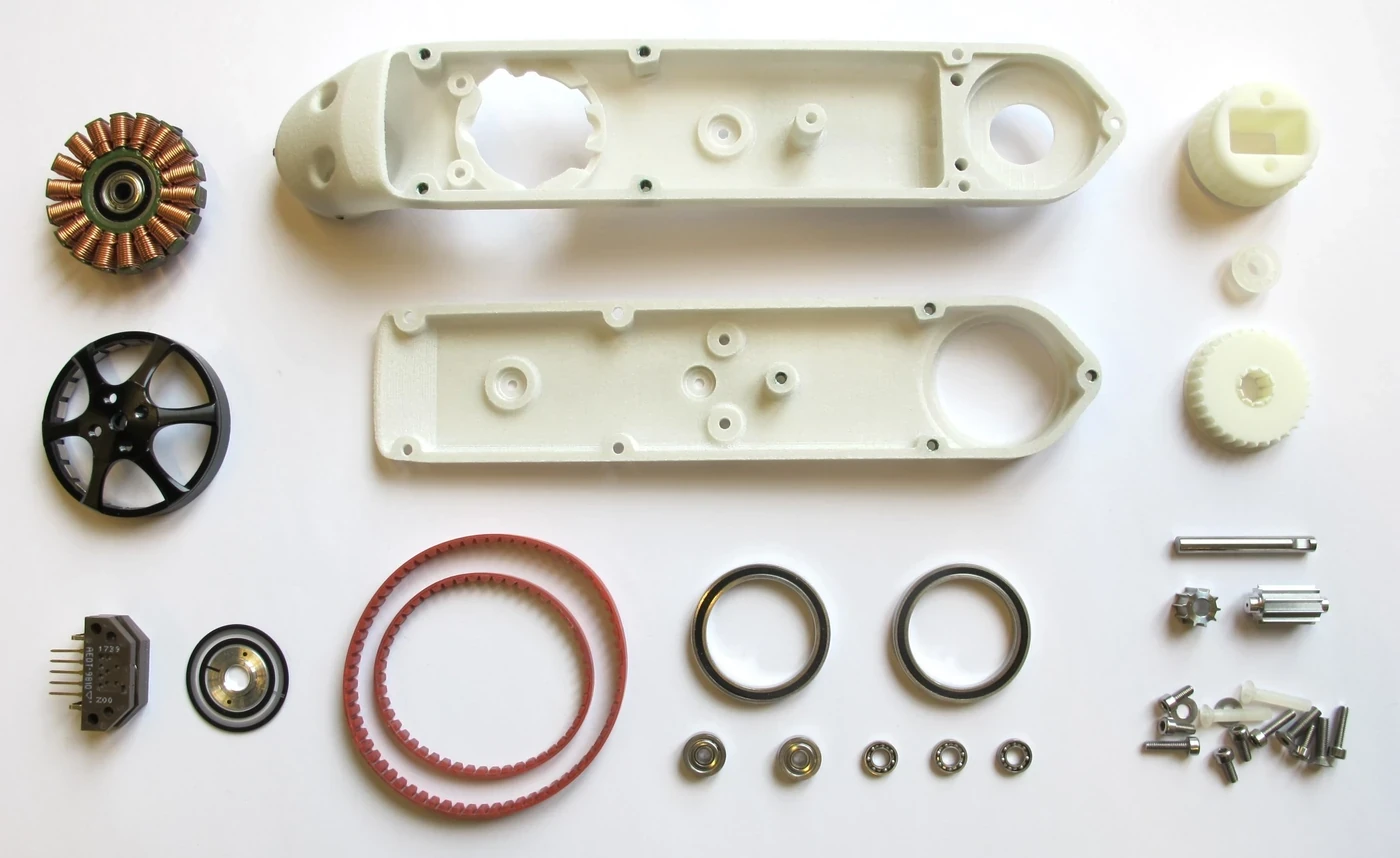
An open module reveals the integration burden
The Open Dynamic Robot Initiative actuator is a transparent research example with motor, belt stages, encoders, bearings and housing. It helps readers trace power and feedback, but it should not be treated as the standard architecture for every commercial humanoid.
Commercial modules may use frameless motors, compact reducers, dual encoders, torque sensing, brakes and integrated drives. The design depends on joint size, motion, load, impact and cost. Compare architectures at the same output task rather than at component level alone.
Joint-module companies package a tested subsystem
A module supplier integrates components into a mechanical and electrical interface with ratings, firmware and support. This can shorten robot development and concentrate manufacturing expertise. It may also constrain geometry, communication, control access and long-term sourcing.
Robot makers choosing vertical integration gain design freedom but must develop winding, assembly, calibration, firmware, thermal management and test capacity. The make-or-buy decision should include volume, intellectual property, service, supply security and redesign cost.
The industry map extends beyond hardware catalogs
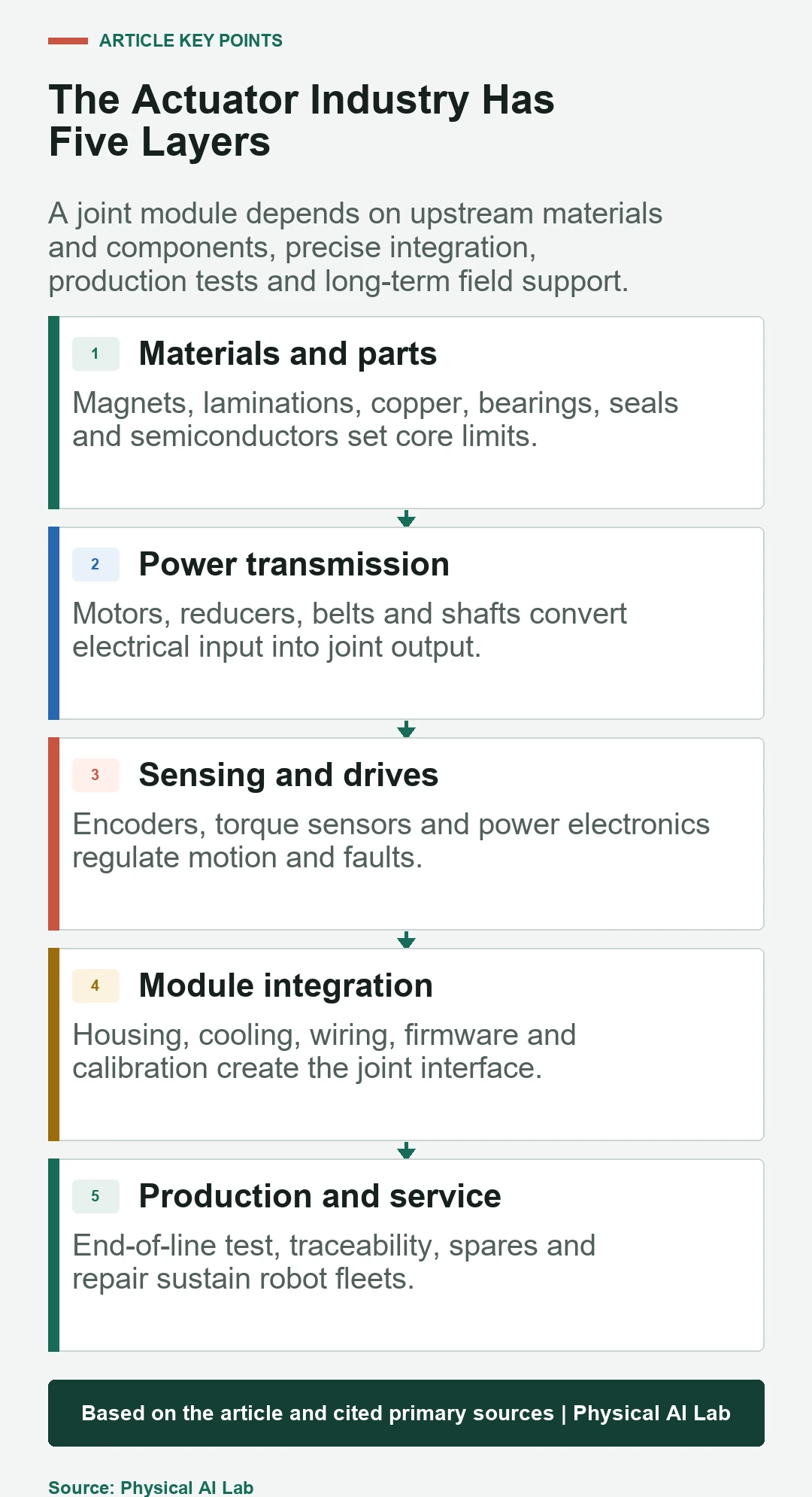
Upstream suppliers provide magnets, laminations, copper, steels, bearings, seals and semiconductor devices. Production needs winding, machining, heat treatment, metrology, balancing, clean assembly and end-of-line testing. Downstream services include repair, spares, diagnostics and field data analysis.
A shortage or quality drift in a low-cost part can stop a high-value robot. Map sole sources, qualification time and second-source feasibility. Supplier capacity claims should be checked against the specific component geometry and process required by the robot.
Manufacturing quality determines joint consistency
Prototype joints can be hand-tuned. Volume production needs controlled dimensions, preload, adhesive, winding, sensor alignment, lubrication and firmware calibration. End-of-line tests should detect torque ripple, noise, friction, backlash, thermal behavior and communication faults.
Statistical process control matters because small joint differences accumulate across a humanoid body. Serial-number traceability should connect components, calibration, test results and later field events. A nominally identical replacement joint should not require rebuilding the whole controller.
| Production test | Output | Defect detected | Field consequence |
|---|---|---|---|
| No-load sweep | Friction and ripple | Assembly or alignment | Poor control and heat |
| Loaded efficiency | Loss versus torque and speed | Transmission or winding issue | Short runtime |
| Thermal cycle | Temperature and derating | Cooling or sensor drift | Unexpected shutdown |
| Backlash and stiffness | Lost motion and compliance | Preload or gear variation | Position error |
| Communication fault | Safe response and diagnostics | Firmware or wiring defect | Unsafe or hard-to-service stop |
Qualification must match humanoid duty cycles
Walking joints experience impacts and cyclic loads, while hands prioritize compactness and fine force control. A warehouse humanoid may repeat lifts for hours, and a demonstration platform may operate intermittently. One generic life test cannot represent every joint and application.
Build load spectra from motion capture, simulation and physical prototypes. Include overloads, falls, regeneration, vibration, contamination and cable motion. Correlate bench tests with field failures and update accelerated-life assumptions.
Procurement should compare evidence, not peak torque
Request continuous output at temperature, efficiency maps, torque-speed curves, mass including drive and housing, backlash, stiffness, bandwidth, noise, environmental rating, lifetime test and failure response. Confirm what is measured at the motor versus the joint output.
Evaluate samples with the intended controller and load. Disassemble failed units and review process controls. The best supplier relationship includes change notification, traceability, firmware support, second-source planning and a clear repair path.
- Define the joint duty cycle and output envelope.
- Compare complete module mass and thermal performance.
- Audit sensing, drive and safety interfaces.
- Require production and life-test evidence.
- Plan traceability, service and alternative supply.
Frequently asked questions
What companies belong to the humanoid actuator industry?
The industry includes material and bearing suppliers, motor and reducer makers, encoder and torque-sensor companies, drive vendors, joint-module integrators, test-equipment providers and manufacturing partners.
Are humanoid actuators all harmonic-drive joints?
No. Designs use harmonic, planetary, cycloidal, belt and quasi-direct-drive architectures depending on torque, speed, compliance, size and cost.
Why use a frameless motor?
A frameless rotor and stator can fit tightly inside a custom joint, improving packaging. The robot maker must then own bearing, housing, alignment, cooling and assembly quality.
Which actuator metric matters most?
Use continuous task-level output with temperature, efficiency, mass, speed, bandwidth and life. Peak torque alone is insufficient.
Should robot makers build their own joint modules?
It depends on volume, differentiation, engineering capacity, supply security and service needs. Buying modules reduces some integration work but can limit geometry and control access.
Industry and Component Note
Supplier products, capacities and humanoid programs change rapidly. Verify current datasheets and qualification evidence, and test complete joint modules under the intended duty cycle before procurement.