Humanoid fall protection estimates when normal balance recovery is no longer feasible, then changes the control objective from completing the task to protecting nearby people and reducing robot damage. A tilt threshold alone is too late for some falls and too sensitive during intentional crouching or dynamic motion.
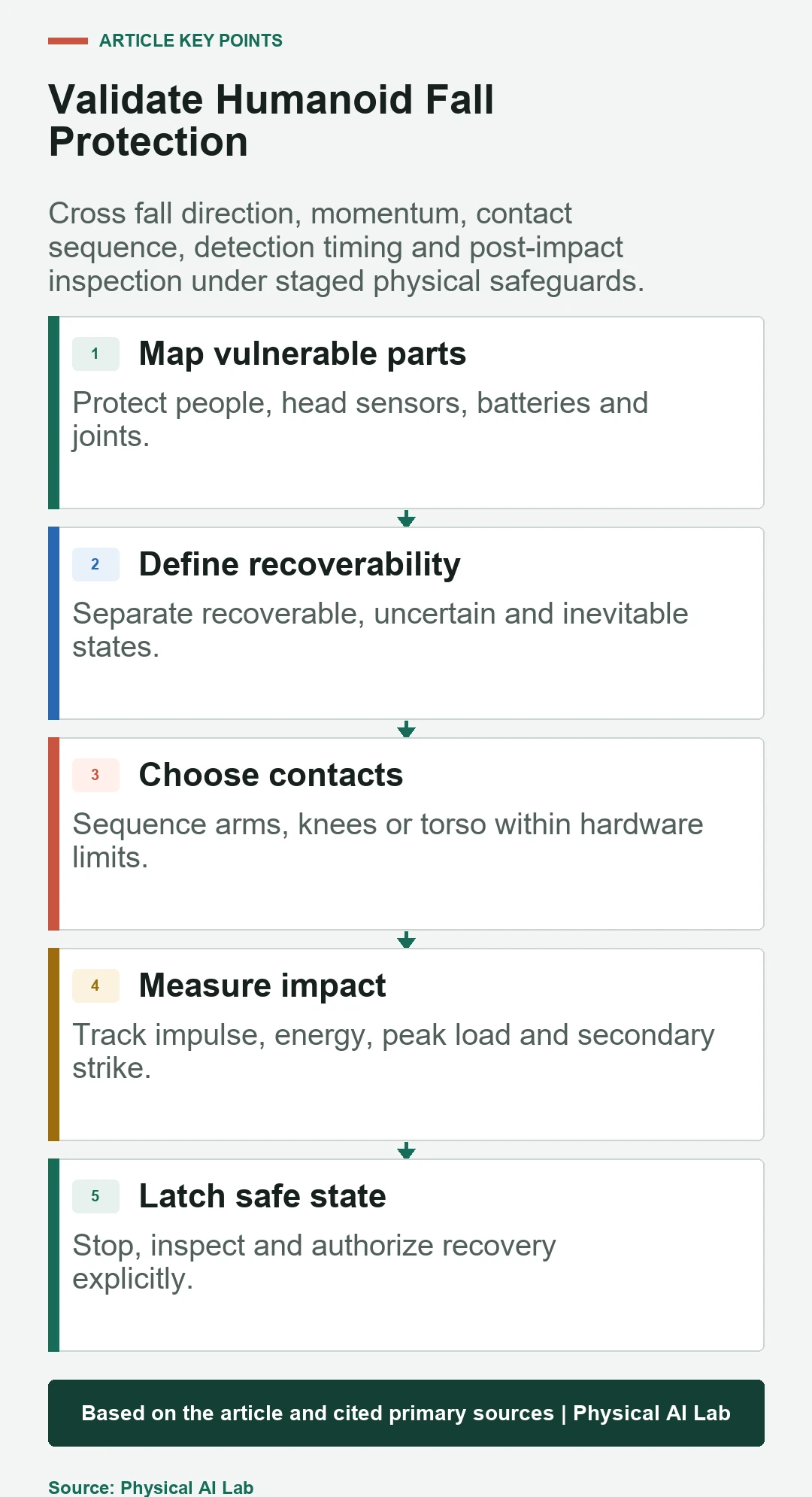
The system needs a recoverability estimate, a direction-aware protective policy, known allowable contacts and a post-impact state that remains latched until inspection. Impact must be judged across the complete contact sequence, not from one peak-force channel.
Use this guide with the humanoid balance guide and whole-body control guide. Start physical testing with restraint, empty surroundings and progressively increasing energy.
Detect loss of recoverability, not just body tilt
Useful evidence includes center-of-mass state, angular momentum, support geometry, contact forces, joint limits and reachable capture steps. The relevant question is whether any qualified recovery action can restore a viable stance within the remaining time and actuator margin.
Large tilt may be intentional, while a small fast velocity near the support edge can already be unrecoverable. Train or tune detection across normal dynamic motions so the protective mode is not triggered by every bend, jump or rapid reach.

Use recoverable, uncertain and inevitable states
A three-state interface prevents a brittle jump between normal control and full fall behavior. Recoverable permits balance or stepping actions. Uncertain reduces speed, expands margins or prepares protection. Inevitable commits to a protective trajectory and inhibits incompatible task commands.
Transitions need hysteresis, deadlines and a safe default when sensors disagree. Returning from inevitable to normal control should be prohibited once protective contacts or a power-state change have begun.
| State | Evidence | Allowed action | Exit condition |
|---|---|---|---|
| Recoverable | Feasible support or step | Balance and task control | Margin restored |
| Uncertain | Conflicting or degraded evidence | Slow, prepare, reobserve | Confidence resolves |
| Inevitable | No timely qualified recovery | Protective contacts | Post-impact latch |
| Impacted | Contact or shock detected | Dissipate and hold | Motion ceased |
| Inspection | Safe posture and isolated motion | Diagnostics only | Authorized reset |
Predict from motion and contact history
Orientation, angular velocity and base acceleration are useful, but contact loss and failed recovery commands often provide earlier context. Track how capture margin changes over time and whether the commanded foot or hand contact is actually becoming available.
Time-align IMU, joint, force and controller-state signals. A delayed predictor can label the direction correctly after the body has already passed the point where a safe protective pose is reachable.
Map vulnerable and allowable contact regions
Protect head sensors, batteries, sharp end effectors, high-value cameras and joints with small impact tolerance. Identify structural areas, padding or sacrificial covers designed to accept contact. Include cable routing and protrusions that can snag during a slide.
Human protection comes first. A robot should not swing a heavy arm toward a person merely to shield its own torso. Use environment perception and conservative exclusion zones when selecting contact direction.
Plan a sequence of protective contacts
A protective fall can distribute momentum through hands, forearms, knees, hip or torso, but each contact adds constraints and possible secondary impacts. The sequence must remain reachable under the actual fall direction and joint speed.
The multiple-contact fall planning project demonstrates research on damage-aware contact sequences. Hardware use still requires structural limits, compliant contact and staged validation on the deployed robot.
Treat forward, backward and lateral falls separately
A forward fall may permit arm contact if wrist and shoulder loads remain safe. Backward falls place head and spine-side hardware at risk and may offer fewer visible contacts. Lateral falls can concentrate load in shoulder, hip and side-mounted equipment.
Direction classification should include yaw and rotation, not only a four-way label. Test mixed and twisting falls because they can invalidate a protective pose optimized for a pure plane.
Measure impulse, energy and secondary impact
Peak force is important but incomplete. Record impulse, contact duration, joint torque, structural strain, head acceleration, rebound and residual motion. Energy reduced at the hand can reappear when the torso or battery enclosure strikes later.
Use synchronized high-rate sensors and video with calibrated timing. Define damage budgets for each vulnerable region and count every contact in the event, including sliding into an obstacle.
Integrate protection as a latched state machine
The protective controller must preempt task goals, navigation and manipulation without leaving conflicting integrators active. Define transitions for prepare, protect, impact, settle, power isolation and inspection. Log the event that caused every transition.
Coordinate brakes and torque control. Removing power instantly can eliminate useful damping, while maintaining torque after entrapment can create another hazard. The response must match the actuator and mechanical design.
Scope learned fall policies to verified conditions
Learning can explore many fall states in simulation and optimize contact timing, but simulated compliance, friction and damage cost are approximations. A policy may exploit contacts or joint loads that the real machine cannot tolerate.
The SafeFall project is a relevant research example. Preserve its reported robot, simulator, objective and evaluation scope rather than treating learned protective control as a general safety certification.
Balance false alarms against late detection
A false protective trigger can itself cause a fall, drop a payload or strike nearby equipment. Late detection can remove the time needed for protective positioning. Report both outcomes and the margin remaining at the decision point.
Cross intentional fast motions, uneven contacts, sensor noise and degraded state estimation in negative tests. Use confidence and time-to-impact measures instead of hiding tradeoffs in one accuracy score.
Stage physical tests by direction and energy
Begin with simulation and suspended low-energy motion, then use soft surfaces, controlled release rigs and progressively larger momentum. Keep personnel outside the fall envelope and use independent emergency isolation. Never rely on the policy under test as the only safeguard.
Connect the collision detection guide to post-impact monitoring. Inspect joints, fasteners, covers, batteries and sensors before increasing severity or commanding recovery.
| Test factor | Variation | Detection metric | Protection metric |
|---|---|---|---|
| Direction | Forward, rear, lateral, twist | Decision latency | Contact sequence |
| Momentum | Speed and height | Remaining time | Impulse and energy |
| Surface | Compliant, hard, sliding | False state rate | Secondary motion |
| Sensor | Delay, dropout, bias | Confidence behavior | Safe fallback |
| Environment | Clear, obstacle, human proxy | Contact choice | External hazard |
Release with a fall-protection contract
Document recoverability model, sensor inputs, decision deadlines, protected regions, allowable contacts, structural limits, human-priority rules, state transitions, impact metrics and inspection criteria. Keep raw synchronized logs for every fall event.
Close validation with the following checklist.
- Separate balance recovery from inevitable-fall protection.
- Map vulnerable, allowable and forbidden contact regions.
- Measure every contact and secondary collision.
- Test direction, momentum, sensor faults and false alarms.
- Latch a safe post-impact state until authorized inspection.
Frequently asked questions
Can an orientation threshold detect every humanoid fall?
No. Intentional motion can cross the threshold, while a fast low-angle state may already be unrecoverable.
Is reaching for the floor with the hands always safer?
No. Wrist, arm, shoulder, nearby people and subsequent torso impact determine whether hand contact reduces total harm.
Can a learned protective policy be tested without restraints?
Not initially. Use independent safeguards and staged energy increases until the physical envelope is established.
Should the robot stand up immediately after impact?
No. It should settle, isolate hazardous motion and pass structural, sensor and environment checks before an authorized recovery.
What defines successful fall protection?
Prioritize people, then measure vulnerable-part load, impulse, energy, secondary impact, damage and safe post-impact behavior.
Inevitable-Fall and Post-Impact Safe-State Boundary
Protective motion is an emergency state, not an extension of normal task control. Once committed, it must prioritize people, bounded contacts and a latched post-impact safe condition.