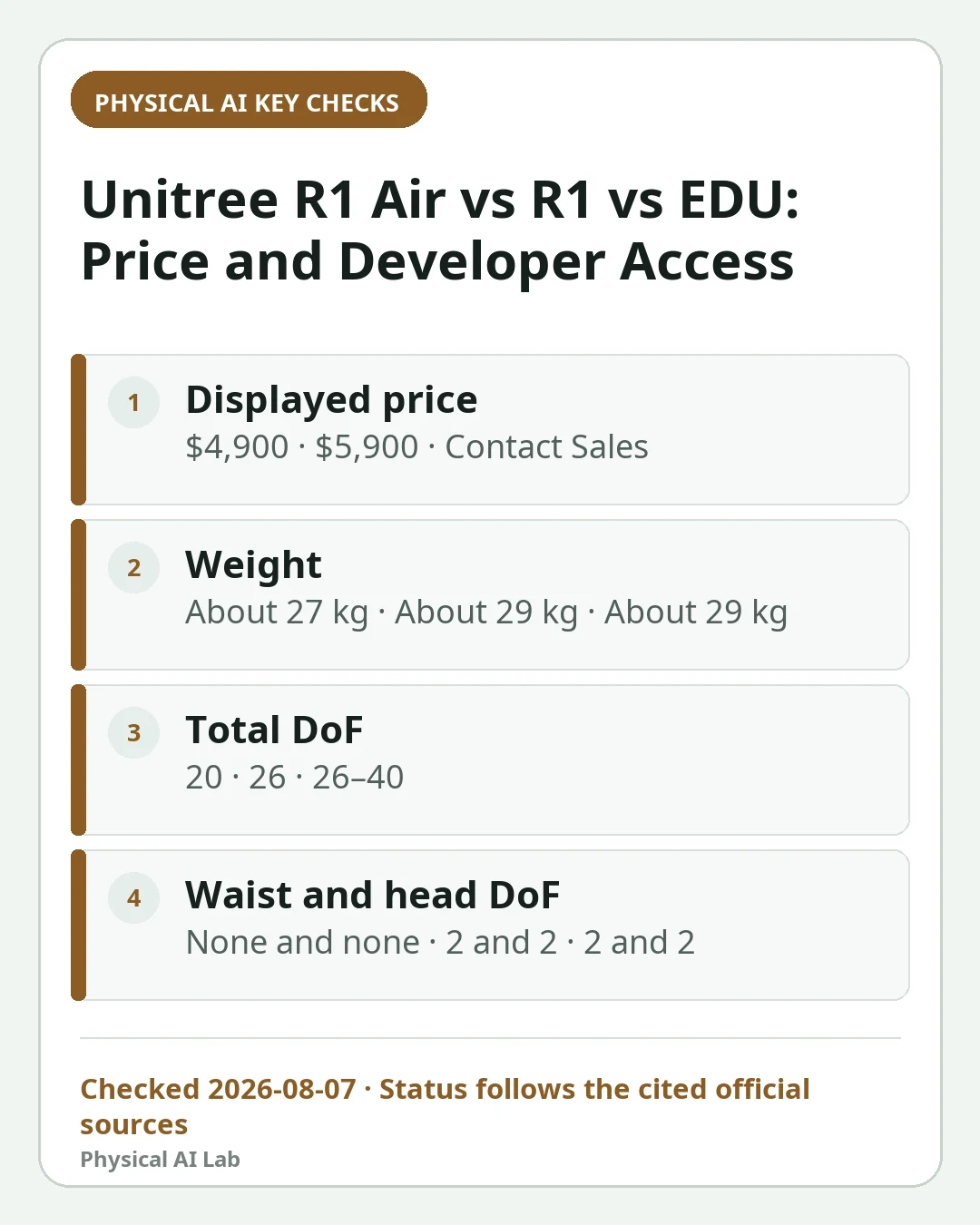
The decision turns on access, not just price. The official Unitree R1 matrix lists R1 Air at $4,900 and R1 at $5,900, while R1 EDU requires a sales quote. As checked on August 7, 2026, Air and R1 do not support secondary development; EDU does.
R1 Air combines 20 degrees of freedom, a monocular camera and about 27 kg. R1 moves to 26 DoF, binocular vision and about 29 kg. EDU spans 26–40 DoF and offers optional dexterous hands and high-compute modules. Place it against the wider Unitree humanoid range, estimate humanoid robot total cost and confirm the right humanoid robot type before requesting a quote.
Air is the entry configuration, R1 adds articulation, and EDU adds development
R1 Air has 20 total joints and omits waist and head degrees of freedom. R1 adds a two-DoF waist and two-DoF head for 26 total. EDU starts from that 26-DoF structure and can reach 40 depending on the configured options, including an optional dexterous hand.
The $1,000 difference between Air and R1 therefore buys more than a camera change; it changes the body and head articulation. If the project must deploy custom policies or sensors, however, the EDU access boundary matters before the DoF count.
| Item | R1 Air | R1 | R1 EDU |
|---|---|---|---|
| Displayed price | $4,900 | $5,900 | Contact Sales |
| Weight | About 27 kg | About 29 kg | About 29 kg |
| Total DoF | 20 | 26 | 26–40 |
| Waist and head DoF | None and none | 2 and 2 | 2 and 2 |
| Camera | Monocular | Binocular | Binocular |
| Secondary development | Not supported | Not supported | Supported |
The $4,900 and $5,900 prices exclude tax and freight
The product table explicitly excludes tax and shipping. The official Unitree R1 store page is a purchase route, but the listed chassis price still does not establish a delivered, cleared and supported system in every country.
A complete quote should identify the exact chassis, batteries, charger, controller, packaging, dangerous-goods handling, freight, insurance, duty, tax, customs fees, local compliance, training, spares and return-to-factory warranty cost. Price the EDU hand and compute module as named options.
| Cost layer | Evidence to request | Common omission |
|---|---|---|
| Chassis | Exact Air, R1 or EDU SKU | Whether demo features are included |
| Options | Hand, compute and sensors | Brackets, cables and licenses |
| Logistics | Freight, insurance, duties and tax | Battery dangerous-goods handling |
| Operations | Training, spares and warranty | Downtime during overseas repair |
The consumer configurations do not include secondary-development rights
The marketing copy refers broadly to open joint and sensor interfaces, but the SKU matrix directly marks Secondary Development as unavailable for Air and R1 and available for EDU. The exact configuration and contract should control the purchase decision over a general platform description.
The Unitree R1 SDK Development Guide confirms that a developer documentation path exists; it does not make every retail SKU a development license. Put SDK version, API layers, root access, simulator assets, sample code, safety limits and support term into the EDU quotation.

An EDU quote must pin DoF, hands and the compute-module SKU
The 26–40 DoF range does not mean every EDU ships with 40 DoF. Dexterous hands are optional, and the high-power compute row describes multiple available brands and models, such as Orin modules in a 40–100 TOPS range.
For a repeatable research platform, record actual joint count, finger and sensor configuration, compute SKU, memory, power mode, camera calibration, external ports, time synchronization, ROS interface and simulator version.
About one hour of battery life is not one hour of guaranteed research time
The matrix lists approximately one hour for all three versions. Motion intensity, fall recovery, an expansion computer, cameras, speech workloads, ambient temperature and battery age can reduce usable time.
Unitree warns that the humanoid has a complex structure and substantial power output and tells users to maintain a sufficient safety distance. Design the fall zone, emergency stop, support rig, floor loading, charging, battery exchange and supervision before the first experiment.
Keep R1-D outside the Air, R1 and EDU price ladder
R1 Air, R1 and R1 EDU belong to one walking-R1 comparison table. A separately named R1-D dual-arm platform should not be treated as a higher trim in that same ladder; its mobility, included arms, control boundary and target task require a separate quote and test.
Shortlist Air for basic motion access, R1 for waist, head and binocular vision without custom control, and EDU for integrating a policy, sensors or compute. Immediately before ordering, make sure the product matrix, store selection and contract use the same version name.
Frequently asked questions
Can I do secondary development on Unitree R1 Air?
The official matrix checked on August 7, 2026 marks R1 Air and R1 as not supporting secondary development. R1 EDU is the supported configuration, subject to its quoted SDK scope.
Is $5,900 the final delivered price for R1?
No. The official price excludes tax and shipping. Options, freight, insurance, duty, customs, training and overseas warranty transport can add to the landed cost.
Does every R1 EDU include 40 DoF and dexterous hands?
No. The matrix states a 26–40 DoF range and marks the dexterous hand as optional. The quote must name the exact joints, hand and compute module.
Official sources checked
- Unitree R1 official product and specification page
- Unitree official R1 store page
- Unitree R1 SDK Development Guide
2026-08-07