Figure Index robot training data: what human video can teach
Figure Index scales human video collection, but useful robot training data still depends on filtering, labels, embodiment signals, access and evaluation.
English articles about robot data and hardware at Physical AI Lab.
Figure Index scales human video collection, but useful robot training data still depends on filtering, labels, embodiment signals, access and evaluation.
An OAK StereoDepth zero is invalid or unknown depth. Diagnose texture, filtering, occlusion consistency and near-range geometry before changing modes.
Read XR-2’s 93% DAgger result against its own baseline, and separate demonstration hours, correction trajectories and documented dataset releases.
Check Robotiq ROS 2 distro and action compatibility, shipped models versus hardware validation, and tagged-release versus main-branch install requirements.
What Schaeffler’s formed strain-wave gearbox changes in manufacturing, what its supplier validation supports, and what remains planned for 2027.
Design and validate AMR Wi-Fi roaming with route-based RF surveys, handoff timing, ROS 2 QoS, traffic stress, monitoring and safe loss-of-link behavior.
Plan robot FAT and SAT with traceable requirements, factory evidence, shipment baselines, site integration, performance trials, punch lists and final handover.
Plan AMR tasks with SOC and SOH uncertainty, task energy models, recovery reserve, shared-charger queues, opportunity charging and disruption tests.
Compare robot SIL and HIL tests through loop boundaries, model fidelity, controller timing, fault injection, physical correlation and release evidence.
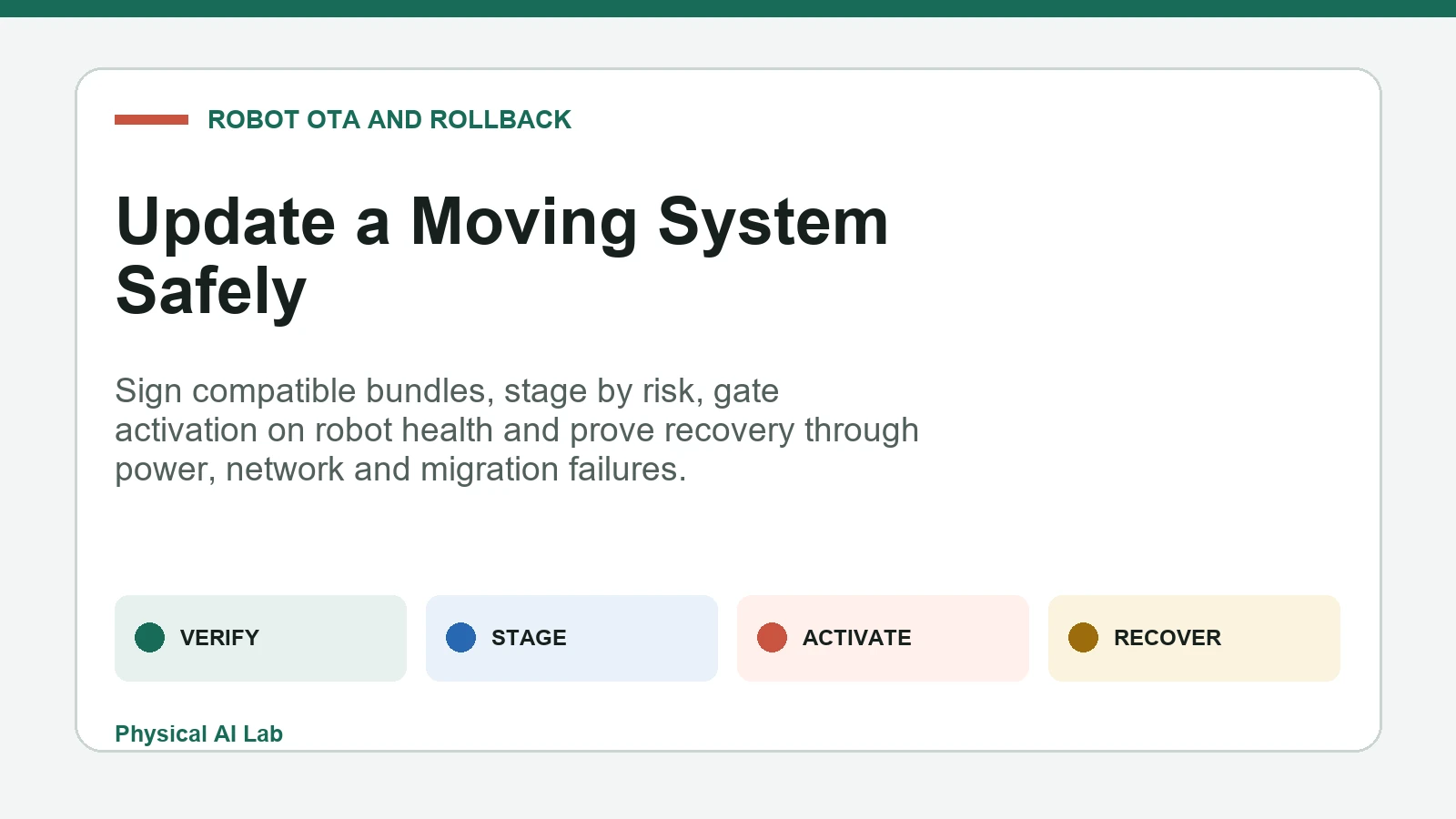
Design robot OTA updates with signed bundles, target checks, safe installation states, canary stages, health gates, A/B rollback, migration and recovery tests.